Wednesday, December 28, 2011

Brother Against Brother, Part 2


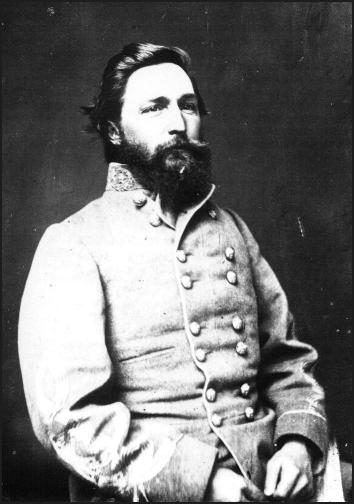
Confederate Brigadier General James B. Terrill


Federal Brigadier General William R. Terrill

       Two more brothers who served as general's during the Civil War on opposite sides were James and William Terrill. Unlike the McIntosh brothers, both of the Terrill brothers would die fighting during the war. William was born in 1834 and obtained an appointment to the United States Military Academy. He would rise to the rank of brigadier general and be mortally wounded by artillery fire at the Battle of Perryville. His younger brother James was born in 1838 and attended the Virginia Military Institute. Unlike William, he didn't make the military his career, but instead became an attorney. When the war began, James and another brother named Phillip joined the Confederate army. Phillip was a private and was killed at the Battle of Cedar Creek. James who rose to the rank of brigadier general was killed at Bethesda Church by a Federal sharpshooter. He was buried by the Federals on the field and his grave has been lost to history.
        After the war, their father erected a monument to the memory of the Terrill brothers which read, 'This monument erected by their father. God alone knows which was right.'


Confederate Major General George B. Crittenden


Federal Major General Thomas L. Crittenden

       George Crittenden was born in 1812 and his younger brother Thomas was born in 1819. George graduated from the United States Military Academy and became a career soldier. He saw action in the Black Hawk War and Mexican War. The Crittenden family were close friends with the Davis family, both from Kentucky. George decided to join the Confederate army under his close friend Jefferson Davis. He commanded the troops at Mill Springs during the defeat there. Rumors soon circulated that he had been intoxicated while on duty. A courts-martial was convened and Crittenden was cashiered from the army. Thomas became a lawyer and joined the army to fight during the Mexican War. He rejoined the army when the Civil War began and rose to the rank of major general before resigning in 1864. 


Confederate Brigadier General John R. Cooke


Federal Brigadier General Phillip St. George Cooke

       In an even rarer incident, there were a pair of general's who fought on opposite sides who were father against son. Virginia born Federal cavalry commander Phillip Cooke remained loyal to the Union when the Civil War began. His Harvard educated son John Rogers Cooke would resign his commission and enter the Confederate army. John's sister Flora Cooke had married a Virginian named James Ewell Brown Stuart, otherwise known as Jeb. When the war began Stuart would see action on the Peninsula in Virginia against his father-in-law Phillip. Stuart once said that his father-in-law would regret his decision for fighting against his home state but once and that would be eternally. 
       Bother Cooke's would survive the war, but Stuart would be mortally wounded at Yellow Tavern in 1864. The senior Cooke would outlive his son by four years dying in 1895. These are just a few of the many close relatives in the officer ranks during the war. There were many cousins who fought against each other in that war also. Abraham Buford and John Buford, both served in the cavalry service. Robert E. Lee's second cousin was Samuel P. Lee who was a rear admiral in the United States Navy and in charge of the North Atlantic Blockading Squadron.  There were probably few families who weren't affected by relatives fighting relatives during the Civil War. 


Sunday, December 25, 2011

Brother Against Brother, Part 1


Confederate Brigadier General James M. McIntosh

       Most everyone has heard stories about the Civil War being a war where brothers often fought one another. Few realize that this also occurred among the generals who fought. James McQueen McIntosh was born in 1828 in Florida while his father was stationed there in the U.S. Army. A year later, while still at that post James little brother John Baillie McIntosh would be born. Their father would be killed during the Mexican War. 
       James would miss the Mexican War while attending West Point. There he proved to be a very poor student. He cared very little for the classroom and like fellow Confederate General George Pickett, he would finish dead last in his class. His brother John wouldn't attend West Point, but served in the Navy as a midshipman during the Mexican War. 


Union Brigadier General John B. McIntosh

       When the Civil War began, James resigned his commission and became colonel of the Second Arkansas Mounted Rifles. He saw action at Wilson's Creek where he proved to be a daring cavalry commander. He was famous for his fearlessness in battle and his colorful language. Leading his men in desperate charges would prove his undoing. 
       He would receive a promotion to brigadier general for his actions in routing a numerically superior force. His first major battle following that promotion would prove to be his last. At the Battle of Pea Ridge after seeing his friend and commander Benjamin McCulloch killed. He charged forward in an attempt to recover the mans body and be shot through the heart. They would carry the high-strung officer back to the National Cemetery in Fort Smith, Arkansas where he rests today. James McIntosh was either 33 or 34 years old. His exact birth date has been lost to history. 


McCulloch and McIntosh were both killed in the treeline across the field

       When the war began, James's brother John was working in business in New Jersey. Like James, John would spend the war serving in the cavalry. He was with McClellan's army during the Seven Days. He served well during the  Battle of Chancellorsville. He led an attack against J.E.B. Stuart's cavalry at Gettysburg. His next action would be over a year later at the Battle of Winchester where he would lose a leg. 
       Following the war, John would return to New Jersey and die there in 1888 at the age of 59. He is buried in Elmwood Cemetery, New Brunswick, New Jersey. It makes you wonder how two brothers so close in age could ever consider fighting a war on opposite sides. 


James grave in Arkansas


John's grave in New Jersey


Thursday, December 1, 2011

The Jennie Wade Story by Cindy L. Small


The Jennie Wade Story by Cindy L. Small claims to be a true account of the only civilian killed during the Battle of Gettysburg.  Although attempts were made to smear her reputation by the famous John Burns,Cindy Small manages to dig up all known evidence and set the record straight.  When you finish this book you will understand that Jennie Wade was indeed baking bread for Union soldiers when she was killed.  Contrary to the way John Burns described Jennie Wade as a lady of loose character.  In truth John Burns attempted to smear Jennie's reputation because he despised having to share his fame with anyone else.  


Although the book is only 71 pages long Mrs. Small does an excellent job covering everything that is known about Jennie's life.  She stops just short of a forensic investigation, describing where the bullet was thought to have come from and the path the bullet took as it struck her in the back after passing through two doors.  The bullet was ranging upwards, passed through her heart and spent its force stopping inside her corset.  All eyewitness accounts claim that Jennie died making bread for union soldiers.  Cindy Small says that Jennie was buried with the dough still on her hands.  


Actual dough tray Jennie was using

Cindy Small goes into the details of Jennie's fiance Jack Skelly, the message he gave to Wesley Culp when he was mortally wounded in Virginia.  Wesley Culp went to school with Jennie and Jack, born and raised in Gettysburg, he had moved to Virginia prior to the war and remained loyal to the South.  Wesley would be killed on his cousins farm before he could deliver any message.  The amazing part of this story is that none of the three childhood friends knew the fate of their classmates.  Cindy Small's book lists for less than six dollars but it is worth every penny.  

Monday, November 14, 2011

A Crisis In Confederate Command


General Edmund Kirby Smith
 On a recent Civil Wargasam my wife bought me the book, The Red River Campaign, edited by Savas, Woodbury, and Joiner.  Reading this small book of only 130 pages reminded me of another book I have read on the subject.  A few years ago I read, A Crisis In Confederate Command by Jeffery Prushankin.  This book went into the disagreement between Confederate General Edwin Kirby Smith and Major General Richard Taylor.  

 The disagreement between Smith and Taylor had more to do with strategy than anything.  Richard Taylor had commanded a Louisiana brigade during the early part of the war under Stonewall Jackson in Virginia.  He had studied closely what Stonewall had accomplished.  He was extremely aggressive like Stonewall and believed that once you had your enemy against the ropes you went in for the kill.  

Major General Richard Taylor

Edmond Kirby Smith was the total opposite of Richard Taylor.  Kirby Smith's generalship has been compared to that of Joseph E. Johnston.  Instead, Kirby Smith's idea on strategy closely resembled that of Confederate President Jefferson Davis.  Smith believed in spreading his forces out and defending every foot of his military district.  Richard Taylor believed in concentrating his forces and hitting a small part of the enemy at a time.  

When Federal Major General Nathaniel Banks began his campaign up the Red River, Richard Taylor only had 6,000 men present.  Banks army numbered 28,000 men.  Taylor was forced to retreat because he didn't have enough troops to stop Banks.  Taylor begged Smith to reinforce him with troops from Arkansas.  Smith was worried about Federal General Steele's forces in Arkansas and was afraid to commit too many men.  He finally reinforced Taylor with 1,800 men, bringing his total to 8,800 men.  In true Stonewall Jackson fashion, Richard Taylor caught Banks army strung out on the road and hit him at a place called Mansfield.  Although his attack was disjointed, he managed to defeat Banks.  At a high cost in officers, Taylor lost 1000 men while Banks lost 2,235 men.  For Banks, the Red River Campaign  was over.  He immediately began to retreat.  

They would fight again the next day  at Pleasant Hill in an indecisive battle.  Banks army then escaped unmolested.  Taylor blamed General Edmond Kirby Smith for not reinforcing him with enough troops to destroy Banks.  Taylor was awarded with a promotion to lieutenant general for his actions in the campaign.  Unfortunately, he had lost Brigadier General Alfred Mouton, Brigadier General Thomas Green, Brigadier General William R. Scurry, and Horace Randall.

Brigadier General Thomas Green

Brigadier General Alfred Mouton


Colonel Horace Randall

Brigadier General William R. Scurry

I have always wondered what these two men could have accomplished if they had worked together instead of bickering with each other more than they did the enemy.  For more on the subject I recommend reading Prushankins A Crisis in Confederate Command.  


Tuesday, October 4, 2011

The Rashness of That Hour by Robert Wynstra


Book focuses on Iverson's actions at Gettysburg

       I've just finished reading The Rashness of That Hour by Robert Wynstra and found it to be an excellent addition to my library. The book begins with the history of General Iverson and his brigade. It is quite interesting to note that the morale of the brigade had been suffering from an internal power struggle. Governor Vance of North Carolina didn't improve things when he protested that a Georgia officer had been promoted to lead troops from his state. As I read the book, I almost began to feel sorry for Alfred Iverson.
       The further into the book I got, I soon switched back to thinking the man brought most of his suffering on himself. The more I read, the more the man reminded me of another general named Braxton Bragg. Once Iverson made an enemy, he immediately did everything in his power to rid himself of the man, no matter how useful that man might have been to the efficiency of his brigade. 


Brigadier General Afred Iverson, Jr.

       By the time I read about Iverson in battle, I had the opinion the man might have had a streak of cowardice. He was far to the rear at Chancellorsville and in his official report claimed to have been rallying another brigade's troops. His job should have been to supervise his own men in battle. At Gettysburg, he again remained in the rear, sending his men across a field against Federal infantry posted behind a stone wall. He didn't have skirmishers posted to the front, simply telling his men to advance and give them hell. They were within eighty yards of the stone wall before they knew there were Federals anywhere near them. Out of his 1400 man brigade, 900 became casualty's in a matter of minutes. They were trapped on the field in a gully under relenting fire. 


This gully would later come to be known as Iverson's Pits. 
It provided no shelter for the men trapped there.

       Iverson in his report failed to mention the brave action of his men, yet blamed them for surrendering when the Federals advanced into the gully and captured most of the survivors. Following the battle, Iverson was eventually sent back home to Georgia where he commanded a brigade of cavalry under Wheeler. He attempted to stop Sherman's invasion of the state and his brigade was credited with capturing Union General George Stoneman's raiders. They planned to ride deep into Georgia and free the prisoners at Andersonville. With a force of only six-hundred men, Iverson's brigade managed to capture Stoneman and his troops. I had always read about Iverson redeeming himself over the fiasco at Gettysburg by this daring feat in Georgia. However, to my shock, Wynstra reports that again Iverson was far in the rear of his command. The actual credit for the capture belongs to Colonel Crews who was present and leading the brigade. 


George Stoneman captured by Iverson's brigade, but not Iverson

       The book is a great read and serves as not only a biography of Alfred Iverson, but also to his North Carolina brigade. Iverson survived the war, one wants to say "of course" here and died of old age in 1911 at the age of 82. He rests in Atlanta's famous Oakland Cemetery. Wynstra does go into a good bit of detail about the commanders of every unit involved in the fighting around Gettysburg if you enjoy that type thing. I'm not one of those people. I can't remember any of the captains names, especially when he lists the commanders of each artillery unit on the field at the time. Other than that, I found it a very interesting book that I found difficult to stop reading. 


Iverson sometime around 1900

       The men of Iverson's North Carolina brigade never forgave their general. Forty years after the battle, Captain Turner of Iverson's command wrote, "Unwarned, unled as a brigade, went forward Iverson's deserted band to its doom. Deep and long must the desolate homes and orphan children of North Carolina rue the rashness of that hour." These are the most appropriate last sentences of Wynstra's book.


Me at the grave of Iverson August, 2011.


Tuesday, September 20, 2011

The Other Virginia: CSS Virginia II


CSS Virginia II

       Everyone remotely interested in the American Civil War has some understanding about the USS Monitor and the CSS Virginia (formerly USS Merrimack). A lot less have heard of the Confederate Ironclad called the CSS Virginia II. Construction on this ship which was classified as an ironclad-ram, began in the spring of 1862 in Richmond, Virginia. Thirty-thousand dollars was raised by the Richmond chapter of the "Ladies Aid and Defense Society". Although, such a large portion of money was raised by women, the Virginia II never acquired the nickname that was given to the CSS Palmetto State in Charleston Harbor. Money for the Palmetto State was raised by the women of Charleston and therefore it was called the "Ladies Gunboat". 


CSS Virginia II blueprints

       The sleek warship was finally ready for launch after a year of construction. It slid into the water in June of 1863 among prolonged cheers. Sadly, because of shortages, she wouldn't be battle ready until the spring of 1864. She would see her first major action at Trent's Reach in January of 1865. The Confederate intentions at Trent's Reach was to break through the Federal Navy and attack City Point, Virginia, General Grant's supply depot for the Army of the Potomac. 


USS Onondaga

       Despite two days of bitter fighting, the Confederate fleet, which consisted of the CSS Virginia II, CSS Fredericksburg, and the CSS Richmond were forced to withdraw. The Federal Navy had one ironclad available called the USS Onondaga accompanied by several gunboats. The Onondaga had withdrawn downriver, the captain afraid to engage the three Confederate ironclads alone. The next day, General Grant ordered the Onondaga back upstream with the gunboats to attack the Confederate flotilla. 
       During the night, at ebb tide, the Virginia II and the Richmond became grounded. The Onondaga arrived and opened fire on the two grounded ships, neither of which could return fire because of they're position. Just as the Onondaga began to close with the two ironclads, the tide rose enough for them to float free. After a brief engagement, the Confederate ironclads retreated upriver while the Onondaga returned downstream toward City Point. 
       The Onondaga had been hit once by the Virginia II which seemed to cause some damage. The Onondaga had hit the Virginia II seven times without much effect, but the Virginia II had been hit by cannon fire over seventy times from the Federal forts ashore and was in bad shape. Her engine was leaking steam and it became obvious she couldn't re-engage the Federal navy without repairs. The Confederate ships had fired almost fifteen-hundred rounds during the two days of action. 


Riddled smokestack of the Virginia II

       Two months after the battle, all three Confederate ironclads were scuttled to prevent capture as General Lee evacuated Richmond and Petersburg. The Virginia II was supposed to be as formidable as her namesake the Virginia. She carried 150 officers and men and was supposed to obtain a speed of ten knots, the fastest of the Confederate built ironclads. The ship carried three 7" Brooke rifles and one 10" Brooke smoothbore. Her weakness was in her armor plating. Originally intended to carry 6" of iron as a shield, because of shortages, she carried 5" on her sides and stern. She was a sleek ship with armor at various angles. Had she been employed earlier in the war, she may have made a diffference. The CSS Virginia II rests today under the twenty feet under the silt opposite from Drury's Bluff. 

Wednesday, September 14, 2011

Alfred Holt Colquitt: A man of many talents


Alfred Holt Colquitt before his 1862 promotion

       Alfred Holt Colquitt became many things during his sixty-nine years on this earth. He was born in Georgia in 1824, the son of a United States Senator. Young Alfred graduated from Princeton and became a lawyer. He served in the United States Army during the Mexican War being commissioned a major. Returning from the Mexican War, Colquitt began to dabble in politics becoming a United States Congressman and serving in the Georgia State Legislature.
       When the Civil War began, Colquitt became a captain in the 6th Georgia Infantry. By the time the regiment saw action at Seven Pines, Colquitt had become colonel. He led the regiment throughout the Seven Days and was promoted to brigadier general before Lee's army invaded Maryland. He would command a brigade at Antietam, Fredericksburg, and Chancellorsville. His brigade was so under-strength following the latter battle that General Lee sent Colquitt and his men back to Georgia to recruit. 
       

Colquitt sometime after his promotion in 1862

       Colquitt and his brigade would next see action in Florida. They were sent there and placed under the command of Brigadier General Joseph Finegan. They were sent there to stop and invasion of 5,000 men under Federal Brigadier General Truman Seymour. Against orders, the Federal general began his invasion meeting Colquitt and Finegan at the Battle of Olustee. Both forces were about equal, but the Federal army lost over 2000 men, while the Confederate's lost less than a thousand. It was one of Colquitt's best days as a commander. Not only had they stopped the invasion, but had defeated the famed 54th Massachusetts Colored Infantry.
       During the Siege of Petersburg, Colquitt's brigade would again be sent to Virginia to serve under General Lee. Despite having seen some of the war's fiercest fighting, especially at Antietam, Colquitt came through the war without a scratch. He returned to Georgia and eventually became governor of the state for two terms and was elected to two terms in the United States Senate. He would die while serving there. 


Colquitt in his later years

       During the Civil War, he was called a competent and inspiring commander. He suffered a stroke in 1893 and was paralyzed on one side of his body for the last six months of his life. Unable to speak, he suffered another stroke on March 26, 1894 and died. He rests today in Rose Hill Cemetery, Macon, Georgia. He'd accomplished a lot in his life, fighting in two wars, serving in both houses of congress, the Georgia legislature, a lawyer, governor and at one point in his life he became a preacher. 


Colquitt's grave