Showing posts with label 35th alabama infantry. Show all posts

Tuesday, October 21, 2014

My Next Book Idea: Company B, 35th Alabama Infantry: The LaGrange Cadets


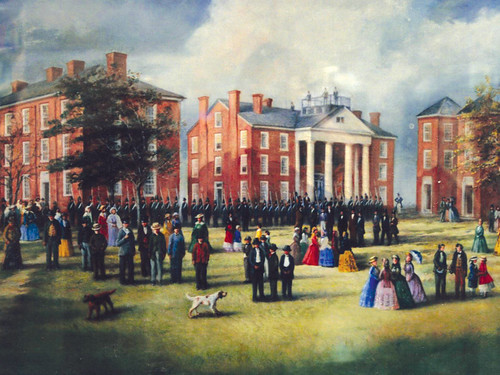
LaGrange College

       I recently got the idea of writing a book about Company B, 35th Alabama Infantry which was organized out of the younger LaGrange Military Academy Cadets. The older cadets had left as soon as the war began to join other units. So far I have counted 114 members of Company B. Of those 36 were cadets, the superintendent of the college became the captain, and the fifer was a slave that was owned by the college. One was a student of 16 years old, one was a saddle maker, one a plasterer, one a steam boat pilot, and the rest were farmers.
       This regiment first saw action at the Battle of Corinth where they were severely cut up on the first day along the railroad a mile west of town. The next day they were engaged near Battery Robinette alongside the 2nd Texas Infantry. They were engaged at Baton Rouge, Champion's Hill, and saw action during the Vicksburg Campaign. During the Atlanta Campaign they heroically charged the enemy at Peachtree Creek and engaged a Federal regiment in hand to hand combat. They fought at Decatur, lost heavily at Franklin, Nashville, and then Bentonville.
       

Rick Reeves Print of Company B Charging at Peachtree Creek

       The records are far from complete making research very difficult, but I have learned a great deal about this company. The roster shows only 8 of the 114 to be killed in action which is a very low number for the severe action they saw. It shows 25 wounded, 14 captured, 11 deserted, 16 died of unknown causes, 5 were transferred, and 2 discharged. This would make the total of 81 casualties out of 114. This we know is inaccurate because of a letter written by Corporal Joseph Nicholas Thompson that stated there were 24 present at Decatur and the unit suffered 22 casualties in the battle. They moved on to Nashville with 6 men, the 2 not wounded and the 4 slightly wounded but able to remain in the ranks. One of these men was wounded at Nashville and 3 were captured. 
       This was truly a tragic company with many sad stories to tell. Not to give away too much of the book I will give a few brief examples. Dee Green was the color bearer in the painting above by Rick Reeves. He was shot in the knee during the action and lost his leg. He had married Bob Wheeler's sister shortly before this battle. Bob was immediately elected to carry the colors now that his brother-in-law was disabled. Bob went to Franklin and was killed. Bob's father and Dee traveled to Franklin following the war and brought Bob and the other members of Company B back to Tuscumbia and buried them in Oakwood Cemetery. Can you imagine going and retrieving the body of your son in a wagon and bringing it home over a hundred miles.
       Sam Stewart was the captain of Company B at Franklin and was killed at the age of 23. He rests in the Confederate Cemetery there today. I have a grandfather and uncle on my dad's side that was in the regiment. The uncle died in service of unknown causes. I have a uncle on my mom's side that deserted to the Federal army and was ordered to remain north of the Ohio River. I thought it a horrible thing that he deserted his country, but then I learned he had a club foot. I can't imagine a man with a club foot serving in an infantry regiment. One volunteer that served was 14 year old Felix Sherrod. One soldier died of chronic diarrhea and sadly he had a brother too young to fight that died of disease while at home. The stories go on and on and hopefully I can do a descent job bringing their memories back to life.

Thursday, February 23, 2012

Hundred and Fifty Year Old Murder Solved?


LaGrange College a few years before the murders

       Two days ago, my buddy Lanny Perry came by the house to share some 35th Alabama Infantry information with me. My G-G-G Grandfather served in Company B, 35th Alabama Infantry which was organized at Lagrange College in March, 1862. Lanny gave me a copy of a map which was drawn in 1944 which showed where the houses and buildings were located prior to the Civil War. This map had numerous little details about the town of LaGrange. The place is still called LaGrange, but it's a ghost town now. Over ninety percent of what was the town is now forest and over half of that belongs to a deer hunting club. 
       One piece of information on the map immediately piqued my interest. According to the map, there was a house beside the cemetery owned by a Captain DeLoney, one of the professors at the college. The map says this is "where the pillar double murder occurred." This immediately set me off on a wild goose chase hoping to find anything I could on the murder. Soon I had my wife involved. We searched every possible thing we could on the internet. The only thing we were able to find was a reference to the DeLoney House where two Pillar brothers were murdered, the killers never caught, but possibly murdered by two brothers. It was mentioned the brothers were robbed and it was the most diabolical murder this area had ever witnessed. 
       At this point I decided to visit the library to see what I could find, but first I just had to visit the place and see if I could find just exactly where the Donley House had once stood. During my wife's lunch break, my four year old son and I met her at the cemetery to do a little prowling. According to the map, the Donley House stood just a few yards south of the cemetery. We explored the forest around the cemetery, but there was simply nothing left here. I did notice that the area had no really old trees, which shows that it had been cleared land in the past. There was nothing left to show the exact spot where this Captain DeLoney lived. Even the foundation was gone. 


Captain Donley's House would have stood to the right of the picture

       Leaving the murder scene, I would spend the rest of the afternoon in Helen Keller Public Library in Tuscumbia. After several hours of digging through everything I could find in the archives room, I was about to give up and head home. I was putting a book back I had been studying when I saw a book on the history of LaGrange College. This book had two paragraphs that referenced the "diabolical" murders that occurred at Captain Donley's home. The thing that caught my attention was the fact that Captain Donley had sold the house to a Mr. Vinson after the war and moved on to Texas. He had no reason to stay, Federal troops under Colonel Cornyn had burned the college to the ground during the war. This told me the murders had occurred after the war. 
       I left the library headed home determined to give the internet one last try with the new information I had obtained. By searching a double murder at LaGrange at the Vinson House instead of the Donley House I got a break in the case. It seems that twenty-five year old Granville A. Pillow had married the daughter of this Mr. Vinson and had lived here since the war. His twenty-one year old brother William C. Pillow had just moved to LaGrange. Both men were from Maury County, Tennessee. Granville had served as a Sergeant, Company H, First Tennessee Infantry, C.S.A. during the war for one year. It appears he went from that unit to Nineteenth Tennessee Cavalry where he fought under Forrest and was wounded during the Streight Raid. William C. Pillow had served with Company G, Ninth Tennessee Cavalry. 
       Here is the story I've gathered. Granville Pillow was alone at the home of his father-in-law, Mr. Vinson. Two intruders entered the home, shot and robbed him, leaving him for dead. The poor man was able to get to his feet and walk to the home of a Mr. Horn. Granville told Mr. Horn that Hugh Phillips and Granville Spangler had shot him. Horn then left the house to find a doctor leaving Granville Pillow there with his family. Hurrying down the road, Horn ran into two disguised men who asked him where he was going in such haste. Horn told the two men about Pillow. The two men asked Horn if Pillow had mentioned the names of the men who had shot him. Horn answered that he had. Not only had Granville Pillow told Horn the name of his attackers, he had also written them down on a piece of paper. 
       Horn thinking nothing about the situation hurried on to find a doctor. The two men headed back to Horn's home and forced the family outside. They destroyed the paper that Pillow had written their names on and again shot Pillow in the chest killing him instantly. 
       That night, the body of Granville Pillow's younger brother William Cheatham Pillow was found shot numerous times, thrown into a sink hole with a bridle tied around his neck. It is believed that he arrived at the Vinson Home as his brother was being murdered and raced into the woods to escape. The two men then gave chase leaving Granville still alive to catch his brother. Somewhere in the forest William was caught and killed. The killers probably returned to make sure Granville was dead to find he was gone. Headed down the mountain is when they happened up on Mr. Horn searching for a doctor. 
       Hugh Phillips was engaged to be married and that night confided to his girlfriend that he and Spangler had committed the murders. Phillips claimed they had be influenced by the people of the community to commit this horrible crime. The next day she told on the two men. Both fled the area immediately.
       Both of the Pillow boys were returned to Columbia, Tennessee where they rest today in Rose Hill Cemetery. I also found that both boys were nephews of Confederate Brigadier General Gideon Johnston Pillow. As far as I have learned so far, their killers were never brought to justice. I did find a bit of data that suggested that Granville Spangler returned to the area and was living near LaGrange when he died in the 1890's. 


Graves of the Pillow Family

       There were two theories about why Granville Pillow was murdered. He leased out his farm in Leighton and one rumor stated that he had eight-hundred dollars in his pocket at the time of his death. Another rumor began that Federal's had killed him because he was a past Confederate soldier, though I believe this is highly unlikely. Both the murderers had served in the Confederate Army also. It may be something as simple as theft or there may be something more sinister. We may never know, but I am excited to learn as much as I have about a small notation on an old map.