Showing posts with label Atlanta. Show all posts

Thursday, May 28, 2020

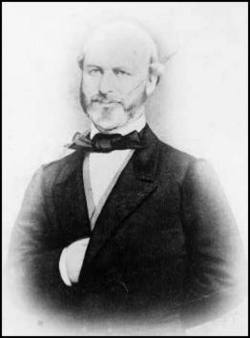
Clement Hoffman Stevens: "Rock"

Clement Hoffman Stevens (1821-1864) - Find A Grave Memorial

A Pre-War photograph of Clement Hoffman "Rock" Stevens

       Clement Hoffman Stevens was born in 1821 in Norwich, Connecticut. His father (a Southerner by birth) was serving in the United States Navy at the time. While a child, Stevens family moved to Florida. When the Seminole War began the family moved to Pendleton, South Carolina (his mother's place of origin) for a safer environment. Like his father, Stevens also joined the Navy and served under two officers that were relatives of his. He married the sister of future Confederate generals Barnard E. Bee and Hamilton P. Bee. 
       Stevens didn't remain in the Navy long before entering the banking business in Charleston, South Carolina. When the Civil War began, Stevens dove into military studies and became an expert on Civil War ordnance. He was already a colonel in the South Carolina Militia when the war began. Stevens built a battery in Charleston Harbor using railroad iron to protect his gunners. He then traveled with his brother-in-law Brigadier General Barnard E. Bee to Virginia where he served as a staff officer during the Battle of Manassas. His brother-in-law was killed during the fighting there while Stevens was seriously wounded. 
       He returned to Charleston and took command of a militia regiment. He and Ellison Capers raised the 24th South Carolina Infantry. Stevens would become their colonel and Ellison Capers was made his lieutenant colonel. Both men would become general officers by the end of the war. He led the regiment in the Battle of Secessionville where he stopped the Federal attack. He remained on the east coast for the next year. During the spring of 1863, his regiment was assigned to Brigadier General States Rights Gist's brigade and sent to Jackson, Mississippi to assist Joseph Johnston's army relieve besieged Vicksburg. Johnston failed to move in time to assist Pemberton and soon Vicksburg was forced to surrender. Gist's brigade was then sent to the Army of Tennessee and fought at the Battle of Chickamauga. A funny incident occurred before the battle. While the battle raged the first day, Gist's brigade was stranded in Rome, Georgia because a railroad engineer was sleeping. Stevens was so angry that he threatened to shoot the man. Stevens had two of his men fire the boilers of the locomotive and forced the engineer to drive them to the battlefield at gunpoint. 
       At Chickamauga, he was severely wounded again and had two horses killed beneath him. His division commander William H.T. Walker called him "iron-willed" and recommended him for promotion for his gallantry as a leader in combat. Colonel Clement Hoffman Stevens became Brigadier General Stevens in January of 1864. He was given command of W.H.T. Walker's old brigade when its new commander Brigadier General Claudius C. Wilson died of fever. His brigade participated in the Atlanta Campaign but saw limited action. General Stevens earned the nickname "Rock" at this time from his troops for his steadiness under fire. Stevens was upset at the replacement of Joseph E. Johnston before the engagements around Atlanta.
       In the first battle for Atlanta at Peachtree Creek, Stevens was leading his brigade on horseback in a charge against Federal breastworks. Sources conflict each other about whether he was hit by a bullet or artillery fire. Either way, he was struck in the head by a projectile that fractured his skull behind his jaw. While being carried from the field by two officers, they were also shot. Stevens was carried to Macon, Georgia where surgeons removed what they called a bullet and bits of bone. General Stevens died on July 25, 1864. He rests today in St. Paul's Episcopal Cemetery in Pendleton, South Carolina along with his brother-in-law General Barnard E. Bee. General Stevens was 42 years old. His wife Ann had died two years earlier and he left behind two sons. 
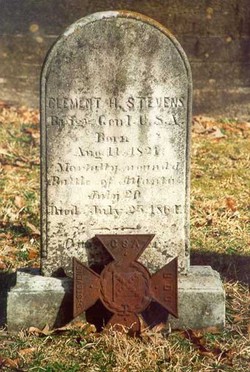
Picture of

Grave of General Stevens

Saturday, March 5, 2011

The Day Dixie Died: The Battle of Atlanta


       I just finished reading The Day Dixie Died by Gary Ecelbarger. This is probably the only book devoted entirely to the July 22, 1864 Battle of Atlanta. It begins talking about the upcoming United States presidential election. If the Union armies didn't show some success somewhere there was a very good possibility that Lincoln would have lost the election and the South may have gained its independence. 
       I enjoyed the first few chapters immensely. Mr. Ecelbarger briefly discusses the Confederate change of commanders with John Bell Hood taking command of the Army of Tennessee. He then jumps right into Hood's plan for the coming battle. Hardee asked Hood to adjust the point of attack so he could get his men in position in time for the assault. (Ironically, Hardee would be about five hours late after Hood agreed to the change.) 


Lieutenant General William J. Hardee

       I had read somewhere that Cleburne made the slowest march of his career the night prior to the Battle of Atlanta. The author (I can't remember the source) stated that Cleburne was overrated as a Confederate general and historians had covered up his mistakes at Atlanta. Mr. Ecelbarger does an excellent job explaining the problem with the night march. 


Major General Patrick R. Cleburne

       Cleburne's division had fought hard the day before the battle just east of Atlanta. He reported that it was the hardest fighting his division had seen during the entire war and his division had seen plenty of action. He was then forced to wait for Hardee's entire corps pass by the rear of his division before withdrawing his men from the enemy in his front. He then had to march in the rear of the rest of the corps which stalled quite often. I can see no fault in General Cleburne's performance at Atlanta. 
       Once you get to the actual battle in the book, Mr. Ecelbarger goes into so much detail with unit numbers that the reading becomes a bit difficult. I had to force myself to continue reading at times. I usually enjoy the fighting part of a good Civil War book more than the building up to the fighting, but that wasn't the case with The Day Dixie Died. 


Major General James B. McPherson

       Mr. Ecelbarger spent a good deal of time talking about the death of Federal Major General James B. McPherson (the highest ranking Union officer killed during the war) which I found very interesting. 
       He did an excellent job talking about the participants in the battle. He discussed Major General Frank Cheatham and his lack of experience in command of a corps. His attack from the west was out of sync with Hardee's attack and was just supposed to be a diversionary attack as ordered by Hood. Cheatham broke through the Federal center, capturing cannons and forcing units to retreat only to be counter-attacked and driven back where he had began his attack. 


Major General Frank Cheatham

       The last chapter discusses how the battle affected the presidential election. Mr. Ecelbarger then goes into detail about the history of the Atlanta battlefield (it no longer exists) and the Atlanta Cyclorama (doesn't even include the flank attack which almost rolled up the Federal lines the way Jackson did at Chancellorsville). 
       Overall, its a very good book, just a little overly detailed for my taste during the combat. Mr. Ecelbarger tends to tell you every unit number and which company's were absent or detached. Some may enjoy all the unit numbers and etcetera, but I'm just not one of those guys. 


Part of the Atlanta Cyclorama