Showing posts with label Edmund Pettus. Show all posts

Tuesday, June 2, 2015

A Mini-Civil Wargasm With My Buddy Pat: Part I


The New Nathan Bedford Forrest Bust in Selma's Live Oak Cemetery

       Stacie and I had been planning to spend the weekend with my good buddy Pat and his wife Ruthie for several months now. We went down on Friday afternoon on May 22nd and spent two nights there. If you know anything about the way our year began, we you understand how badly we needed the time away. Pat, Ruthie, and another couple of their friends were there the first night. When we planned this visit, we had no idea that the new Nathan B. Forrest bust was to be unveiled on this weekend. When Pat told me we were going the next morning, I was excited because it would add another three pictures of me with Confederate generals graves. 
       Pat cooked us all the biggest steaks I've ever attempted to eat in my life. I couldn't do it. Pat's buddy Larry not only ate all of his steak, but half of his wife Nita's. I couldn't believe it. Larry was a door gunner during the Vietnam War. Larry went to bed before Pat and I, so we sat on the front porch and discussed our favorite subject of course, the Civil War. 
       The next morning we arose early and headed to Selma which is about an hour south of Pat's house. The trip was relatively uneventful if you don't take into account the lady texting while meeting us in our lane. Pat has a brand new pickup that I thought was gonna need a lot of work, along with its three occupants. The wives were following us down in another vehicle. 


Pat and I at the grave of Catesby Ap Jones

       We arrived in Live Oak Cemetery at 9:30 a.m. just in time for the cemetery tour. The first grave we got our picture taken was at Confederate Naval Captain Catesby Ap Jones. Captain Jones was the man who took charge of the CSS Virginia during its engagement with the USS Monitor. We then were led to the grave of Brigadier General Edmund Winston Pettus. Pettus had the distinction of being captured three times during the war. We learned that Pettus was buried under a flat concrete marker because he was a very humble person. 


Pat and I with Brigadier General Edmund W. Pettus

       We were then taken to the grave of "Old Reliable" himself. Confederate Lieutenant General William J. Hardee. Hardee fought with the Army of Tennessee from Shiloh until Atlanta when he finally left that army following an argument with General John Bell Hood. He would return to that army to finish the war in the Carolina's during the spring of 1865. General Hardee was my favorite general's best friend, Patrick R. Cleburne. Hardee was also known as the Army of Tennessee's biggest back biter, which says a lot when you look at all the turmoil that occurred in that army. 


Me and Pat with General William J. Hardee

       We then finished up the Civil War tour with little known Confederate Brigadier General John Tyler Morgan. Morgan was more famous as a post-war senator than as a Confederate general. Ironically, his monument is much larger than the others as you can see by the photo. 


Us with General John T. Morgan

       We remained in the cemetery for most of the rest of the afternoon listening to the unveiling ceremony. It was not in our original plans, but I'm extremely glad we did. There were four wonderful speakers that kept our attention. (Even with my narcolepsy I only nodded once or twice). During the cemetery tour, I'd learned there was an extremely interesting cannon at City Hall that I wanted to visit. Pat promised me we'd go there before calling it a day. My wife became extremely interested in a couple of strange looking grasshoppers on Catesby Ap Jones grave that we don't have in Northern Alabama. (She kept calling them crickets for some reason which caused Pat to laugh and say "Those are grasshoppers.")
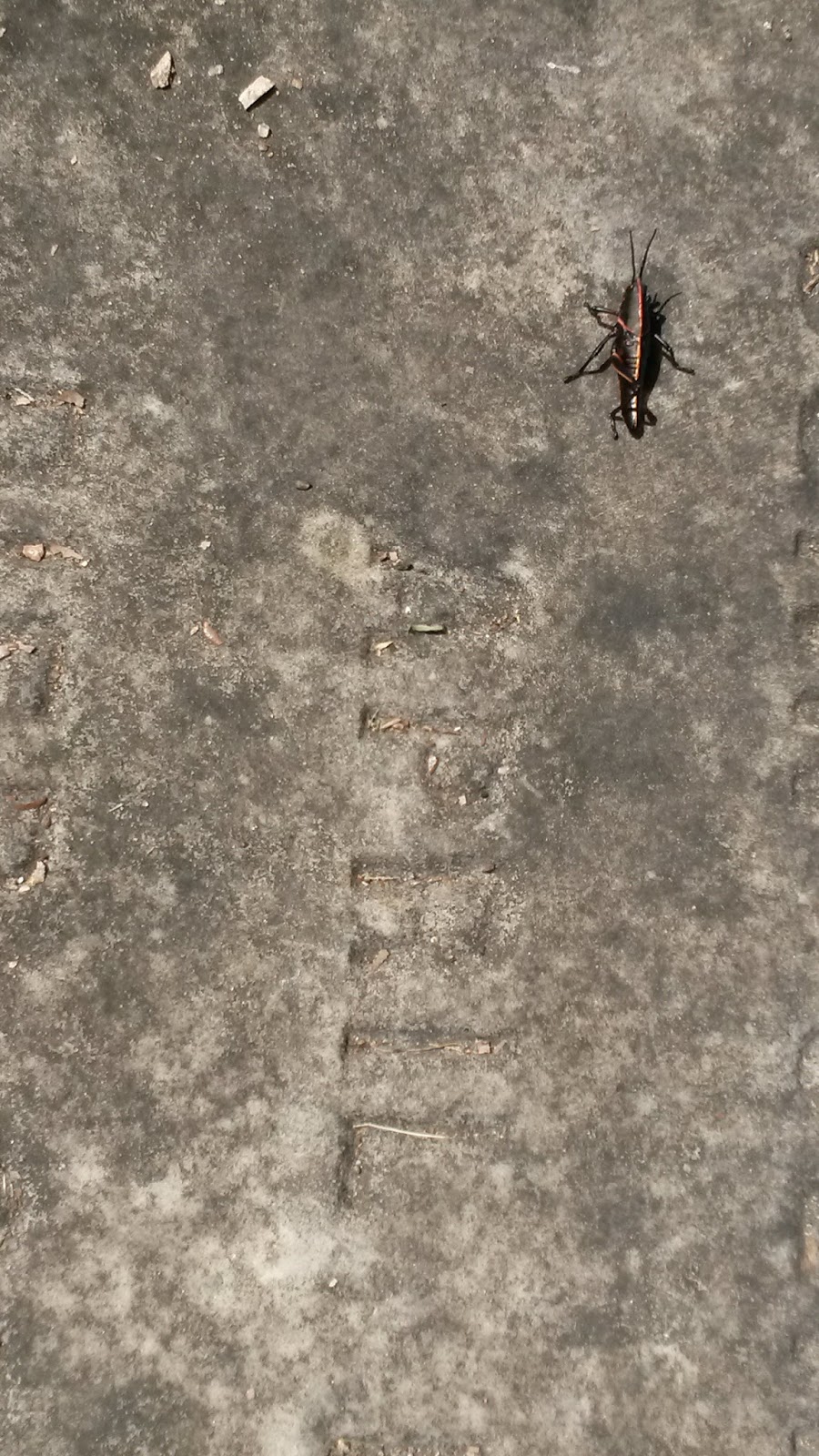

The Eastern Lubber Grasshopper on Captain Jones's Grave

       The city historian was one of the speakers at the event and as soon as it was finished, I approached him and asked where the Confederate ironclads were built during the war. He told me where to go (it just happened to be very near where we ate dinner). Sadly, there is nothing left on the location but just some trees. After we ate, we headed to City Hall where one of the Seven Inch Brooke rifles that was on board the CSS Tennessee during the Battle of Mobile Bay sits today. Two Confederate sailors were killed serving this very gun during that engagement. The rifle is marked S-5, which means it was the fifth Brooke Rifle cast at Selma. 


Left to Right: Me, Pat, and Larry with the sweetest piece of history in Selma

       I thought this was a pretty neat little Civil War trip, but Pat had a surprise in store for me the next day. He took me to a Confederate ironwork's and cemetery. I'll write that blog tomorrow, stay tuned. 


Monday, March 25, 2013

Confederate General's with ties to Colbert and Lauderdale Counties


Brigadier General James Deshler

       I was recently reading a local history book about the Confederate general's with ties to Colbert and Lauderdale County. The author left a few out and I just thought it would be fun to list some that he missed. Of course, most people around the area are familiar with James Deshler who attended West Point and was killed at the Battle of Chickamauga just after his promotion to brigadier general. Another local boy was Brigadier General John Gregg who was born in Leighton and graduated from Lagrange College. He then moved to Texas and soon commanded a brigade of infantry. He was killed in the fighting around Richmond, Virginia late in the war.


Brigadier General John Gregg

       Both of those generals were born in Colbert County, but Lauderdale County also was the home to two Confederate general officers. Brigadier General Edward Asbury O'Neal was born in Madison County, Alabama but soon made Florence his home. He would fight under Lee in Virginia until he made a mess of his attack at Gettysburg and was eventually returned to the west where he continued to serve. 


Brigadier General Edward Asbury O'Neal

       Brigadier General Sterling Alexander Martin Wood (nicknamed Sam because of his initials) was born in Florence. He would fight at Shiloh and later served in Cleburne's hard hitting division beside of James Deshler. After losing control of his brigade during the night assault he resigned his commission and moved to Tuscaloosa where he practiced law. Ironically, Wood Avenue in Florence is named after his brother who was an attorney there. 

SAMWoodACW.jpg

Brigadier General S.A.M. Wood

       Brigadier General Thomas Neville Waul moved to Florence from South Carolina and taught school at the Florence Male Academy. He would teach here a couple of years before moving on to Vicksburg and eventually on to Texas. He would spend his Civil War service in the Trans-Mississippi Department (everything west of the Mississippi River was called the Trans-Mississippi). 


Brigadier General Thomas Neville Waul

       Major General William Wirt Allen had no prior ties to the area until after the war. He was born in New York and graduated from Princeton. During the war he rose to Major General in Joseph Wheeler's cavalry. He moved to Sheffield, Alabama in 1893 and died there a year later in 1894. First buried in Florence, he was eventually exhumed and buried in Birmingham's Elmwood Cemetery (the same place where Coach Bear Bryant rests today). 


Major General William Wirt Allen

       Another cavalry officer who had ties to the area was Brigadier General Lawrence Sullivan Ross (nicknamed Sul) who fought under Nathan Bedford Forrest. Ross was a Texan who traveled to the area to attend college at Wesleyan University in Florence, Alabama. The school eventually became the University of North Alabama. The building he took classes in is still there (in fact its where I took all my Political Science classes) and is called Wesleyan Hall today. 


Brigadier General Lawrence Sullivan Ross

       Brigadier General Edmund Winston Pettus also lived in Colbert County for a brief period of time. After finishing college he studied law in Tuscumbia, Alabama. He is most likely related to the Winston's who lived in Tuscumbia at the time. Sadly, the bridge named in his honor is recognized today more than he is. 


Brigadier General Edmund Winston Pettus

       Another Confederate General I thought I would include was Brigadier General Gideon Johnson Pillow although he never lived in the area. He was a Tennessean who fought in the Mexican War where he was laughed at because of having his soldiers dig their breastworks facing the wrong direction (if we're to believe Ulysses Grant). He was a self proclaimed military genius and was mostly responsible for the loss of Fort Donelson. He would be accused of cowardice at the Battle of Murfreesboro and there his career basically ended. 


Brigadier General Gideon Johnson Pillow

       At the insistence of his aide Sergeant Robert Patton, Pillow used the Sweetwater mansion in Florence as his headquarters. It was the fall of 1864 and Hood's army was poised to march into Tennessee. General Pillow was at this point given the position of commanding the Volunteer and Conscription Bureau of Hood's army (a fancy title given him after he failed as a field commander earlier in the war). 


Fountain in front of the Sweetwater Plantation

       According to the daughters of future Alabama governor Robert Patton, Pillow was pacing up and down the walk in front of the fountain in deep thought when he tripped and fell into the fountain, bruising himself and scaring the fish. The truth would be a lot different than that told in the Victorian Era. According to former slaves, there was a party at Sweetwater that night and General Pillow was intoxicated when he fell into the fountain. It was also reported that he broke his arm in the fall. One thing I'd be willing to bet about the incident, if he was indeed drunk, I bet he sobered up in a hurry hitting that cold water on a November night.