Showing posts with label louisiana. Show all posts

Monday, July 20, 2015

Mansfield Lovell: Awaiting Further Orders


An Early War Photograph of Major General Mansfield Lovell

       Most of my blogs are about great Confederate General's that happen to be my hero's. This is not one of those blogs. Mansfield Lovell may have tried his best, but just wasn't a great commander. He was known for his ability with artillery and perhaps in engineering, but he just wasn't a leader of combat troops. 
       Lovell was born in Washington, D.C. in 1822. His father was the first surgeon general of the United States Army. He grew up in Washington, and after 1836, moved to New York. His grandfather was a prominent politician in Boston, Massachusetts. His ancestry hailed from the north. Lovell received an appointment to West Point and graduated ninth out of 56 cadets in the Class of 1842. His high class ranking ensured he wouldn't be assigned to the infantry and he received an appointment as lieutenant in the artillery. He would see action in the Mexican War, where he was wounded twice and cited for gallantry. Lovell's star was on the rise. For the latter part of the Mexican conflict, Lovell served on the staff of Brigadier General John Quitman. 
       

Brigadier General John Quitman

       Quitman, like Lovell was born in the north, studied law, and eventually moved to Natchez, Mississippi. He would become governor of Mississippi from 1850-1851. The relationship between the two men became like a father and son. It is believed that Quitman is the man that swayed Lovell to consider himself a southerner. 
       In 1854, Lovell resigned his commission from the U.S. Army and moved to New Jersey. He eventually became the deputy street commissioner for New York City under another southerner named Gustavus W. Smith (see my blog http://trrcobb.blogspot.com/2013/07/major-general-gw-smith-was-strain-more.html). 
       When the Civil War began, both Gustavus Smith and Mansfield Lovell left New York City for the south. They arrived and reported to Joseph Johnston, who in turn recommended them to Jefferson Davis as the two "best officers whose services we can command." Lovell would be sent to New Orleans, Louisiana where he would be promoted to major general and begin service in command of the coastal defenses there. 
       The Confederate government believed that New Orleans was safe from the south because of Fort's Jackson and St. Phillip. They soon began to strip Lovell of guns and men believing the real threat came from the upper Mississippi River. Six months later, a Federal fleet under David  Farragut would run past the forts and capture New Orleans. Lovell received an unfair share of the blame for the loss, but in truth, the government was at fault. Lovell reacted quickly and sent men, guns, and supplies to Vicksburg to hold that important city. Although criticized, Lovell was beginning the war doing the best that could be expected of anyone. 


Mansfield Lovell has grown his whiskers out for this photograph

       To appease the people of Mississippi and the state government, President Davis placed Major General Earl Van Dorn over Lovell. Van Dorn himself had become something of a failure as a general of troops having almost lost his army at the Battle of Elkhorn Tavern in Arkansas. He assigned Lovell to a division of his new command in Mississippi and marched northward intending to retake Corinth, Mississippi. The Federal commander waiting there was William Rosecrans and ironically, his army was occupying the same breastworks built by the Confederate Army in the spring of 1862. 
       Lovell began the campaign as a division commander under Van Dorn, but Lovell was an arrogant man. He believed himself superior to Van Dorn and equal to the best general in the Confederate Army. This would be the recipe for a disaster. It was said he had a swagger that reminded his subordinates of a conquering Caesar. To make matters worse, while advancing toward Corinth, he spotted what appeared to be the wheels of a single artillery piece on the horizon. He ordered skirmishers thrown out and an entire brigade to advance across the field toward the enemy threat. The distance was covered quickly, every man expecting to receive enemy fire in an instant. Once the skirmishers reached the position, they found to their amazement, a single pair of abandoned wagon wheels from an old sawmill. 
       During the first day of the battle, Lovell's division advanced on the far right and after serious fighting took possession of Oliver's Hill. (One of his regiments that my grandfather fought in, was the 35th Alabama Infantry. They captured a cannon there named "The Lady Richardson.") At this point in the battle, Lovell seems to have lost his nerve. With the Federal troops in full retreat, he halted his advance. His three brigade commanders were just itching to finish the fight. Lovell allowed the two divisions on his left to do the remainder of the days work. Brigadier General John Stevens Bowen (see my blog http://trrcobb.blogspot.com/2011/03/death-of-another-stonewall.html) was extremely irritated that the battle had been won when Lovell inexplicably called a halt. He went to Lovell and asked for permission to attack. It was only 3 p.m. For the remainder of the day, Lovell's division cared for their wounded and collected their dead for burial as they listened to the fury of the battle. Lovell's actions are inexcusable. 
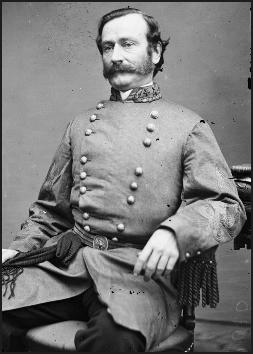

Another uniformed photograph of Mansfield Lovell

       He continued to do little on the second day of the battle. Ordered to attack by Van Dorn, he simply ignored the order and did nothing. Van Dorn must have been out of touch with what was occurring that day because he praised Lovell's actions in his official report. That praise would not save Lovell. President Davis still blamed Lovell for the fall of New Orleans. Jefferson Davis was famous for holding grudges. There were positions where Lovell could have possibly excelled, but Davis refused to give him the chance. 
       A court of inquiry was held on Lovell's responsibility for losing New Orleans and the court cleared him of any blame. Once this occurred, Joseph Johnston asked Davis to assign Lovell to his army to command a corps. Davis refused. (Likely a good thing considering Lovell's failure commanding troops at Corinth). Again, Braxton Bragg suggested Davis make Lovell chief of artillery of the Army of Tennessee, a position Lovell had excelled in before. Again, Davis refused. The only message from Richmond to Lovell was "Await further orders." 
       Lovell finally gave up on receiving a new assignment and served Joseph Johnston as a volunteer aide during the Atlanta Campaign. When A.P. Stewart took command of Leonidas Polk's old corps following that officers death, Johnston asked that Lovell be assigned to command Stewart's division. Not surprisingly, Davis refused this request also. Once Hood took command of the army, he asked Davis to assign Lovell to command his old corps. Despite the close relationship between Hood and Davis, the president still would not relent. 
       Not until Robert E. Lee was made commander in chief of all Confederate troops would Lovell receive another assignment. Johnston was given command of the Army of Tennessee during the Carolina's Campaign in 1865 and asked Lee for Lovell's services. Lee assigned Lovell to command Confederate forces in South Carolina. He held the assignment from April 7 until his surrender one month later. 


Lovell's frock coat in the Louisiana State Museum

       Following the war, Lovell attempted to run a rice plantation in Savannah, Georgia, but high water wiped out his first crop. He then moved to New York City where he became a civil engineer and surveyor. He helped with the removal of river obstructions in Hell's Gate, Queens, New York. Lovell would die in New York City on June 1, 1884 before the completion of the job. He was 61 years old. He rests today in Woodlawn Cemetery, Bronx, New York. 

Mansfield Lovell

Lovell's grave


U.S. Army Corps of Engineers completing the work at Hell's Gate one year after the death of Mansfield Lovell.


Thursday, June 18, 2015

Major General Franklin Gardner

Franklingardner.jpg

Major General Franklin Gardner

       Frank Gardner was born in 1823 in New York City. His father was a lieutenant colonel in the U.S. Army and his mother was from a wealthy Louisiana family. He entered the United States Military Academy at West Point, New York in 1838 and graduated 17th out of 39 cadets in the Class of 1843. His one note of distinction was his ranking of first in his class in drawing which was considered an important subject at the time because of the need to draw fortifications and maps in wartime. 
       Like his father, Frank married into a wealthy Louisiana family. He married Marie Celeste Mathilde Mouton, the sister of future Confederate Brigadier General Jean Jacques Alfred Alexander Mouton (see my blog http://trrcobb.blogspot.com/2010/12/general-with-long-name-jean-jacques.html). Her father Alexander Mouton would also become the governor of Louisiana. 
       Following graduation from West Point, he entered military service in the infantry. He would see at least four major battles in the Mexican War and was distinguished twice for gallantry. He served under Albert Sidney Johnston during the Morman Expedition with the rank of captain. When the South seceded from the Union, he never bothered to resign, but simply departed his post in Utah for Louisiana. 
       He spent the early part of the Civil War bouncing from post to post. He served as a lieutenant colonel of infantry, a staff officer under Jubal Early, commanded a brigade of cavalry, and even saw action at Shiloh. When Beauregard became commander of the Army of Mississippi, he was promoted to brigadier general commanding all the cavalry of the army. Gardner would see action at Perryville in this capacity. Following Perryville, he promoted to major general and sent to the position he would become most famous for holding: Port Hudson. 
       Although John C. Pemberton and Vicksburg have gained more attention, Port Hudson was just as important as Vicksburg as a fort defending the Mississippi River. While Vicksburg held the northern part of a 200 mile section of the Mississippi, Port Hudson held the southern point. While Pemberton's 33,000 man army was withstanding a siege by Ulysses Grant and his army of 77,000, Frank Gardner was fighting longer odds. His 7,500 men were facing between thirty and forty thousand under Nathaniel Banks. 


A Confederate Columbiad at Port Hudson

       At Port Hudson, Frank Gardner placed his engineering skills to good work. He strengthened the fort and prepared the defenders for hard fighting. When Banks army arrived, Gardner withstood 47 days of siege and inflicted 5,000 casualties on his enemy. Another 5,000 Union soldiers became casualties to disease during this same period. Gardner's total casualties amounted to almost one thousand men. 
        He refused to surrender until July 9, 1863 after he was certain that Vicksburg had fallen and that Joseph Johnston wasn't coming to his aide with reinforcements. His men were half starved, been exposed to constant artillery fire for over forty days, had no medical supplies, and were utterly exhausted. He had accomplished far more than most men would have in the same situation. 
       He remained a prisoner of war until August of 1864 when he was exchanged. Gardner was then sent to command the District of Mississippi and East Louisiana under Richard Taylor. He would see minimal action for the remainder of the war. Following the war, he made a living farming in Lafayette, Louisiana. He would only survive the war by eight years. He died at age fifty of unknown causes. His tombstone lists his middle name as Kitchell, although there are few other sources that show him having a middle name. 

Franklin Kitchell Gardner

Frank Gardner's grave

       He rests today in Saint John's Cemetery in Lafayette, Louisiana. His wife Mary would outlive him by almost 42 years. He rests in the same cemetery as his brother-in-law Brigadier General Jean Jacques Alfred Alexander Mouton who was killed at the Battle of Mansfield in 1864. 


An image said to be Franklin Gardner, some people believe this is actually a photograph of Confederate Brigadier General Richard Brooke Garnett

(See my blog http://trrcobb.blogspot.com/2011/01/who-is-richard-brooke-garnett.html?showComment=1434653687876#c3561612509051448284)

Saturday, December 11, 2010

The General with the long name: Jean Jacques Alfred Alexander Mouton


Brigadier General Alfred Mouton

       Alfred Mouton was born on February 18, 1829 in Opelousas, Louisiana. His father would become governor of the state in 1843. The younger Mouton would eventually receive an education at West Point, graduating 38th in the class of 1850. He immediately resigned his commission and returned to Louisiana to become a planter. After managing his fathers plantation for two years, he then purchased a plantation of his own. 


Mouton's father's plantation called Ile Copal

        He received an appointment as brigadier general in the Louisiana State Militia in 1855. When the Civil War arrived, Mouton was commissioned a captain in the Confederate army by President Jefferson Davis. He would help raise the 18th Louisiana Infantry and was elected colonel of the unit.
      The regiment would be placed in Daniel Ruggles brigade and sent to Corinth, Mississippi. From there, the unit would see action at Shiloh. On the first day, Mouton led a brave charge which resulted in heavy casualties. The colonels clothes and saddle had dozens of bullet holes and his horse was killed beneath him in the assault. On the second day of the battle, Mouton was wounded in the face. The wound became infected and he was forced to return home to recover. 
       For the gallantry he demonstrated at Shiloh, President Davis promoted Mouton to brigadier general. Upon recovery, he was placed under Richard Taylor in Louisiana. Because of an attack of rheumatism, he would miss his first battle with his new command. He repulsed Federal attacks at the Battle of Bisland in April of 1863, but would see no more action for the remainder of the year.
       Taylor gave Mouton command of a division although it didn’t result in a promotion to major general. In other words, Mouton had more responsibility, but with the same pay. He would lead the division in the Battle of Mansfield on April 8, 1864 and helped Taylor’s army defeat Federal General Banks. Sadly, this battle would be Mouton’s last.
       Taylor had nothing but praise for Mouton’s brave charge at Mansfield. Despite heavy casualties, Mouton’s men pressed on across an open field, through a ravine and up a hill. They captured several Federal guns and caused the enemy line to break. Thirty-five Federal soldiers threw down their rifles to surrender. Mouton watched as his men raised their rifles to fire on the defenseless enemy soldiers. He immediately rode his horse in front of his men and ordered them to hold their fire. Five of the surrendering enemy soldiers reached down and grabbing their rifles opened fire on the man who had just saved their lives. 
       Mouton was hit by several bullets and fell from the saddle, killed almost instantly. The act so enraged Mouton’s men that they immediately opened fire killing all thirty-five of the enemy troops. One Confederate soldier said the dead enemy soldiers lay around the body of General Mouton looking like a guard of honor pulled from the Federal ranks to honor such a brave man.


Death site of General Mouton at Mansfield

       Mouton was buried on the field and his division marched past the grave, many with tears filling their eyes. Some were said to have thrown themselves on the ground in sorrow at the loss of their brave commander. His men were so angered at the act, that many captured Federals begged for mercy for fear of vengeance. 
      Richard Taylor admitted to being deeply affected at the loss of his division commander. Mouton had been loyal to his commander. Kirby Smith in overall command had been feuding with Taylor over strategy. Smith wanted to fight on the defensive and react to the enemy’s moves. Taylor had learned his warfare under Jackson and believed in taking the initiative against the enemy. With Mouton gone, Taylor lost an ally in his personal battle with Smith.


Mouton's statue in Lafayette, Louisiana

       Alfred Mouton’s body would eventually be removed and buried in the Mouton family plot in Saint John Cemetery, Lafayette, Louisiana. The only bad thing that was ever said about Mouton was written by one of his soldiers. The man complained that Mouton didn't like to carry out executions of his men for desertion. The general with the long name was not only respected by his men, but he seemed like a genuine good person. He certainly didn't deserve the sad fate that he suffered.


The grave of Alfred Mouton