Showing posts with label Vicksburg. Show all posts

Monday, July 20, 2015

Mansfield Lovell: Awaiting Further Orders


An Early War Photograph of Major General Mansfield Lovell

       Most of my blogs are about great Confederate General's that happen to be my hero's. This is not one of those blogs. Mansfield Lovell may have tried his best, but just wasn't a great commander. He was known for his ability with artillery and perhaps in engineering, but he just wasn't a leader of combat troops. 
       Lovell was born in Washington, D.C. in 1822. His father was the first surgeon general of the United States Army. He grew up in Washington, and after 1836, moved to New York. His grandfather was a prominent politician in Boston, Massachusetts. His ancestry hailed from the north. Lovell received an appointment to West Point and graduated ninth out of 56 cadets in the Class of 1842. His high class ranking ensured he wouldn't be assigned to the infantry and he received an appointment as lieutenant in the artillery. He would see action in the Mexican War, where he was wounded twice and cited for gallantry. Lovell's star was on the rise. For the latter part of the Mexican conflict, Lovell served on the staff of Brigadier General John Quitman. 
       

Brigadier General John Quitman

       Quitman, like Lovell was born in the north, studied law, and eventually moved to Natchez, Mississippi. He would become governor of Mississippi from 1850-1851. The relationship between the two men became like a father and son. It is believed that Quitman is the man that swayed Lovell to consider himself a southerner. 
       In 1854, Lovell resigned his commission from the U.S. Army and moved to New Jersey. He eventually became the deputy street commissioner for New York City under another southerner named Gustavus W. Smith (see my blog http://trrcobb.blogspot.com/2013/07/major-general-gw-smith-was-strain-more.html). 
       When the Civil War began, both Gustavus Smith and Mansfield Lovell left New York City for the south. They arrived and reported to Joseph Johnston, who in turn recommended them to Jefferson Davis as the two "best officers whose services we can command." Lovell would be sent to New Orleans, Louisiana where he would be promoted to major general and begin service in command of the coastal defenses there. 
       The Confederate government believed that New Orleans was safe from the south because of Fort's Jackson and St. Phillip. They soon began to strip Lovell of guns and men believing the real threat came from the upper Mississippi River. Six months later, a Federal fleet under David  Farragut would run past the forts and capture New Orleans. Lovell received an unfair share of the blame for the loss, but in truth, the government was at fault. Lovell reacted quickly and sent men, guns, and supplies to Vicksburg to hold that important city. Although criticized, Lovell was beginning the war doing the best that could be expected of anyone. 


Mansfield Lovell has grown his whiskers out for this photograph

       To appease the people of Mississippi and the state government, President Davis placed Major General Earl Van Dorn over Lovell. Van Dorn himself had become something of a failure as a general of troops having almost lost his army at the Battle of Elkhorn Tavern in Arkansas. He assigned Lovell to a division of his new command in Mississippi and marched northward intending to retake Corinth, Mississippi. The Federal commander waiting there was William Rosecrans and ironically, his army was occupying the same breastworks built by the Confederate Army in the spring of 1862. 
       Lovell began the campaign as a division commander under Van Dorn, but Lovell was an arrogant man. He believed himself superior to Van Dorn and equal to the best general in the Confederate Army. This would be the recipe for a disaster. It was said he had a swagger that reminded his subordinates of a conquering Caesar. To make matters worse, while advancing toward Corinth, he spotted what appeared to be the wheels of a single artillery piece on the horizon. He ordered skirmishers thrown out and an entire brigade to advance across the field toward the enemy threat. The distance was covered quickly, every man expecting to receive enemy fire in an instant. Once the skirmishers reached the position, they found to their amazement, a single pair of abandoned wagon wheels from an old sawmill. 
       During the first day of the battle, Lovell's division advanced on the far right and after serious fighting took possession of Oliver's Hill. (One of his regiments that my grandfather fought in, was the 35th Alabama Infantry. They captured a cannon there named "The Lady Richardson.") At this point in the battle, Lovell seems to have lost his nerve. With the Federal troops in full retreat, he halted his advance. His three brigade commanders were just itching to finish the fight. Lovell allowed the two divisions on his left to do the remainder of the days work. Brigadier General John Stevens Bowen (see my blog http://trrcobb.blogspot.com/2011/03/death-of-another-stonewall.html) was extremely irritated that the battle had been won when Lovell inexplicably called a halt. He went to Lovell and asked for permission to attack. It was only 3 p.m. For the remainder of the day, Lovell's division cared for their wounded and collected their dead for burial as they listened to the fury of the battle. Lovell's actions are inexcusable. 
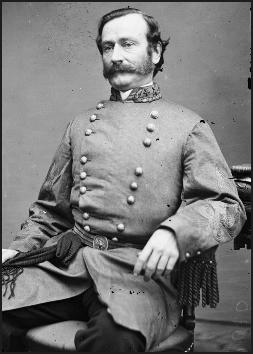

Another uniformed photograph of Mansfield Lovell

       He continued to do little on the second day of the battle. Ordered to attack by Van Dorn, he simply ignored the order and did nothing. Van Dorn must have been out of touch with what was occurring that day because he praised Lovell's actions in his official report. That praise would not save Lovell. President Davis still blamed Lovell for the fall of New Orleans. Jefferson Davis was famous for holding grudges. There were positions where Lovell could have possibly excelled, but Davis refused to give him the chance. 
       A court of inquiry was held on Lovell's responsibility for losing New Orleans and the court cleared him of any blame. Once this occurred, Joseph Johnston asked Davis to assign Lovell to his army to command a corps. Davis refused. (Likely a good thing considering Lovell's failure commanding troops at Corinth). Again, Braxton Bragg suggested Davis make Lovell chief of artillery of the Army of Tennessee, a position Lovell had excelled in before. Again, Davis refused. The only message from Richmond to Lovell was "Await further orders." 
       Lovell finally gave up on receiving a new assignment and served Joseph Johnston as a volunteer aide during the Atlanta Campaign. When A.P. Stewart took command of Leonidas Polk's old corps following that officers death, Johnston asked that Lovell be assigned to command Stewart's division. Not surprisingly, Davis refused this request also. Once Hood took command of the army, he asked Davis to assign Lovell to command his old corps. Despite the close relationship between Hood and Davis, the president still would not relent. 
       Not until Robert E. Lee was made commander in chief of all Confederate troops would Lovell receive another assignment. Johnston was given command of the Army of Tennessee during the Carolina's Campaign in 1865 and asked Lee for Lovell's services. Lee assigned Lovell to command Confederate forces in South Carolina. He held the assignment from April 7 until his surrender one month later. 


Lovell's frock coat in the Louisiana State Museum

       Following the war, Lovell attempted to run a rice plantation in Savannah, Georgia, but high water wiped out his first crop. He then moved to New York City where he became a civil engineer and surveyor. He helped with the removal of river obstructions in Hell's Gate, Queens, New York. Lovell would die in New York City on June 1, 1884 before the completion of the job. He was 61 years old. He rests today in Woodlawn Cemetery, Bronx, New York. 

Mansfield Lovell

Lovell's grave


U.S. Army Corps of Engineers completing the work at Hell's Gate one year after the death of Mansfield Lovell.


Wednesday, January 11, 2012

Whistling Dick


18 pound Confederate Cannon called 'Whistling Dick'

       There are several artillery pieces used during the Civil War that have famous nicknames. There is the famed Federal siege gun called the 'Swamp Angel' at Charleston, South Carolina. Brigadier General William Pendleton who was a pre-war preacher named his four cannons after the four gospels of the Bible. There is also the famed 'Widow Blakely' of Vicksburg fame. There was another artillery piece at Vicksburg with a nickname and that piece was called 'Whistling Dick'. 
       'Whistling Dick' wasn't that large of a piece, it was small in comparison with the 150 pound Armstrong and other siege guns. It was too heavy to be used in field service. Although there were 20 pound field pieces and even 32 pound field guns, 'Whistling Dick' was heavy for an 18 pounder. The iron cannon was rifled and had reinforced bands on the back to prevent the tube from exploding when fired. It had been built at Tredegar Ironworks in Richmond. 
       The gun would gain fame because of a whistling sound the oddly rifled weapon caused the shells to make in flight. The weapon was originally a model 1839 smoothbore cannon that was later rifled. It became a legend when Union veterans at post-war reunions would claim to have been narrowly missed by fire from 'Whistling Dick'. There have been many theories on why the shells made a whistling sound after the gun was rifled, but no one today can be sure what caused this phenomenon. 
       'Whistling Dick' served more as a psychological weapon than a true threat to Federal forces. It interrupted Ulysses Grant's canal digging operation when he tried to bypass Vicksburg. Although the chances of 'Whistling Dick' hitting someone was minute, it caused slaves and soldiers Grant used for digging to run for cover. It is also rumored to have caused severe damage on Federal dredging machines. 
       The ironic part about the famous Confederate artillery piece is the fact that it was served by a company of Louisiana Cavalry. These cavalrymen were well disciplined and learned to handle 'Whistling Dick' rather well. They have been credited with sinking the Federal ironclad U.S.S. Cincinnati. The most amazing part about this particular cannon is the fact that it served well throughout the siege of Vicksburg and following the surrender of that river fortress it disappeared. There is no evidence today of what happened to this famed Confederate artillery piece that earned the nickname 'Whistling Dick'. 

Sunday, January 1, 2012

Vicksburg 1863 and Winston Groom


       I'm currently reading Vicksburg 1863 by Winston Groom and so far it has been an excellent read. I also have a copy of Shrouds of Glory by the same author. Shrouds of Glory deals with the Nashville Campaign and is also a descent read although I'm not in total agreement. Groom seems to agree with Hood's attack at Franklin. I can see Groom's point as well as Hood's reasoning behind the attack, but in hindsight one can't help but admit it was a horrible mistake. 
       At one point in Vicksburg 1863, Groom mentioned a rumor that a local potter had made chamber pots with pictures of notorious Federal General Benjamin Butler in the bottom. He goes on to admit that he hasn't found any evidence to support this. That is the reason I decided to post this blog. We'll get to that part later. 


Benjamin "Beast" or "Spoons" Butler

       Next to Abraham Lincoln, Benjamin Butler was possibly the most hated man in the Confederacy. When he arrived in New Orleans, a crippled veteran of the Mexican War named William Munford had torn the United States flag from the Federal mint. Butler charged Munford with treason and hanged him. Citizens who refused to sign the loyalty oath had their homes confiscated and used by his officers. His brother got rich off of steeling from the citizens of New Orleans which earned Butler the nickname "Spoons" for all the silverware he had stolen. 
       The most infamous thing Butler ever did was to issue an order that stated if any woman insulted or showed contempt toward a Union officer, she will be regarded as a woman of the town. Shock waves would be heard across the Atlantic from this proclamation. The way the order read, it sounded as if he was giving his men permission to rape southern women. Jefferson Davis branded Butler an outlaw and ordered if the man was captured to have him hanged on the spot. British prime minister Lord Palmerston declared that any Englishman should blush that Benjamin Butler was a member of the Anglo-Saxon race.


William Munford

       This brings us back to the statement Groom makes about the chamber pots. My wife noticed me smiling and asked me what I was reading. I told my wife I have actually seen these chamber pots. 


One of the chamber pots Mr. Groom can't find any evidence of.

Thursday, July 7, 2011

Northern Born Confederate Generals

       Of the 425 Confederate generals commissioned during the Civil War you may find it surprising to learn that 33 were born in Northern states. New York was the leader with seven Confederate generals followed by Pennsylvania and Ohio who had six each. Massachusetts had five, New Jersey three, Maine two, and one each from Iowa, Connecticut, Indiana and Rhode Island. I did a little research to try and figure out why so many fought for the South. 
       There were six generals that moved with their families at a very young age and were raised in the South. All served in the war as brigadier Generals. They were Charles Clark (Ohio), Robert Hopkins Hatton (Ohio), William Miller (New York), Lawrence Sullivan Ross (Iowa), Clement Hoffman Stevens (Connecticut), and William Stephen Walker (Pennsylvania).
       There were 15 generals that moved to the South after reaching adulthood and in essence considered themselves Southerners. Two were eventually promoted to major general. They were Samuel Gibbs French (New Jersey) and Bushrod Rust Johnson (Ohio). The other 13 were commissioned brigadier generals and they were Albert Gallatin Blanchard (Massachusetts), Julius Adolph De Lagnel (New Jersey), Johnson Kelly Duncan (Pennsylvania), Daniel Marsh Frost (New York), Archibald Gracie, Jr. (New York), Richard Griffith (Pennsylvania), Danville Leadbetter (Maine), William McComb (Pennsylvania), Edward Aylesworth Perry (Massachusetts), Albert Pike (Massachusetts), Daniel Harris Reynolds (Ohio), Claudius Wistar Sears (Massachusetts), and Zebulon York (Maine).


General Samuel Cooper

       Eight Northern born generals married Southern women and that's how they came about joining the Confederacy. One may come as a complete surprise to most. That was General Samuel Cooper (New Jersey) who was the highest ranking Confederate general. Although he was essentially a desk general, many are surprised that the man actually ranked General Robert E. Lee. One was Lieutenant General John Clifford Pemberton (Pennsylvania) who eventually would become hated in the South for surrendering Vicksburg. Two became major generals. One was Martin Luther Smith (New York) and Franklin Gardner (New York) who ironically was forced to surrender Port Hudson after Vicksburg fell. The other four were brigadier generals. They were Josiah Gorgas (Pennsylvania), Roswell Sabine Ripley (Ohio), William Steele (New York), and Walter Husted Stevens (New York). 


Major General Lunsford Lindsay Lomax

       Major General Lunsford Lindsay Lomax (Rhode Island) really can't be counted like the others because he was born to Southerners while his father was stationed up North in the army. Brigadier General Otho French Strahl (Ohio) moved South because his grandmothers were Southerners and impressed him with stories of the South. One of the most surprising of all was Brigadier General Francis Asbury Shoup (Indiana) who was still living in Indiana when the Southern states began seceding. The man immediately moved to Florida because of his admiration of the South and claimed he was a Southerner in his heart. The other was Brigadier General Daniel Ruggles (Massachusetts) who I was unable to find the reason for his joining the South. 
       Of those 33 Confederate generals born in the Northern states, five would be killed in action. All five were brigadier generals. They were Archibald Gracie, Jr. (Petersburg), Richard Griffith (Savage's Station), Robert Hopkins Hatton (Fair Oaks), Clement Hoffman Stevens (Atlanta), and Otho French Strahl (Franklin). 
       Later, I will try and figure out how many Southern born generals served in the Union army during the war. It will be daunting task as the Union army had so many more generals than the Confederacy. 

Tuesday, July 5, 2011

Thomas Pleasant Dockery: The Volunteer


Thomas Pleasant Dockery

       Few people realize that one of the finest brigade commanders in the Confederate Army was Thomas Pleasant Dockery. One reason for this lack of recognition is because he served most of the war in the Trans-Mississippi Department. The man was said to have received his energy from his father Colonel Thomas Dockery who'd served in the U.S. Army during the removal of the Indians. 
       The younger Dockery was born in 1833 in North Carolina, but his family moved to Tennessee and then on to Arkansas while he was young. It was there that his father would establish a large plantation and bring the first railroad to the state. 
       When the Civil War began, Dockery organized the 5th Arkansas State Troops and was commissioned colonel. He was soon made colonel in the Confederate Army and assigned to the 19th Arkansas Infantry. The young officer would see his first action at the Battle of Wilson's Creek. He would then see action at Elkhorn Tavern and move across the Mississippi River with Earl Van Dorn. There he would lead his men in the Battle of Corinth and command a brigade during the Vicksburg Campaign. At Vicksburg his brigade was placed in a very exposed position to enemy gunboat fire, but bravely held their ground. He was surrendered there with the rest of Pemberton's army on July 4, 1863.
       After being exchanged, Dockery's men moved across the Mississippi River where they would stay for the remainder of the war. There he was commissioned a brigadier general and ordered to reorganize his command and collect troops to bring his brigade back up to strength. For some reason Kirby Smith didn't think the man was capable of handling this assignment. He would eventually bring the brigade up to just over 900 men. He saw action again during the Camden Campaign in early 1864. He was assigned command of Arkansas's Reserve Corps for the last six months of the war. 
       Many men wrote about the brave and gallant leader. One called him a "broad-gauged man." He had the reputation of being an extremely aggressive commander. One of Dockery's Infantryman said, "It was one of Colonel Dockery's hobbies to volunteer to take some battery or storm some difficult stronghold."


The Brave Brigadier

       The war cost him everything he owned. Following the war he became a civil engineer and moved to Houston, Texas. He seems to have been visiting New York City in 1898 at the age of 64 when he died. His body was sent to Natchez, Mississippi where his two daughters lived. He rests there in the city cemetery. A simple Confederate marker serves as his tombstone and that's probably the way General Dockery would have wanted it.


"Reserve Corps of Arkansas" a position he held briefly

       Had he served in Lee's Army, Thomas Dockery may have received the recognition that he deserves. It is also highly probable that such an aggressive commander would have never survived the war. Reading about the man, you are reminded of another aggressive brigadier general named William Barksdale who was shot nine times at Gettysburg.


Sunday, March 27, 2011

The Death of another Stonewall


John Stevens Bowen

       Anyone who knows anything about the Civil War will quickly identify "Stonewall" Jackson. Most people with a little Civil War knowledge can identify Patrick Cleburne as the "Stonewall of the West." Very few people know that there was a third "Stonewall" in the Confederate Army during the war. 
       John Stevens Bowen was the other man nicknamed "Stonewall" and lost that nickname due to his death. He is not as famous as Jackson or Cleburne and the reason is simple. Despite being a great commander and well loved by his men, Bowen didn't die in combat. His death was a lot less glorious as the other two "Stonewalls." 
       Bowen was born in Georgia in 1830 and attended the University of Georgia. He left before graduating and entered the United States Military Academy. He was suspended a year because he had refused to tell on another student he'd caught out after hours. He returned to the academy and graduated in the class of 1853. 
       Bowen would spend three years in the U.S. Army before resigning to become an architect back in Georgia. He became a lieutenant colonel in the Georgia Militia before moving to Missouri just three years before the Civil War began.
       Bowen was initially captured in Missouri by Federal General Nathaniel Lyon. Upon his exchange he was quickly given command of a brigade in Leonidas Polk's corps. When Confederate Major General George Crittenden was dismissed from service for drunkenness, the logical choice to replace him was John Bowen. Sidney Johnston chose John Breckinridge instead because Breckinridge was the ex-vice president of the United States and a more popular man among the public. Bowen was relatively unknown. 
       Bowen remained in command of a brigade at the Battle of Shiloh where he was severely wounded and out of action for quite some time. Upon his recovery, Bowen took command of a division under John Pemberton at Vicksburg. He would be Pemberton's most trusted subordinate. 


Bowen: The hero of Port Gibson

       Bowen delayed Grant's approach to Vicksburg at Port Gibson despite being outnumbered and because of his action there he was promoted to Major General. He continued to serve under the inept Pemberton, fighting at Champion Hill and served as Pemberton's rearguard afterward. 
       During the siege of Vicksburg, Pemberton became extremely sick with dysentery. Dysentery was a deadly disease during the Civil War. It was a combination of bloody diarrhea, fever and extreme pain. Bowen was paroled after the surrender of Vicksburg and was travelling with his wife when he was forced to stop near Edwards, Mississippi. On July 13, 1863 just nine days after he was surrendered at Vicksburg, John Bowen died. 


Walton House, death site of John Bowen

       John Stevens Bowen, the other "Stonewall" of the Confederate Army was thirty-two years old. He is not as well known as the other two for several reasons. The way he died helped contribute to this, but also because he died just as he was reaching the best part of his career. He is another Civil War officer that we must ask ourselves the question. Had he lived, what might he have accomplished?


Cedar Hill Cemetery, Vicksburg Mississippi