
Turner Ashby
Turner Ashby was born in Virginia in 1828. His father, Turner Ashby, Sr., served as a colonel in the War of 1812 and died while he was very young. His grandfather was a captain in the Revolutionary War. Turner Ashby was privately tutored and after finishing, he purchased a farm near his mother's home. He named the home Wolf's Crag.

Wolf's Crag
Turner Ashby was known for his chivalry, horseman ship, and as an avid outdoorsman. He was a natural leader and when the war began, he took command of a cavalry unit. The man was described as about five feet, eight inches, weighing about one hundred-sixty pounds and had a dark complexion from all the time he'd spent outdoors. He earned the nickname 'Black Knight of the Confederacy' because of his jet black hair and dark eyes. Always riding either a solid black horse or a solid white horse, he was a fearless leader. His command would follow him anywhere, but he was without formal military training and had lots of trouble because of his lack of discipline.
Ashby was soon assigned to Stonewall Jackson's command in the Shenandoah Valley. Jackson gave him the job of patrolling the Potomac River north of the valley. In an engagement there, his brother Richard Ashby would be killed. Turner was told that Richard was bayoneted to death while attempting to surrender. No one for certain exactly what happened there, but regardless, Turner believed the story. From that point forward, he hated Northern troops and fought with a vengeance.

Ashby in the militia uniform of Virginia before the war
Ashby was soon promoted to colonel and given command of the 7th Virginia Cavalry Regiment. Many were pushing for Ashby to be promoted to brigadier general, but Jackson was against the idea. Jackson didn't think Ashby was capable of higher command because of the lack of discipline in his command and no proper military training. A brave fighter, Ashby never learned how to properly drill his men. Despite what Jackson suggested, Ashby was promoted to brigadier general in May of 1862. He would hold that rank for just ten days.
Although Ashby was brave to a fault, there were times when he failed Jackson. Cavalry being the eyes of an army, it was Ashby's job to give Federal positions and troop strengths. At Kernstown, he greatly underestimated the size of the Union army. Jackson attacked the position and was defeated. Near Winchester, Virginia, after Jackson's infantry had defeated Nathaniel Banks force, Ashby's soldiers were too busy plundering captured wagons and allowed the retreating enemy to escape. Had Ashby's men been trained properly and disciplined, most of Banks force would have been captured.
On June 6, 1862, General Ashby was fighting a rearguard action near Harrisonburg, Virginia. His force was being attacked by both Federal cavalry and infantry. His men easily repulsed the first attack. When the second attack began, Ashby's horse was killed. Rising from the ground, Ashby charged the enemy force, yelling, "Forward, my brave men!"
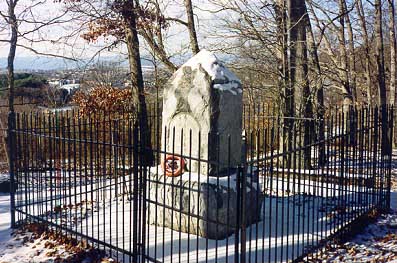
Monument marking the place where Ashby was killed
Those were his last words. A bullet had hit him in the heart. He was killed instantly. It has been suggested that he could have been hit by friendly fire leading his men forward, but this seems highly unlikely. Turner Ashby's body was carried to the Kemper Home in Port Republic, photographed and then laid out in one of the rooms. Jackson soon arrived to view his remains.

Frank Kemper Home
Despite the differences between Jackson and his cavalryman, the Confederate commander retired to his tent when he learned of his Ashby’s death. He later wrote, “As a partisan officer I never knew his superior; his daring was proverbial; his powers of endurance almost incredible; his tone of character heroic, and his sagacity almost intuitive in divining the purposes and movements of the enemy.”

Room where Jackson viewed Ashby's body
Ashby rests today in the Stonewall Cemetery, Winchester, Virginia next to the body of his brother Richard. Turner Ashby was thirty-three years old.

Ashby photographed in death

Grave of both Turner and Richard Ashby


