Monday, April 30, 2012

Civil Wargasm #3


Me and James "Beasley" Howard at the grave of General Pillow

       About two months ago, Jerry and I decided to go on another Civil Wargasm. We thought it would be fun to ask two of our buddies along, James Howard and Lanny Perry. Unfortunately, Lanny's wife wouldn't let him miss any work, but James was game. We planned to head to Memphis and hit Elmwood Cemetery and then travel to the grave of Jerry's hero, Nathan Bedford Forrest.
       The trip got off to a slow start when James (who happens to be 49 years old) couldn't seem to get away from his mom. They stood on the front porch (I didn't want to be nosy so I never looked to see if they were hugging or not) for several minutes. I was beginning to wonder about James. Perhaps his mother had been told some bad things about Jerry and myself. I immediately decided that it had to be Jerry who she thought was the bad influence and my mind was put to ease. 

General Vaughan's Desk

       The three of us left for Memphis and discussed my favorite subject the entire way, the war of course. We soon arrived in Elmwood and entered the office to find a map. Inside the office was the desk (the actual word is secretariat) that belonged to Confederate Brigadier General Alfred Jefferson Vaughan who is also buried in Elmwood.
       We purchased a map showing the burial places of all prominent people buried in Elmwood. There are eleven Confederate general's buried there not to mention some militia general's and two Federal general's. We left the office and struck out for the nearest grave. We found the grave of Major General James Patton Anderson first. Not wanting anything to be unusual about this trip, I managed to attract a wierdo. The fellow gave us a brief lesson on General Anderson and mentioned the general was buried in the poor section of the cemetery. He told us he just couldn't grasp why a major general would be buried among the poor. I explained to him the general was in financial trouble after the war as most Southerner's were. The man looked at me with a confused look on his face and said, "I just can't imagine why he is buried over here." Oh, well, I tried. 
       

Me with Brigadier General Preston Smith

       We found all the generals, although we were followed and greatly distracted by my wierdo. We were regaled with tales from one end of the planet to the other and time began to become a factor. I got a picture of myself at the grave of one of my hero's, General Preston Smith who was killed at Chickamauga after riding forward in the darkness to locate the Federal main line. Among the other generals we found in Elmwood were Elkanah Greer, Alfred Jefferson Vaughan, Gideon Pillow, William Humes, Lucius Marshall Walker, James Chalmers, William H. Carroll, George W. Gordon, Robert V. Richardson, and William M. Gardner. 
       Before leaving the cemetery, Jerry found a dog monument with an actual flea collar around its neck. Obviously, Jerry thought this was a waste and James and I had to talk him out of taking the collar home to use on his Dachshund named Pumpkin. James did learn that when you don't have a door covering your memory card on your camera and you swing it around like a mad man, your apt to lose the card. (By the way, if anyone comes across a memory card in the Forrest family section of Elmwood, please contact James Beasley). 


Jerry thought this fluorescent collar would make Pumpkin look good

       The best part of the trip was saved for last. We headed down town to Forrest Park where the "Wizard of the Saddle" himself is buried. The fearless commander who struck fear in the hearts of all Federal troops including Grant himself, happens to be Jerry's hero of hero's. I thought we would arrive to see Jerry well up in tears, rushing from the car to the giant monument, but Jerry never fails to surprise me. 


Two rednecks trying to operate a parking meter

       Instead, he and James spent the next fifteen minutes trying to figure out how to operate the parking meter. I decided to press on to the monument alone while they beat, banged and twisted the meter mercilessly. They finally arrived at the huge monument (I'm still not certain who won, but I'm putting my money on the meter). As we walked around the monument in awe of the great man, I continued to check Jerry's eyes for moisture. Jerry was not to be outdone. He understood that if he shed one single tear I would never let him forget it. I walked over to Jerry and asked, "What do you think?" He replied simply, "That stud horse is anatomically correct. Just look at that thing." What could I say? Just another typical Civil Wargasm with Jerry.


Jerry and me in front of Forrest's grave


Tuesday, April 17, 2012

Guest Blog by Tim's Wife on the 150th Re enactment of the Battle of Shiloh

Tim, me and Carlee taking a break


On Thursday afternoon of the re-enactment the confederate army marched out of camp to do a little fighting and try to experience a little of what the soldiers did way back when, including sleeping on the ground all night.  It was extremely hot this afternoon and I thought I was going to be seriously ill for a few minutes but I forgot all about it when we started firing on the Yankees.  There is nothing like holding an original 1855 Harpers Ferry in your hands and actually getting to shoot it.  (Still can't believe Tim lets me use this!) We did this off and on for a couple of hours with a few breaks in between.  Then our fearless leaders lead us to the campsite for the night.  In my mind I had imagined  we would be lying in a field under the beautiful dark night with the stars scattered above us.  Wrong!  I was jerked from my fantasy when we were told to go up into the tree line of the woods behind us and pick a spot.  The woods?  You have got to be kidding!  Ticks, spiders and chiggers! Oh my!  Luckily Tim's best friend Jerry was with us and we stayed together and whatever scent Jerry had on attracted all the ticks from our vicinity. 


Jerry waiting to go fight


Darkness began to fall and we were all lazing on our blanket rolls talking when all of a sudden Tim Kent and Jerry Smith started doing what they do best.  Storytelling.  They told stories about aunts turning into mules, small killer spiders, boiling cats, and who knows what else.  All I know is after a few hours of this I was begging them to stop because my sides were hurting so bad.  Not to mention our fellow soldiers scattered around us.  Needless to say they kept us entertained.

After things had calmed down a bit we started hearing rumors about a night fight.  Sure enough here comes the word to get up and go.  So we jumped up, put on our gear and marched as silently as we could through the night.  Unfortunately we didn't get very close but did get to shoot a few times.


The one good thing about it was I was finally worn out enough to actually get a little sleep.  Waking only when some part of my body that was on the ground either went to sleep or started hurting really bad.  

Tim and Captain Hunter waiting on the word to go in

I know it's not even close to what the soldiers went through 150 years ago but I can say those poor guys had it rough.  I definitely have a renewed respect for these brave men.

Friday, March 16, 2012

Solving another long lost mystery

 
Confederate graves from one of the hospitals in Forsyth, Georgia

       Since I've been travelling from place to place signing books and doing talks on the War Between the States, I've met a lot of interesting people. In Troy, Alabama on Tuesday, I met Jonathan Richard who presented me with a question I couldn't answer. He said his ancestor was  William Richard, a private in Company H, 46th Alabama Infantry. The man had died in a Confederate hospital in Gilmer, Georgia on 1 August 1864. He wondered how his ancestor could have died so far behind Sherman's lines at this stage of the war. 
       I love a good mystery and immediately went to work to solve this riddle. Gilmer County, Georgia is in the north-central part of the state. By the time William died, Sherman was on the verge of taking Atlanta. I found William's records and discovered that he died at Gilmer Hospital. That's all the records state. I began to think about other Confederate Hospitals and discovered that although they were typically named Confederate Hospital #1, etc, they also had another name. These names ranged from the location to being named after an actual person. There was a Hardee Hospital in Georgia at the time. I remembered that there was a Confederate major general named Jeremy Francis Gilmer, so I set out to find if there was a Confederate hospital named after him. That is where I got my break in the case. 
       There was actually a Confederate hospital in Marietta, Georgia named Gilmer Hospital until the middle of June, 1864. Sherman's Army began to threaten Marietta at this time and Gilmer Hospital was moved to Forsyth, Georgia along with two other hospitals. That was my break in the case. I notified Jonathan that his ancestor didn't die in Gilmer County, Georgia, but in Gilmer Hospital, Forsyth, Georgia which is south of Atlanta. Things began to make more sense. William Richards doesn't have a cause of death or the reason he was hospitalized in his records, but I would be willing to bet quite a sum of money that he was mortally wounded in one of the battles around Atlanta in June of 1864.
       Here is the reply I received upon delivering the news to Jonathan. 

       Wow! My family is excited about this new revelation that you've opened up for us! I had always just assumed it was named for the county! This makes more sense as it's apparently closer to Atlanta and further into the Confederacy.  We appreciate this help so much!! Thank you!!!!

God bless!
Jonathan P. Richard

       It's nearly impossible for me to say how much those few lines make one feel when he is able to solve a 150 mystery for a family that has been wondering what went on during those final days of their loved ones life so long ago. It is very possible that Jonathan's ancestor is buried in one of these small cemetery spots in Forsyth, Georgia in an unknown grave. If he is lucky, which I've never been, he may travel to Forsyth and it just might be marked. 

Thursday, February 23, 2012

Hundred and Fifty Year Old Murder Solved?


LaGrange College a few years before the murders

       Two days ago, my buddy Lanny Perry came by the house to share some 35th Alabama Infantry information with me. My G-G-G Grandfather served in Company B, 35th Alabama Infantry which was organized at Lagrange College in March, 1862. Lanny gave me a copy of a map which was drawn in 1944 which showed where the houses and buildings were located prior to the Civil War. This map had numerous little details about the town of LaGrange. The place is still called LaGrange, but it's a ghost town now. Over ninety percent of what was the town is now forest and over half of that belongs to a deer hunting club. 
       One piece of information on the map immediately piqued my interest. According to the map, there was a house beside the cemetery owned by a Captain DeLoney, one of the professors at the college. The map says this is "where the pillar double murder occurred." This immediately set me off on a wild goose chase hoping to find anything I could on the murder. Soon I had my wife involved. We searched every possible thing we could on the internet. The only thing we were able to find was a reference to the DeLoney House where two Pillar brothers were murdered, the killers never caught, but possibly murdered by two brothers. It was mentioned the brothers were robbed and it was the most diabolical murder this area had ever witnessed. 
       At this point I decided to visit the library to see what I could find, but first I just had to visit the place and see if I could find just exactly where the Donley House had once stood. During my wife's lunch break, my four year old son and I met her at the cemetery to do a little prowling. According to the map, the Donley House stood just a few yards south of the cemetery. We explored the forest around the cemetery, but there was simply nothing left here. I did notice that the area had no really old trees, which shows that it had been cleared land in the past. There was nothing left to show the exact spot where this Captain DeLoney lived. Even the foundation was gone. 


Captain Donley's House would have stood to the right of the picture

       Leaving the murder scene, I would spend the rest of the afternoon in Helen Keller Public Library in Tuscumbia. After several hours of digging through everything I could find in the archives room, I was about to give up and head home. I was putting a book back I had been studying when I saw a book on the history of LaGrange College. This book had two paragraphs that referenced the "diabolical" murders that occurred at Captain Donley's home. The thing that caught my attention was the fact that Captain Donley had sold the house to a Mr. Vinson after the war and moved on to Texas. He had no reason to stay, Federal troops under Colonel Cornyn had burned the college to the ground during the war. This told me the murders had occurred after the war. 
       I left the library headed home determined to give the internet one last try with the new information I had obtained. By searching a double murder at LaGrange at the Vinson House instead of the Donley House I got a break in the case. It seems that twenty-five year old Granville A. Pillow had married the daughter of this Mr. Vinson and had lived here since the war. His twenty-one year old brother William C. Pillow had just moved to LaGrange. Both men were from Maury County, Tennessee. Granville had served as a Sergeant, Company H, First Tennessee Infantry, C.S.A. during the war for one year. It appears he went from that unit to Nineteenth Tennessee Cavalry where he fought under Forrest and was wounded during the Streight Raid. William C. Pillow had served with Company G, Ninth Tennessee Cavalry. 
       Here is the story I've gathered. Granville Pillow was alone at the home of his father-in-law, Mr. Vinson. Two intruders entered the home, shot and robbed him, leaving him for dead. The poor man was able to get to his feet and walk to the home of a Mr. Horn. Granville told Mr. Horn that Hugh Phillips and Granville Spangler had shot him. Horn then left the house to find a doctor leaving Granville Pillow there with his family. Hurrying down the road, Horn ran into two disguised men who asked him where he was going in such haste. Horn told the two men about Pillow. The two men asked Horn if Pillow had mentioned the names of the men who had shot him. Horn answered that he had. Not only had Granville Pillow told Horn the name of his attackers, he had also written them down on a piece of paper. 
       Horn thinking nothing about the situation hurried on to find a doctor. The two men headed back to Horn's home and forced the family outside. They destroyed the paper that Pillow had written their names on and again shot Pillow in the chest killing him instantly. 
       That night, the body of Granville Pillow's younger brother William Cheatham Pillow was found shot numerous times, thrown into a sink hole with a bridle tied around his neck. It is believed that he arrived at the Vinson Home as his brother was being murdered and raced into the woods to escape. The two men then gave chase leaving Granville still alive to catch his brother. Somewhere in the forest William was caught and killed. The killers probably returned to make sure Granville was dead to find he was gone. Headed down the mountain is when they happened up on Mr. Horn searching for a doctor. 
       Hugh Phillips was engaged to be married and that night confided to his girlfriend that he and Spangler had committed the murders. Phillips claimed they had be influenced by the people of the community to commit this horrible crime. The next day she told on the two men. Both fled the area immediately.
       Both of the Pillow boys were returned to Columbia, Tennessee where they rest today in Rose Hill Cemetery. I also found that both boys were nephews of Confederate Brigadier General Gideon Johnston Pillow. As far as I have learned so far, their killers were never brought to justice. I did find a bit of data that suggested that Granville Spangler returned to the area and was living near LaGrange when he died in the 1890's. 


Graves of the Pillow Family

       There were two theories about why Granville Pillow was murdered. He leased out his farm in Leighton and one rumor stated that he had eight-hundred dollars in his pocket at the time of his death. Another rumor began that Federal's had killed him because he was a past Confederate soldier, though I believe this is highly unlikely. Both the murderers had served in the Confederate Army also. It may be something as simple as theft or there may be something more sinister. We may never know, but I am excited to learn as much as I have about a small notation on an old map.

Wednesday, January 18, 2012

Civil War ego's: Grant and Banks


Nathaniel Prentiss Banks

       Ever wonder why certain generals of the Civil War were more loved by their men than others? I have a theory. First, let me set the stage.
       When Nathaniel Prentiss Banks ordered his second assault on Port Hudson against Franklin Gardner's entrenched Confederate troops, he suffered over 1500 casualties in a very short time. His wounded lay suffering in the hot July sun and when the Southern troops attempted to go assist these poor men, they were fired on by the Federals on Banks' orders. Gardner sent a flag of truce to Banks asking for a truce that his men may go out and bury Banks' dead, Banks replied that he had no dead on the field. 
       One of Banks' subordinates, General William Dwight had several Confederate officers send him messages asking for a truce to bury the dead and tend the wounded. Dwight replied, "No, sir, it is a strategem of the enemy to get the dead carcasses carried away from their works. No sir. I'll stink the rebels out of the citadel with the dead bodies of these damned volunteers. If I cannot make the cowards take it by storm, as I have ordered them to do." Surprisingly, Dwight wasn't very loved by his troops either. The bodies of his troops lay on the field as the bones were picked clean by vultures until the siege ended. 


Ulysses Grant

       Many present day historians have attempted to re-write history by attempting to show what everyone during Civil War times knew about the man. Grant was nicknamed the "butcher" and apparently for good reason. More importantly, it wasn't the people of the southern states who gave Grant this nickname, but his own people. 
       After Grant's assault at Vicksburg, hundreds of dead and wounded lay between the lines in the Mississippi sun. The cries of the wounded caused Confederate troops to venture out in the night to give these poor men water. Confederate General James Pemberton asked Grant for a truce so Grant could bury his dead and recover the wounded. Pemberton even told Grant the southern troops would do this for Grant if he didn't want to care for his own men. Grant refused citing that it would appear a weakness on his part to call a truce. The Confederate soldiers complained that Grant was attempting to stink them out of Vicksburg because he couldn't take it. Finally, Grant's own medical staff warned Grant that the bodies were bound to cause health and sanitation problems if not buried. Grant then relented. 
       After the bloody assaults at Cold Harbor which inflicted 9000 casualties on Grant's army, he found himself again with hundreds of dead and wounded between the lines. Lee's men had been entrenched and therefore had no bodies between the lines. Hancock asked his commander to ask for a truce to care for the wounded and bury the dead. 
       Grant understood that to ask Lee for a truce was the same as admitting he had been defeated in the climactic battle of his first campaign in the east. Therefore, he wrote Lee saying it has been reported to me there are wounded between the lines of both armies. If it was alright with Lee, anyone along the line could call a truce to attend these men. The wording of the note to Lee made it appear that Grant had been too busy to notice there were wounded men between the lines.
       Lee worried about misunderstandings with anyone along the line calling temporary truces replied to Grant that he would agree to a truce if Grant desired one, but it should be done by the commanders, not individual soldiers. Grant decided to pretend he misunderstood Lee. He wrote Lee saying he understood Lee wanted a flag of truce and would send the men out at noon the next day. 
       Lee was forced to write Grant again apologizing that he had not made himself clear. He stated that for a truce to be made it should be sent from one army commander to another in the proper military way. Grant finally conceded and requested the truce, but by the time he did so it was too late and the wounded lay between the lines another night. 
       It is interesting to note, that while Lee was eventually defeated by Grant, it is Lee who was more respected by his men. Although, some modern historians want us to think Grant was not what history labeled him, one can understand how he earned his nickname. His ego certainly ruled his decision making at times, where a commander who loved his men would have realized his mistake and asked for a truce right away. Of course there were commanders who cared too much for their men. Two such generals were McClellan and Joe Johnston who often refused to fight for fear of losing any men. These type men are poor commanders also. There is a fine line between a general who cares for his men and yet is able to send them to their deaths. Lee is an example of just that type commander. 
       

Wednesday, January 11, 2012

Whistling Dick


18 pound Confederate Cannon called 'Whistling Dick'

       There are several artillery pieces used during the Civil War that have famous nicknames. There is the famed Federal siege gun called the 'Swamp Angel' at Charleston, South Carolina. Brigadier General William Pendleton who was a pre-war preacher named his four cannons after the four gospels of the Bible. There is also the famed 'Widow Blakely' of Vicksburg fame. There was another artillery piece at Vicksburg with a nickname and that piece was called 'Whistling Dick'. 
       'Whistling Dick' wasn't that large of a piece, it was small in comparison with the 150 pound Armstrong and other siege guns. It was too heavy to be used in field service. Although there were 20 pound field pieces and even 32 pound field guns, 'Whistling Dick' was heavy for an 18 pounder. The iron cannon was rifled and had reinforced bands on the back to prevent the tube from exploding when fired. It had been built at Tredegar Ironworks in Richmond. 
       The gun would gain fame because of a whistling sound the oddly rifled weapon caused the shells to make in flight. The weapon was originally a model 1839 smoothbore cannon that was later rifled. It became a legend when Union veterans at post-war reunions would claim to have been narrowly missed by fire from 'Whistling Dick'. There have been many theories on why the shells made a whistling sound after the gun was rifled, but no one today can be sure what caused this phenomenon. 
       'Whistling Dick' served more as a psychological weapon than a true threat to Federal forces. It interrupted Ulysses Grant's canal digging operation when he tried to bypass Vicksburg. Although the chances of 'Whistling Dick' hitting someone was minute, it caused slaves and soldiers Grant used for digging to run for cover. It is also rumored to have caused severe damage on Federal dredging machines. 
       The ironic part about the famous Confederate artillery piece is the fact that it was served by a company of Louisiana Cavalry. These cavalrymen were well disciplined and learned to handle 'Whistling Dick' rather well. They have been credited with sinking the Federal ironclad U.S.S. Cincinnati. The most amazing part about this particular cannon is the fact that it served well throughout the siege of Vicksburg and following the surrender of that river fortress it disappeared. There is no evidence today of what happened to this famed Confederate artillery piece that earned the nickname 'Whistling Dick'. 

Sunday, January 8, 2012

Another Civil War Gasm

       I was very lucky to go on two Civil War Gasms in one week, this time while babysitting.  Jerry and I planned a trip that would add another ten Generals graves to our collection.  The only problem with this trip was the fact that it was pouring down rain here at home.  Jerry swore up and down that his intuition (women's intuition is what I think it is)  told him that it wasn't raining south of us.  We'll come back to this part later.  


Me and Timmy at the grave of William F. Tucker

       
       Our first stop was in Okolona, Mississippi at a cemetery called Odd Fellows.  I told Jerry that he should be buried in a cemetery by this name.  Luckily for us General Tuckers grave was easy to find.  We had just gotten our pictures made at the grave site when the bottom fell out.  We were forced to run to the car and while running Timmy announced "that old man got us wet!"  Brigadier General William Feimster Tucker lead Mississippi infantry in the  Army of Tennessee.  He was severely wounded at Resaca only two months after his promotion, disabling him from service for the rest of the war.  This resulted in him not being one of the well known Confederate Generals.  


More Mississippi road signs

       Again Jerry found road signs that made no sense in the state of Mississippi.  He insisted I stand out in the rain to take a picture of this phenomenon.  We are driving down the road and approach a 'do not enter' sign and just 50 yards beyond is a stop sign.  Jerry's question is, "if you're not supposed to enter, why do you need a stop sign?"  Jerry is always on the lookout for such things.  Between Okolona and Aberdeen he found  a county road that went into a cotton field and ended.  I talked him out of stopping and forcing me to take a picture of this, thank goodness because we were running behind.  


Timmy and I at the grave of Samuel Gholson

       We left Okolona and the dark cloud that follows Jerry everywhere he goes and went south to Aberdeen.  At another cemetery where Jerry should be buried, also called Odd Fellows, we found the grave of Brigadier General Samuel A. Gholson.  General Gholson lost an arm in a cavalry skirmish in Egypt, Mississippi.  We passed through Egypt on the way to Aberdeen and I had to talk Jerry out of stopping and asking where the pyramids were.  


Jerry and I at the grave of John Gregg

       About 20 yards from Gholson we found the grave of one of my favorite generals.  Brigadier General John Gregg was born in Lawrence County, Al and attended college at LaGrange which was considered the West Point of the South.  LaGrange is less than 10 miles from my house.  He fought in the Vicksburg campaign, was wounded in the neck at Chickamauga, and transferred to Lee's army in Virginia where he was shot in the neck again just outside of Richmond and killed. For more on General Gregg please see my John Gregg blog April 2011.   I never thought I would get a four year old to take a good picture, but the picture of Jerry and I was taken by Timmy.  As soon as he took the picture he announced,  "I got you and that old man with the white mustache."  


Confederate New Jersey Cavalry?

       In the confederate section of the Aberdeen cemetery we found a private John Wallace company B 2nd regiment, CSA.  Jerry was amazed to find that New Jersey provided regiments for the confederate army.  I told him that I thought the J should have been a C and it had to be North Carolina cavalry, but I learned Jerry was right this time.  There was a sign at the cemetery entrance that told the story of John Wallace.  Apparently John Wallace was a deserter from the 2nd New Jersey Cavalry, U.S. He burned the house of an elderly southern gentleman which resulted in the mans death.  The mans son then killed John Wallace.  There was still no explanation why this criminal was buried beneath a confederate marker.  


Me and Timmy at William Baldwin's grave

       We then traveled on southward to Columbus, Mississippi and to Friendship Cemetery where three confederate generals rest.  The first grave we found was of another one of my favorite generals, Brigadier General William Edwin Baldwin.  The first words out of Jerry's mouth was, "There is no drain hole in the bowl on top of the stone.  I wonder what keeps the water from freezing and bursting this bowl?"  

       I replied sarcastically, "Jerry, that is just the question I was about to ask after I finished paying tribute to one of my Confederate heroes."  You can read more about William Baldwin in my blog, 'Confederate General Killed by DUI?'  August 2011.


Photo taken by Timmy of Tim and the Old Man with General SD Lee

       The next general was one of Jerry's heroes, General SD Lee.  Jerry's ancestor served under Forrest who in turn served under Lieutenant General SD Lee at times.  Following the war, Lee was the first president of Mississippi State University.  


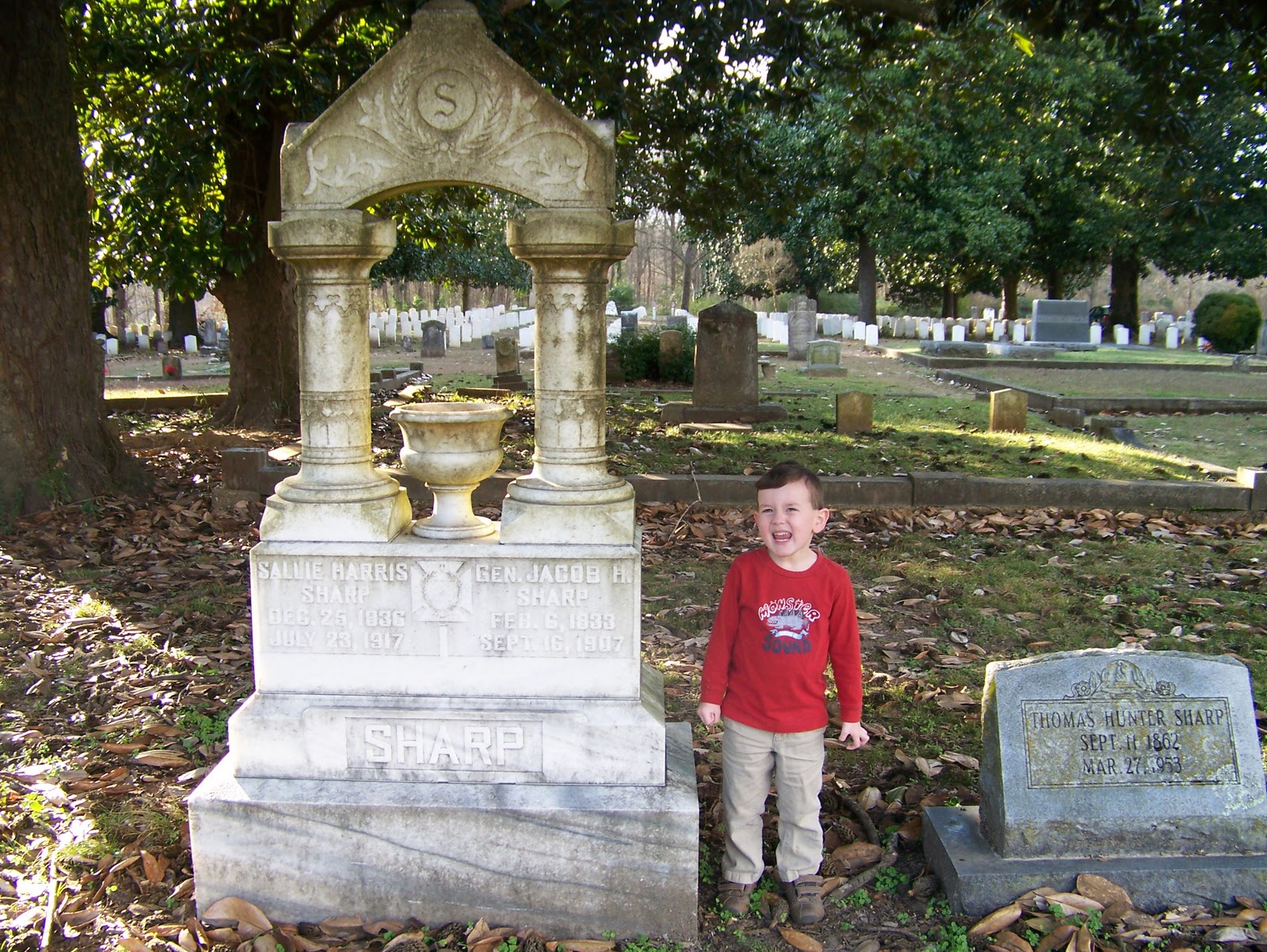
Timmy with General Sharp

       Brigadier General Jacob Hunter Sharp is also buried in this cemetery.  General Sharp led a brigade in the Army of Tennessee from Chickamauga to Bentonville.  


Me and Timmy with Phillip Roddey

       We arrived in Tuscaloosa only 30 minutes before sunset.  While I was frantically hunting the graves of Brigadier Generals George D. Johnston and Phillip D. Roddey Jerry was being entertained by two police officers attempting to arrest a man in a house next to the cemetery.  General Roddey was called 'the defender of the Tennessee Valley'.  


Timmy and I with Josiah Gorgas

       It was almost dark when we found the graves of Josiah Gorgas and S.A.M. Wood.  Wood was a native of Florence, Alabama.  He saw action from Shiloh to Chickamauga where he lost control of his brigade during a night fight and resigned.  One could throw a stone from these two officers graves and hit Bryant Denny Stadium.  It had been a great trip. We had gotten ten generals grave photos.  Any trip with Jerry that doesn't end with an arrest is a good trip.


Timmy in the cemetery with Bryant Denny Stadium in the back