Showing posts with label albert sidney johnston. Show all posts

Sunday, October 26, 2014

The Shiloh Commanders Killed


General Albert Sidney Johnston at Shiloh

       After writing a three part blog about the Confederate colonel's killed or mortally wounded at the Battle of Gettysburg, I decided to do the same for the regimental commanders and above killed at Shiloh. There weren't as many colonel's killed at Shiloh (nor at any other battle for that matter), so I decided to include anyone that commanded a regiment regardless of his rank when killed. 
       Colonel James Tappan who would later become a Confederate brigadier general was absent because of sickness at the Battle of Shiloh. Lieutenant Colonel Adam D. Grayson was in command of the 13th Arkansas Infantry on the first day of the battle. The 13th Arkansas was a part of A.P. Stewart's Brigade, of Clark's Division, Leonidas Polk's Corps at Shiloh. Grayson was mortally wounded and died 11 days later. Grayson was mortally wounded while leading a charge. No one knows the exact location of his grave to this day. Grayson, born in Tennessee, was 24 years old, had a wife and six kids. 
       Colonel A.K. Blythe was an attorney born in Tennessee when he arrived at Shiloh in command of the 44th Mississippi Infantry. At the time of the battle, the regiment was known as Blythe's Mississippi Regiment. When the war began in 1860, Colonel Blythe was 39 years old with a wife who was 28 years old. The couple had no children in 1860. They lived in Oakland, Mississippi Colonel Blythe was shot dead while leading his regiment forward on the first day of Shiloh. At the moment of his death, he was leading his men as a conspicuous target on horseback. 


Lieutenant Colonel David Luckie Herron

       When Colonel Blythe fell, Lieutenant Colonel David Luckie Herron took command of the 44th Mississippi Infantry. He was killed about 2 p.m. on the first day of the Battle of Shiloh. He was a pre-war prosperous farmer. He took command of the regiment following the death of Colonel Blythe. According to the 1860 census, there is no age and no state of birth. This confuses matters greatly. Looking at his photograph above, one might conclude that David Luckie Herron was not yet 40 years old. His body servant recovered his remains and brought them home to Coffeeville, Mississippi for burial. He rests there today. Colonel Herron was probably about 37 years old. 
       Charles Wickliffe commanded the 7th Kentucky Infantry at Shiloh. He was a graduate of West Point and was born in 1819. He had fought in the Mexican War and was a lawyer when that conflict was over. When he was killed at Shiloh, he had a wife and two sons back home in Kentucky. He was killed from wounds received on Monday near the end of the battle. He was leading his regiment forward attempting to regain control of the field from the Federals. He was forty-three years old. He rests today in Bardstown City Cemetery in Bardstown, Kentucky. 


General Albert Sidney Johnston

       The highest ranking field officer of the Civil War was Albert Sidney Johnston. I have already written a blog or two about him and won't go into repetitive detail here. For more information, see my blog on the great man from a year or so ago.
       Major Anatole Placide Avegno commanded the 13th Louisiana Infantry at Shiloh. He survived the first days fighting and was mortally wounded on April 7, 1862. He would die later the same die on the field of battle. His commander Randall Lee Gibson had been moved up to command of the brigade the day before. Major Avegno was 26 years old. He rests today in Saint Louis Cemetery Number 1 in New Orleans, Louisiana. 
Adley Hogan Gladden.jpg

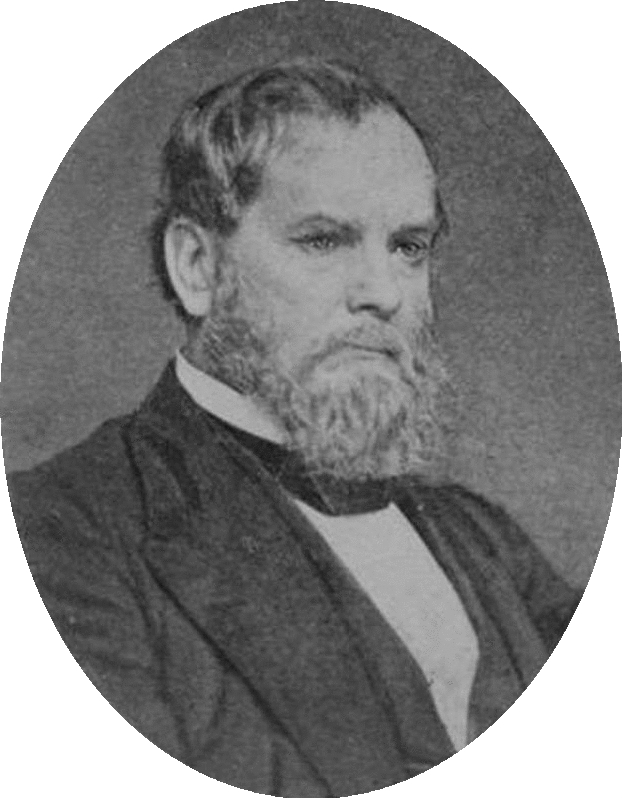
Brigadier General Adley Hogan Gladden the other Confederate General killed at Shiloh

       Brigadier General Adley Hogan Gladden was the other Confederate General that fell at Shiloh. I recently took my brother-in-law, his son, and our father-in-law to Shiloh and showed them the spot on the field where General Gladden fell. In the visitor center is the sword of General Gladden. I explained to them how important this sword happens to be because I have held a sword that belonged to Nathan Bedford Forrest after the war and the diary that was in Brigadier General Lewis Henry Little's pocket when he was killed at Iuka. I can never complain in my old age (which happens to be very soon for me) about not being treated right. I can never complain because I have had opportunities that I never thought I'd get with Confederate general's personal belongings. 
       Lieutenant Colonel William A. Rankin commanded the 9th Mississippi Infantry at the Battle of Shiloh. He was wounded during the battle and died six or seven days later in Corinth, Mississippi. To learn more about how these guys returned to Corinth, read my book called "Betrayed." 
       

Lieutenant Colonel John M. Dean of the 7th Arkansas Infantry

       John Dean was killed at Shiloh leading the 7th Arkansas Infantry as a part of Hindman's brigade at the battle. He has a stone at Oakwood Cemetery at Spartanburg, South Carolina, yet that stone is a cenotaph, his body was buried on the field and never recovered. His body probably still rests in a trench at Shiloh today. 
       Archibald Kennedy Patton fell at Shiloh on the first day of battle on April 6, 1862. He was forty-two years old. As commander of the 15th Arkansas Infantry, a regiment in Patrick Cleburne's Brigade of Hardee's Corps at the battle. 
       Christopher Harris "Kit" Williams, colonel of the 27th Tennessee Infantry was killed on the first day of the Battle of Shiloh. The regiment lost over half of its command on the first day at Shiloh. They served at Shiloh under the command of S.A.M. Wood and his brigade served in Hardee's Corps. Colonel Williams was 32 years old at the time of his death. He rests today on Cedar Grove Plantation in Yazoo City, Mississippi. 
       When Colonel Williams fell, his second in command Major Samuel T. Love took command of the regiment. Once Colonel Williams and his second in command Lieutenant Colonel Blackburn Brown was severally wounded, Major Samuel T. Love took command of the regiment. He too would fall in the great Battle of Shiloh. Commanding the 27th Tennessee Infantry, he would be mortally wounded and captured. Carried north to Mound City, Illinois, he would die there and be buried in Mound City National Cemetery, something that rarely happened to Confederate soldiers. 
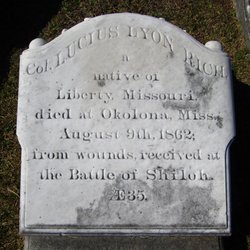
       
Col Lucius Loomis Rich

Lucius Rich's Gravestone

       The biggest surprise of all for me when writing this blog was the founding of Colonel Lucuis Lyon Rich's grave in Mobile, Alabama. I've actually spent quite a bit of time with my good buddy Jerry searching Magnolia Cemetery in Mobile, Alabama. I had been told by Confederate General John Bell Hood's nephew when I was writing my book "Die Like Men" that his good West Point friend Lucius Rich had fought for the north and died in battle at Shiloh. I was surprised to find that Lucius Rich was a Confederate colonel that died at Shiloh and was buried at Shiloh. I can't blame Sam Hood (the nephew of John Bell Hood for this mistake, more than likely it was my mistake because of my ADD, I probably heard what I wanted to hear). Nevertheless, I now know that Lucius Rich was mortally wounded at Shiloh, brought back to Okolona, Mississippi where he died two months after being wounded in Tennessee. 
       This brings us to the last of the regimental commanders that served and died at Shiloh. Colonel Charles G. Nelms (listed in the Official Records as Charles S. Nelms) was mortally wounded on the last day of the Battle of Shiloh on April 7, 1862. He died 8 days later on April 15, 1862. At the time he was in command of the 22nd Mississippi Infantry. His regiment was a part of Statham's Brigade of Breckinridge's Reserve Corps. Either way, he led a regiment against a vastly superior Federal force and gave his life leading him men in defense of their homeland. 
       I carried my wife's sister's husband, their son, and my father-in-law on a tour of this magnificent battlefield this past Friday. The next task I have before me is carrying Shirley McKenzie and her family on a tour of this battlefield, but I have to carry them with my best Civil War buddy Jerry Smith to do things right. Jerry won't allow me to return home and latter that night remember something I left out that I never should have. That is the most difficult part of all. All I have to say is get yourself ready for the tour, Shirley!!!!


Tuesday, September 10, 2013

Beauregard Lost Shiloh Because of Hesitation

Beauregard Lost Shiloh Because of Hesitation


P.G.T. Beauregard

Every student of the Civil War has heard the story about how Confederate General P.G.T. Beauregard blew the Southern victory at the Battle of Shiloh. General Albert Sidney Johnston had worked so hard throughout the day to win a desperately needed victory over Federal Major General Ulysses Grant only to have the victory squandered by Beauregard who stopped the action late in the day believing he would finish up the Union army the next morning.

Each time the story of Shiloh is brought up, one must endure this same story repeatedly. Is this story fact or myth? It is true that Grant's army was pushed all the way back to Pittsburg Landing overlooking the Tennessee River. It is true that many of his men had become demoralized and refused to fight. But in order to understand if Beauregard blew the victory that afternoon, we must look at the condition of the troops Grant had left and the condition of the troops Beauregard had to continue the battle. One must also take a look at the terrain Grant was defending and what Beauregard would have to advance through to reach his position.

Once Johnston was killed at Shiloh, many historians believe a lull fell upon the field that gave the Federal's time to regroup at the landing. The lull actually fell on the field as a result of the capture of over two-thousand Union troops. These men were taken, processed (weapons taken away), and then marched to the rear. Once this was completed, the Confederate's had about one hour of daylight remaining to deal with Grant. Brigadier General James R. Chalmers infantry brigade was given a fresh supply of ammunition and ordered forward. Brigadier General John K. Jackson's brigade was almost depleted of ammo, thus they were sent forward with Chalmers and instructed to rely upon the bayonet. Colonel Robert Trabue's brigade was sent forward with their fellow Confederate's. Two of his regiment's had newly captured Enfield rifles abandoned by the fleeing Federal troops.

These three brigades arrived at the ravine that contains Dill Branch about 6 p.m. For anyone who has walked through the terrain and up the steep hill on the north side of Dill Branch (I am one of those who have), it takes no great imagination to see the obstacle these weary men who'd been fighting since daylight were facing. For anyone who has worn Civil War era brogans on steep mossy ground (again I have), it's extra treacherous.

Hill overlooking Dill Branch

This brings us to the next question of what were these men facing once they actually struggled up that hill. At the top of this ridge, Grant's chief of artillery, Colonel Joseph Webster had arrayed fifty artillery pieces there to hold the last line. Chalmer's wrote about the attempt by his brigade to carry Grant's last line, “In attempting to storm the last ridge we were met by a fire from a whole line of batteries protected by infantry and assisted by shells from the gunboats. Our men struggled vainly to ascend the hill, which was very steep, making charge after charge without success.” He went on to report about a battery of Confederate artillery that was brought forward to assist his men, “Gage's battery was brought up...but suffered so severely that it was soon compelled to retire. This was the sixth fight in which we had been engaged during the day, and my men were too much exhausted to storm the batteries on the hill.”

Grant's last line just above Dill Branch Ravine

Historian James Lee McDonough stated, “Those who have criticized Beauregard for ordering the army to fall back about six o'clock have shown little understanding of the condition of the Rebel army or the terrain they had to cross. He has been criticized for not consulting the other commanders before withdrawing the army, but his decision was the right one and was probably based, at least in part, on intelligence of the total situation of his tired and exhausted troops as supplied by his staff officers.”

This was occurring after 6 p.m. What was happening on the Union side at this time? A brigade of Buell's army had arrived across the Tennessee River from Pittsburg Landing at 5 p.m. At 5:40, this brigade under Colonel Jacob Ammen were crossing the river to reinforce Grant. Also, Major General Lew Wallace's tardy division arrived on the field just after dark.

Beauregard wasn't wrong to call off the assault with what he had available to move against Grant's position at this point. The Confederate army was exhausted having fought all day and most units were low on ammunition. Still, much of the Confederate army was seeing battle for the first time and most units were down to half strength or less. The victory had disorganized the Confederate's as badly as it had their Union counterparts.

So we're left with the question of who was actually at fault for the loss of the Battle of Shiloh? Before entering the United States Military Academy at West Point, Beauregard had attended a school taught by two brothers who had served as lieutenants in Napoleon's army. Beauregard who was already of French descent was further enamored by the great French hero Napoleon.

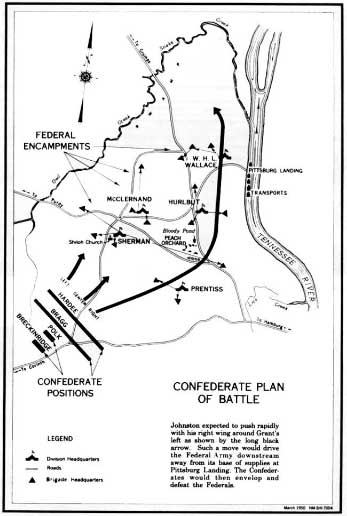
Before departing Corinth for the showdown with the Federal army at Shiloh, Sidney Johnston, Beauregard's superior, wired President Davis in Richmond that his plan of operations was to turn the Federal left flank. In doing this, he would be required to place his strongest corps on the right flank. He told Davis he would place Hardee's large corps on the right, Bragg's corps in the middle, with Polk's weaker corps on the left. The reserve corps under Breckinridge would be placed behind Hardee's corps. What Johnston was attempting to do was push Grant's army away from the river and its route of escape. He wanted Grant's army pushed into the swamps northwest of Pittsburg Landing where they would be forced to surrender.

Beauregard arrived at Corinth recovering from throat surgery. Besides the throat surgery he was suffering from a bronchial infection. Thus he had his chief of staff Thomas Jordan draw up the battle plan. Jordan, understanding Beauregard's love of Napoleon, used the only Napoleonic battle plan he had in hand, the Battle of Waterloo. The plan called for all four corps arrayed in line one behind the other, thus the Confederate army of 40,000 men would strike the Federal army of 40,000 men one corps at a time. Basically, 10,000 men would strike the 40,000 man Union army alone each time.

Beauregard's alignment of the Confederate Army

Sidney Johnston accepted Beauregard's plan without objecting to a single thing. This was a fault that General Hardee had with General Johnston. The man was so easy going that he lacked the ability to override a strong-willed subordinate. Historian James Lee McDonough stated, “Beauregard's...colossal ego...made him fully capable of scrapping a superior's instructions and writing his own.”

The resulting battle plan resulted in confusion and the many ranks jumbled together. Each corps commander had a line almost three miles long and with the terrain and forests at Shiloh, had no way of controlling his entire corps. The result was a mass of men who couldn't be watched over by their own commanders. Most of the Confederate army being green troops with no combat experience made matters even worse.

After the war, President Davis was asked to speak in New Orleans at an unveiling of a monument to Sidney Johnston. With Beauregard in attendance, Davis said, “In the entire Shiloh Campaign, Johnston made only one mistake, he let another officer direct the march to the battlefield.” Davis was only close to being correct. Johnston allowed Beauregard to plan the entire campaign and thus lose that battle. The only difference in history and the myth we've been taught today is the fact that Beauregard lost the Battle of Shiloh before leaving Corinth, not the afternoon of the first day.