Showing posts with label jefferson davis. Show all posts

Sunday, March 1, 2015

Robert Hopkins Hatton: The Purest, Noblest, and Best

Hon. Robert Hatton, Tenn - NARA - 528692.jpg

Robert Hopkins Hatton

       One of the northern born Confederate general's was Robert Hopkins Hatton who was born in Ohio in 1826. The son of a preacher, he moved with his family to Tennessee at the age of eight. At the age of fourteen, he had a severe fever. Physicians prescribed him oral mercury which burned his lips to the point that when he made speeches later in life, his mouth would froth. By 1850, he was practicing law in Lebanon, Tennessee. He was elected to the state legislature in 1855 and ran against Isham Harris for governor in 1857. The two men campaigned hard against each other, at one point they got into a fist fight. Hatton lost the campaign to Harris who would become Tennessee's wartime governor. 
       When the southern states began to secede, Hatton worked tirelessly to keep Tennessee in the Union. His figure was burned in effigy by his hometown because of his pro-Unionist views. All of that was before Abraham Lincoln called for volunteers to invade the South. Hatton lost faith in the Union and joined the Confederate Army. He was elected colonel of the 7th Tennessee Infantry and his regiment was ordered to the mountains of western Virginia. During the cold winter of 1861-1862, he came down with camp fever. His health would suffer in the cold mountains of western Virginia. He attempted without success to have his regiment transferred back to Tennessee. 
       By late May of 1862, he was back in good health and had also received a promotion to brigadier general. His brigade was sent to join Joseph E. Johnston's army guarding Richmond. His brigade arrived on the battlefield of Seven Pines on May 31, 1862. 


Another pre-war photograph of Robert Hopkins Hatton

       Mounted on his horse named "Old Ball," he led his brigade forward across an open field and into a swamp of thick brush. He rode forward, waving his hat, and shouting, "Forward, my brave boys! Forward!" President Davis was on the field personally watching the charge and remarked, "That brigade moves in handsomely, but it will lose its commander." At that moment, the Federal line unleashed a volley into the charging Tennesseans and General Hatton was instantly killed. Some sources say his horse was killed first and General Hatton was killed as he charged ahead on foot. The attack was repulsed, but not before his men brought the body of their beloved commander off the field. 
       Robert Hatton was 36 years old. First buried in Richmond, Virginia, his body was then buried in Knoxville, Tennessee. In 1866, his body would be brought home to Lebanon, Tennessee where he rests today in Cedar Grove Cemetery. His pistol had been found by a Federal officer in the mud the day after his death and thirty years later was returned to his family. The Louisville Journal called Hatton one of the purest, noblest, and best men. 


An obviously retouched photograph of Hatton in a uniform
Gen Robert Hopkins Hatton


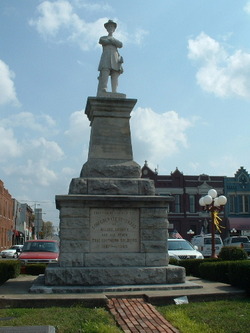
Monument to Robert Hatton in Lebanon, Tennessee
Gen Robert Hopkins Hatton

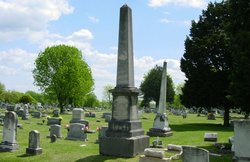
Grave of Robert Hatton

Sunday, June 1, 2014

The Ultimate Civil Wargasm Part IV


The Monument to the Confederate Dead

       While in Hollywood Cemetery, we stopped by the monument to the Confederate dead. All those stones reminded me of my rock climbing days and I began to climb the monument. I got about fifteen feet off the ground when I thought about the caretakers. I was afraid they would toss us from the cemetery before we finished the job at hand, so I came back down. 
       We found Brigadier General Joseph Reid Anderson (Virginia), James Jay Archer (Maryland), Robert Chilton (Virginia), John Pegram (Virginia and killed at Hatcher's run), Samuel Garland (Virginia and killed at Fox's Gap), John Rogers Cooke (Virginia), and Major General Henry Heth (Virginia). We then ran into a snag. We couldn't find Brigadier General Philip St. George Cocke (Virginia). He was an early casualty, not from enemy fire, but from depression. The day after Christmas of 1861, he committed suicide. We were forced to spread out and comb the area around where he is marked on the map. It took us awhile and the temperature had really heated up at this point. Jerry finally found the hard to find grave. 


The writing is barely legible on Cocke's stone

       We then went to the graves of Confederate President Jefferson Davis, Major General Fitzhugh Lee (Virginia), Brigadier General Eppa Hunton (Virginia), David Rumph "Neighbor" Jones (South Carolina), Samuel Jones (Virginia), Thomas Muldrop Logan (South Carolina), William "Extra Billy" Smith (Virginia), Henry Wise (Virginia), Reuben Lindsay Walker (Virginia), William Richard Terry (Virginia) and Isaac Munroe St. John (Maryland). We then visited the grave of Major General Jeb Stuart (Virginia), one of the most famous cavalrymen of the war next to Forrest, but I always consider Forrest as leading mounted infantry. At this point, we kept running into cemetery tours and were getting a lot of strange looks in our jackets.


Stacie and I with Jeb and Flora Stuart

       I hope I didn't leave anybody out. That should be 27 generals if anyone wants to go back and count them. We left the cemetery, found a place to eat, and then headed to the Museum of the Confederacy and the White House of the Confederacy where Davis lived throughout the war. 


Stacie and I standing with President Jeff Davis

       Outside the museum we found the drive shaft and anchor of the Confederate ironclad C.S.S. Virginia. We also posed beside the anchor chain of one of the ships she sank, the U.S.S. Cumberland. We then hit the museum and toured the house. The museum was good, not near as nice as I remembered it back in 1996. The upstairs has been re-arranged to glorify the movie "Gettysburg." Another part of the museum is loaded with post war memorabilia that I could of skipped entirely. Jerry found a display that contained Bedford Forrest's field glasses and I thought I would have to pry him away from it. 
       We found one display that contained all of Lee's wartime things in a mock up of his tent. I told Jerry the cot needed a chicken underneath it. We then noticed that the museum staff had done the right thing and placed an egg beneath the cot. Lee had a pet hen during the war that slept beneath his cot and laid him an egg which he ate for breakfast each morning. 


Notice the egg just behind Lee's boots beneath his cot

       There were a lot of neat displays and some disappointing ones. A lot of things were removed for one reason or another. The trousers that Dorsey Pender was wearing at Gettysburg when he was mortally wounded in the thigh were removed. Jeb Stuart's memorabilia was neat, as was John Hunt Morgan's. The outfit that Jeff Davis was captured wearing is on display. If you remember, Davis was accused of wearing a dress by northern papers. This is not true at all and Davis had his photograph taken in the gray suit he was wearing to prove them wrong. Evidently, people didn't sue the newspapers back then when they reported false stories, but they did challenge editors to duels a lot. 


The gray suit Davis was captured wearing


Jeb Stuart's effects

       We left the Museum of the Confederacy and attempted to head to the battlefields of Gaines Mill, Cold Harbor, and Malvern Hill, but ran into another snag. We were using the GPS on Jerry's phone and it began to act as goofy as Melanie. I think Jerry has this effect on people and machines. I began to think we were stuck in Virginia's version of the Bermuda triangle. His phone kept sending us in circles and back to the toll road. We paid a toll to get on the road and then paid a toll to get off the road at least three times. I was growing frustrated. Unfortunately, Jerry thought I was aggravated at him. He would apologize to my wife at the hotel that night, but I was never upset with Jerry. Maybe I should have been, because since the trip, I've come to the conclusion that Jerry gets a percentage of toll money in Richmond. Why else would he keep sending me through the same toll road over and over?
       I finally got frustrated and decided enough was enough. We left Richmond for Petersburg and skipped the battlefields. I've always wanted to visit these three battlefields and thought I would while on this trip. My mom always said that the one thing the good Lord didn't provide me with was patience. We arrived in Petersburg with enough time to tour the battlefield before dark and visit Blandford Cemetery. I will post that blog another day. 


Monday, September 17, 2012

Joseph E. Johnston: Misunderstood?


General Joseph E. Johnston

       Some of my friends believe the old legend that if President Davis would have left Joseph E. Johnston in command of the Army of Tennessee then Atlanta would not have fallen. I say we take a look at General Johnston's record as a commander and see if it supports the legend. 
       In early March of 1862, General Johnston abandoned the Manassas line before the Federal army ever left Washington. He promised President Davis that he would do his best to secure all the supplies and heavy artillery. Johnston made no attempt to keep this promise. Most of the heavy artillery was abandoned to the Federal army and most of the supplies were burned. A meat processing plant at Thoroughfare Gap was burned along with one million pounds of meat. All this occurred without a single threat of a Federal move. He further surprised the president when he stated that he hadn't selected a line to hold when he retreated. 
       He stated during the Peninsula Campaign that he could make no guarantee's that he would be capable of holding Richmond. The man could have been Union General George McClellan's long lost twin. Neither man wanted to fight at all unless assured of a victory before hand. Unfortunately for Johnston, but fortunately for the South, he was wounded at the Battle of Fair Oaks just east of the capital. Davis turned to a man who would willingly fight the Federals to save his state. Robert E. Lee drove McClellan away from the capital with attacks upon his right flank and by September had invaded Maryland. Johnston would never have accomplished as much.
       During the siege of Vicksburg, Johnston was given a force of 24,000 troops and ordered to assault the rear of Grant's army in an attempt to help Pemberton's forces escape. Johnston refused to move without more men. It was the same thing McClellan had done with Lincoln. Neither man could ever have enough men. Mary Boykin Chestnut the famed diarist of Charleston, South Carolina had told a story about Johnston before the war. He'd been invited to go duck hunting with Wade Hampton. They'd hunted all morning and Hampton had taken several ducks. Johnston had never fired a shot. Each time the birds came by he said they were too high or too far. You see, Johnston had a reputation as a crack shot and if he missed a duck he was afraid his reputation would be ruined. He was the same way in command of an army. As long as he didn't risk a battle, his generalship could never be questioned. 
       My friends use the Atlanta Campaign as evidence of his superior generalship. They claim (along with the legend) that he was luring Sherman far from his supplies and then planned on striking him. I have seen nothing in the record of the man that would make me believe he would ever have attacked Sherman. He would not give President Davis an assurance that he would fight for Atlanta and therefore he was relieved and a man was put in command that would fight. As General Hood stated following the war, if a man couldn't hold the mountains of Northern Georgia, he wasn't much of a general. William Sherman himself stated that Northern Georgia itself was one vast fortress. General Longstreet wrote his friend Joseph Johnston before the Atlanta Campaign began. He understood Johnston's philosophy and wanted to help him. He told Johnston that unless he placed a force on Sherman's flank to force him to protect his long supply line, Sherman would simply turn his flanks all the way to Atlanta and that is exactly what he did. 
       

The late Shelby Foote

       The late Shelby Foote once said that Joseph Johnston was the worst full general in the Confederacy during the war. That is a pretty bold statement and tells you what he thought of Johnston when you had Braxton Bragg as another pretty bad full general. Foote believed the man was afraid to fight and the record supports this claim. 


Johnston monument at Bentonville

       I took my wife to her first reenactment at Bentonville, North Carolina and she was able to see the unveiling of the statue of General Johnston at the time. She was so excited to witness the event. I told her what I thought of the general and how he was quite a bit overrated in my opinion. That didn't deter her one bit. She was still excited to have witnessed something that historic. I suppose she has a point. Studying these men wouldn't be interesting if each of them were alike. I do enjoy learning the parts of the war that are legend and how we come to believe today what was decided by one person and truly isn't very accurate.

Sunday, May 8, 2011

Who killed Albert Sidney Johnston


Albert Sidney Johnston

       There is a mild controversy among historians as to who actually killed Albert Sidney Johnston at Shiloh. The Kentucky born general had adopted Texas as his home state and because of his friendship with Jefferson Davis was made the highest ranking field general in the Confederate Army. Davis had once said, "If Johnston is not a general, then we have no general."
       What is known about Johnston's death is that he led a charge against the Peach Orchard sector of the battlefield. He was struck in the back of the knee, the bullet slicing his popliteal artery and he bled to death on the field. There is more to the story, however. 


Johnston led his men from the far tree line

       On February 7, 1837, Johnston fought a duel with Texas General Felix Huston. He was struck in the hip by a pistol ball. The wound damaged a nerve in Johnston's right leg and he lost a good bit of sensation as a result. When he was struck by the bullet at Shiloh, he had no idea that he'd been wounded. 


Popliteal Artery located behind the knee

       Johnston wore high riding boots and the blood poured into his boot and as a result was unnoticed by members of his staff. It wasn't until moments later that he was observed under a tree slumping in the saddle. His staff took him off his horse and carried him into a nearby ravine and searched for the wound. When they removed his boot, they found it filled with blood. Ironically, Johnston carried a tourniquet with him, but none of his staff understood how to use it. Johnston soon lapsed into unconsciousness and died. 


Site where Johnston was noticed to be wounded


Ravine where Johnston died

       The story gets even murkier at this point. A surgeon dug the bullet out of the back of Johnston's leg and announced that it was an Enfield bullet. Federal soldiers in that section of the battlefield weren't carrying Enfield's. The Confederate soldiers that Johnston was leading in the charge were carrying Enfield Rifles. That would mean in all probability that Johnston was shot by his own men by accident. 
       One account states that Johnston, Harris and Breckinridge placed themselves about forty paces in front of the line of about 5,000 men and led the charge. It was the highest ranking charge in American history. Johnston was the ranking field general in the Confederate Army, Breckinridge was the ex-vice president of the United States, and Harris was the current governor of Tennessee. As a side note, the Confederate governor of Kentucky George Johnson was killed at Shiloh on another part of the field while serving as a volunteer private on line with men from his state.
       

Albert Sidney Johnston in C.S. Uniform

       It can be argued that Johnston was hit in the back of the knee by a Confederate bullet during the charge. It could also be argued that his surgeon misidentified the bullet. One could also argue that Johnston was killed by Felix Huston in the duel 25 years before that fateful day. Had he not had the nerve damage in his leg, he would have felt the wound when it occurred. Regardless, Sidney Johnston remains one of the great what-ifs of the war. I plan on doing another blog on his generalship in the future. 
       It is a strong possibility that Johnston was the first Confederate general to be shot by his own men, but he certainly would not be the last. Stonewall Jackson (Chancellorsville), Micah Jenkins (The Wilderness) and James Longstreet (The Wilderness, but survived) would be other Confederate's hit by friendly fire.