Showing posts with label stonewall. Show all posts

Sunday, July 24, 2011

John Decatur Barry: The man who destroyed a stone wall


John Decatur Barry

       John Decatur Barry was born in Wilmington, North Carolina in 1839. He graduated from the University of North Carolina and was working as a banker when the war began. He was a member of a local militia company that became Company I, Eighteenth North Carolina Infantry. 
       The regiment spent the first part of the war in North Carolina. In April, 1862 the company was reorganized and Barry was made a captain. The regiment was sent to Robert E. Lee's army the next month and fought during the Seven Days battles where they took heavy casualties. Barry himself was seriously wounded at Frayser's Farm. It is believed he wasn't able to return to the army until September. He would enter Maryland with Lee's army where he was commended for his gallantry and bravery and awarded with a promotion to major. Barry would see action at Fredericksburg in December. 
       The low point of Barry's career would occur at the Battle of Chancellorsville on May 3, 1863. After Stonewall Jackson's successful attack on the Federal right flank, the Eighteenth North Carolina was called up from reserve for night operations. A group of horsemen came riding toward the fresh regiment. Barry, thinking it was Federal cavalry ordered his men to open fire. Despite the yells from the riders that they were friends, Barry thinking it was a trick ordered them to fire again. Because of this order, John Decatur Barry had mortally wounded Confederate Lieutenant General Thomas J. "Stonewall" Jackson.
       The battle had been severe on the officer corps of the Eighteenth North Carolina. Out of thirteen field officers, only Barry was unhurt. He had moved from private to colonel in just over a year. He would lead the regiment in Pickett's Charge at Gettysburg and during the Mine Run Campaign. Because of his actions during the Battle of the Wilderness, Barry's commanding officer recommended he be promoted to brigadier. He also saw heavy action at Spotsylvania. 
       When Brigadier General James Lane was wounded at Cold Harbor, Barry took command of the brigade. He would see his first major action in command of a brigade at the Weldon Railroad. General Lee asked Davis to promote Barry to brigadier general in command of Lane's brigade. He would never lead the brigade in battle once he was promoted. While scouting the Federal lines at Deep Bottom, a Federal sharpshooter shot the newly appointed brigadier in the hand which caused him to lose two fingers and remain out of action for the rest of the year. Lee was forced to ask the war department to cancel the promotion which it did. 


Barry as a major

       He would return to duty and again command the brigade in early 1865, but was soon transferred back to North Carolina. After the war he became a newspaper editor. Just two years after the war, Barry would die in Wilmington, North Carolina at the age of twenty-six. The man was noted for his bravery. He rests today in Wilmington's Oakdale Cemetery. 
       It was said that he returned from the war with his health broken, but his friends told a different story about the man's early death. It was said that Barry felt responsible for Stonewall's death and couldn't live with the fact that he may have cost the Confederacy the war that night at Chancellorsville. His friends often said that John Decatur Barry died of a broken heart.


John Decatur Barry's grave

The inscription reads, "I found him a pygmy and left him a giant."
This is in reference to his rise from private to general.


Sunday, March 27, 2011

The Death of another Stonewall


John Stevens Bowen

       Anyone who knows anything about the Civil War will quickly identify "Stonewall" Jackson. Most people with a little Civil War knowledge can identify Patrick Cleburne as the "Stonewall of the West." Very few people know that there was a third "Stonewall" in the Confederate Army during the war. 
       John Stevens Bowen was the other man nicknamed "Stonewall" and lost that nickname due to his death. He is not as famous as Jackson or Cleburne and the reason is simple. Despite being a great commander and well loved by his men, Bowen didn't die in combat. His death was a lot less glorious as the other two "Stonewalls." 
       Bowen was born in Georgia in 1830 and attended the University of Georgia. He left before graduating and entered the United States Military Academy. He was suspended a year because he had refused to tell on another student he'd caught out after hours. He returned to the academy and graduated in the class of 1853. 
       Bowen would spend three years in the U.S. Army before resigning to become an architect back in Georgia. He became a lieutenant colonel in the Georgia Militia before moving to Missouri just three years before the Civil War began.
       Bowen was initially captured in Missouri by Federal General Nathaniel Lyon. Upon his exchange he was quickly given command of a brigade in Leonidas Polk's corps. When Confederate Major General George Crittenden was dismissed from service for drunkenness, the logical choice to replace him was John Bowen. Sidney Johnston chose John Breckinridge instead because Breckinridge was the ex-vice president of the United States and a more popular man among the public. Bowen was relatively unknown. 
       Bowen remained in command of a brigade at the Battle of Shiloh where he was severely wounded and out of action for quite some time. Upon his recovery, Bowen took command of a division under John Pemberton at Vicksburg. He would be Pemberton's most trusted subordinate. 


Bowen: The hero of Port Gibson

       Bowen delayed Grant's approach to Vicksburg at Port Gibson despite being outnumbered and because of his action there he was promoted to Major General. He continued to serve under the inept Pemberton, fighting at Champion Hill and served as Pemberton's rearguard afterward. 
       During the siege of Vicksburg, Pemberton became extremely sick with dysentery. Dysentery was a deadly disease during the Civil War. It was a combination of bloody diarrhea, fever and extreme pain. Bowen was paroled after the surrender of Vicksburg and was travelling with his wife when he was forced to stop near Edwards, Mississippi. On July 13, 1863 just nine days after he was surrendered at Vicksburg, John Bowen died. 


Walton House, death site of John Bowen

       John Stevens Bowen, the other "Stonewall" of the Confederate Army was thirty-two years old. He is not as well known as the other two for several reasons. The way he died helped contribute to this, but also because he died just as he was reaching the best part of his career. He is another Civil War officer that we must ask ourselves the question. Had he lived, what might he have accomplished?


Cedar Hill Cemetery, Vicksburg Mississippi


Wednesday, January 19, 2011

The Black Knight


      Turner Ashby

       Turner Ashby was born in Virginia in 1828. His father, Turner Ashby, Sr., served as a colonel in the War of 1812 and died while he was very young. His grandfather was a captain in the Revolutionary War. Turner Ashby was privately tutored and after finishing, he purchased a farm near his mother's home. He named the home Wolf's Crag.


Wolf's Crag

       Turner Ashby was known for his chivalry, horseman ship, and as an avid outdoorsman. He was a natural leader and when the war began, he took command of a cavalry unit. The man was described as about five feet, eight inches, weighing about one hundred-sixty pounds and had a dark complexion from all the time he'd spent outdoors. He earned the nickname 'Black Knight of the Confederacy' because of his jet black hair and dark eyes. Always riding either a solid black horse or a solid white horse, he was a fearless leader. His command would follow him anywhere, but he was without formal military training and had lots of trouble because of his lack of discipline.
       Ashby was soon assigned to Stonewall Jackson's command in the Shenandoah Valley. Jackson gave him the job of patrolling the Potomac River north of the valley. In an engagement there, his brother Richard Ashby would be killed. Turner was told that Richard was bayoneted to death while attempting to surrender. No one for certain exactly what happened there, but regardless, Turner believed the story. From that point forward, he hated Northern troops and fought with a vengeance. 


Ashby in the militia uniform of Virginia before the war

       Ashby was soon promoted to colonel and given command of the 7th Virginia Cavalry Regiment. Many were pushing for Ashby to be promoted to brigadier general, but Jackson was against the idea. Jackson didn't think Ashby was capable of higher command because of the lack of discipline in his command and no proper military training. A brave fighter, Ashby never learned how to properly drill his men. Despite what Jackson suggested, Ashby was promoted to brigadier general in May of 1862. He would hold that rank for just ten days.
       Although Ashby was brave to a fault, there were times when he failed Jackson. Cavalry being the eyes of an army, it was Ashby's job to give Federal positions and troop strengths. At Kernstown, he greatly underestimated the size of the Union army. Jackson attacked the position and was defeated. Near Winchester, Virginia, after Jackson's infantry had defeated Nathaniel Banks force, Ashby's soldiers were too busy plundering captured wagons and allowed the retreating enemy to escape. Had Ashby's men been trained properly and disciplined, most of Banks force would have been captured.
       On June 6, 1862, General Ashby was fighting a rearguard action near Harrisonburg, Virginia. His force was being attacked by both Federal cavalry and infantry. His men easily repulsed the first attack. When the second attack began, Ashby's horse was killed. Rising from the ground, Ashby charged the enemy force, yelling, "Forward, my brave men!"


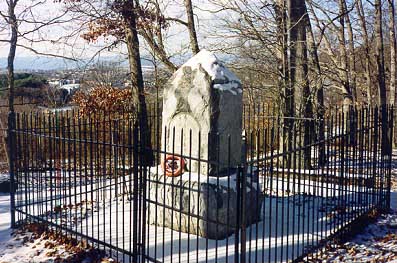
Monument marking the place where Ashby was killed

       Those were his last words. A bullet had hit him in the heart. He was killed instantly. It has been suggested that he could have been hit by friendly fire leading his men forward, but this seems highly unlikely. Turner Ashby's body was carried to the Kemper Home in Port Republic, photographed and then laid out in one of the rooms. Jackson soon arrived to view his remains.


Frank Kemper Home

       Despite the differences between Jackson and his cavalryman, the Confederate commander retired to his tent when he learned of his Ashby’s death. He later wrote, “As a partisan officer I never knew his superior; his daring was proverbial; his powers of endurance almost incredible; his tone of character heroic, and his sagacity almost intuitive in divining the purposes and movements of the enemy.”


Room where Jackson viewed Ashby's body

       Ashby rests today in the Stonewall Cemetery, Winchester, Virginia next to the body of his brother Richard. Turner Ashby was thirty-three years old. 


Ashby photographed in death


Grave of both Turner and Richard Ashby


Sunday, January 2, 2011

Who is Richard Brooke Garnett


Long believed to be a photo of Richard Brooke Garnett

       Richard Brooke Garnett came from a famous Virginia family. His cousin Robert Selden Garnett was the first Confederate general to die in the Civil War. Like his cousin Robert, Richard attended West Point and was serving in the United States Army when the war began. When Virginia seceded from the Union, he immediately resigned his commission and entered Confederate service.
       He is now known as a hero because of his bravery at Gettysburg, but that wasn’t always the case. Being a Virginian, he rose to take command of the famed “Stonewall Brigade” and his career took a turn for the worse after the Battle of Kernstown. Jackson had received bad intelligence and attacked a Federal force twice the size of his own. Garnett’s brigade found itself being overwhelmed and running low on ammunition. In order to save his men, he ordered a retreat. 
       General Jackson was so infuriated by the action that he had Garnett arrested, accusing him of cowardice in the face of the enemy and neglect of duty. The entire episode is a black mark on the career of Stonewall Jackson. Garnett had undoubtedly done the right thing, but Jackson had accomplished his goal. None of his subordinates would ever retreat again without orders. (Ironically, Garnett didn’t hold a grudge against Jackson. He believed the entire incident was a huge misunderstanding and after Jackson was killed at Chancellorsville he served as a pallbearer in his funeral.)
       General Robert E. Lee released Garnett from arrest and placed him in command of George Pickett’s brigade of Virginians. All  General Garnett wanted was a chance to redeem his honor. In command of his new brigade, he saw minor action at Antietam, was held in reserve at Fredericksburg and missed Chancellorsville entirely. 
       Needless to say, Richard Garnett wasn’t a happy man when he arrived at Gettysburg. He had been kicked by a horse a few days earlier and was unable to walk. He was running a high fever, wearing a coat in the hot July sun because of chills. Lee ordered all officers to walk during “Pickett’s Charge” because of the target a man on horseback would make. Garnett couldn’t walk and refused to miss the battle for fear he would be called a coward again. 
       Richard Garnett would ride his large black horse “Red Eye” to just in front of the clump of trees. Garnett never pulled his sword, but cheered his men forward with the black felt hat he wore. At some point    he was hit by canister fire, some say in the waist. His blood covered horse was seen galloping toward the rear. 


Death site of Richard Garnett

       Richard Brooke Garnett was never seen again. Years later, his sword was found in a Baltimore pawn shop by Confederate General George Hume Steuart.


Garnett's sword

       The mystery of General Garnett only began with the finding of his sword. There is a picture long thought to be that of Richard Brooke Garnett, but many believe that picture is of his cousin Robert Selden Garnett who was killed at Corrick’s Ford. According to a family member Garnett was the opposite of his cousin, having blonde hair, blue eyes and no beard. This family member wrote this description in 1908 and many historians believe he never met Richard Garnett. Interestingly, the family of Richard Garnett identified the original photograph as that of the general at the time of the war. Why would they identify the original photograph as Richard if the photograph is indeed Robert. 


Robert Selden Garnett

       To further complicate the matter, many believe that a photograph labeled as Confederate Major General Franklin Gardner is actually a picture of Richard Garnett. The matter became even more complicated a couple of years ago when a photograph surfaced with Richard Garnett’s name on the back. It shows a blonde haired gentleman that looks nothing like Robert Selden Garnett. Another historian believes this photograph is actually Confederate congressman Muscoe Russell Hunter Garnett of Virginia. 


Confederate General Franklin Gardner


Photograph labeled Franklin Gardner that many believe is that of Richard Garnett


Mystery Photograph with Richard Garnett's name on the back

       Prior to the Civil War, Garnett had a son by an Oglala Souix woman. They named the boy William “Billy” Garnett and there are several photographs of him in existence. Many historians try to take this photograph and compare them to the three photographs claimed by many to be Richard in order to figure out which is the famed general. 


Billy Garnett

       Garnett’s body was never found following the grand charge and many believe he was probably reinterred with the Confederate dead of Gettysburg in Hollywood Cemetery. The question still remains, which of these three are Richard Brooke Garnett or is it possible he never had a photograph taken that survived. We may never know. 


Monument in Hollywood Cemetery for Richard Brooke Garnett


Monday, November 22, 2010

Death of Confederate General Cobb: A Conspiracy Theory

      
        Confederate Brigadier General Thomas Reade Rootes Cobb was born on April 10, 1823 in Jefferson County, Georgia. Incredibly, he weighed twenty-one and one-half pounds at birth.
He attended college at what is now the University of Georgia and finished first in the class of 1841. He became a lawyer in the state of Georgia before his nineteenth birthday. By the time the Civil War began, he had accumulated a fortune worth 120,000 dollars and owned 23 slaves.
Thomas Cobb was known for his mercurial temper. During the war, he constantly complained about his superiors especially Jefferson Davis and Robert E. Lee. He was always faultfinding and finding reasons to argue with others. Elijah H. Sutton, one of his soldiers, declared that his own men despised him. W.R. Montgomery claimed that his men admired him because he was brave and gallant.
        The brigadier seemed to be paranoid, once writing about General Lee, “Lee hates me and sneers whenever my name is mentioned.” After meeting Lee, he wrote, “Lee is haughty and boorish and supercilious in his bearing and is particularly so to me.”
He missed all major combat until December, 1862. He was present with his brigade at Fredericksburg. Ironically, his first major battle would also prove to be his last. Cobb’s brigade held the Stone Wall at the Battle of Fredericksburg. He was seen waving his hat over his head and crying to his men, “Get ready, boys, here they come.”
As to what happened next remains a mystery. According to historian Robert K. Krick, a piece of artillery shrapnel struck General Cobb in the left thigh and severed his femoral artery. General Cobb collapsed in the sunken road about two in the afternoon and bled to death. 
        In 1901, an anonymous veteran announced that General Cobb had been killed by a Confederate soldier who lived at Lost Mountain. According to this veteran, General Cobb had berated several men for stopping on a march to fill their canteens with water. Cobb had then ordered them to pour out the water, but one soldier had refused. He then told the others that he would kill Thomas Cobb when the first opportunity presented itself. 
According to this anonymous veteran, General Cobb was killed by a shot from Phillip’s Legion, the same unit that this man served with. This veteran approached the man who had made the threat against the general and asked, “Sam, did you shoot General Cobb?”
(Sam was later identified as Samuel Drake of Phillip’s Legion.) Sam replied, “Well, I got him.”
         Later in the battle, Samuel Drake was shot in the chest and carried to the field hospital. The anonymous veteran went there and asked him, “Sam, you are going to die and I want you to tell me did you kill General Cobb?”
“I did,” Sam replied, “I always do what I say I will.”
According to this anonymous veteran, he had spoken to General Cobb’s descendants after the war and they told him they had always known that Thomas Cobb was killed by one of his own men.
Historian Robert K. Krick writes, “That story cannot be substantiated and in fact is clearly inaccurate, its calm assertion lends credence to the other negative declarations about Cobb.” 
Doctor Gilmore, chief surgeon of McLaws division stated that Cobb was hit by a bullet that passed through a plank fence and a tourniquet would have saved his life. He stated that N.H. Hammond of Flippen, Georgia was within thirty feet of Cobb and can substantiate that the general died in this way. 
According to Derek Smith, author of The Gallant Dead, General Cobb was hit by either artillery shrapnel or a Federal sharpshooter. He fails to mention the friendly fire theory at all. 
        General Joseph Kershaw reported that Cobb was killed by Federal sharpshooters posted near his left flank. Colonel Porter Alexander reported that Cobb was killed by a Union sniper about one hundred and fifty yards from his front. 
        It seems fitting that a man that was so paranoid would be surrounded by controversy as to who killed him following his death. There were several Confederate generals hit by friendly fire, Stonewall Jackson being the most famous. Micah Jenkins and James Longstreet were also hit by friendly fire. Thomas Reade Rootes Cobb seems to be the only one that a witness has come forward and claimed that it was intentional. Was Cobb shot by Samuel Drake? The story seems a little far fetched and we will probably never know.