Showing posts with label south carolina. Show all posts

Thursday, May 28, 2020

Clement Hoffman Stevens: "Rock"

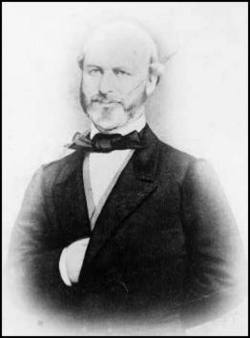
Clement Hoffman Stevens (1821-1864) - Find A Grave Memorial

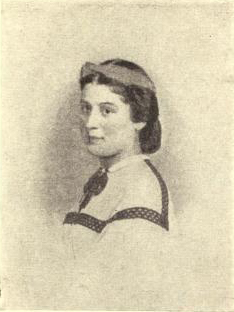
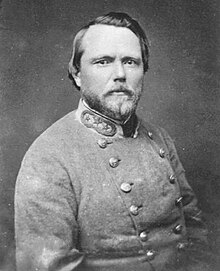
A Pre-War photograph of Clement Hoffman "Rock" Stevens

       Clement Hoffman Stevens was born in 1821 in Norwich, Connecticut. His father (a Southerner by birth) was serving in the United States Navy at the time. While a child, Stevens family moved to Florida. When the Seminole War began the family moved to Pendleton, South Carolina (his mother's place of origin) for a safer environment. Like his father, Stevens also joined the Navy and served under two officers that were relatives of his. He married the sister of future Confederate generals Barnard E. Bee and Hamilton P. Bee. 
       Stevens didn't remain in the Navy long before entering the banking business in Charleston, South Carolina. When the Civil War began, Stevens dove into military studies and became an expert on Civil War ordnance. He was already a colonel in the South Carolina Militia when the war began. Stevens built a battery in Charleston Harbor using railroad iron to protect his gunners. He then traveled with his brother-in-law Brigadier General Barnard E. Bee to Virginia where he served as a staff officer during the Battle of Manassas. His brother-in-law was killed during the fighting there while Stevens was seriously wounded. 
       He returned to Charleston and took command of a militia regiment. He and Ellison Capers raised the 24th South Carolina Infantry. Stevens would become their colonel and Ellison Capers was made his lieutenant colonel. Both men would become general officers by the end of the war. He led the regiment in the Battle of Secessionville where he stopped the Federal attack. He remained on the east coast for the next year. During the spring of 1863, his regiment was assigned to Brigadier General States Rights Gist's brigade and sent to Jackson, Mississippi to assist Joseph Johnston's army relieve besieged Vicksburg. Johnston failed to move in time to assist Pemberton and soon Vicksburg was forced to surrender. Gist's brigade was then sent to the Army of Tennessee and fought at the Battle of Chickamauga. A funny incident occurred before the battle. While the battle raged the first day, Gist's brigade was stranded in Rome, Georgia because a railroad engineer was sleeping. Stevens was so angry that he threatened to shoot the man. Stevens had two of his men fire the boilers of the locomotive and forced the engineer to drive them to the battlefield at gunpoint. 
       At Chickamauga, he was severely wounded again and had two horses killed beneath him. His division commander William H.T. Walker called him "iron-willed" and recommended him for promotion for his gallantry as a leader in combat. Colonel Clement Hoffman Stevens became Brigadier General Stevens in January of 1864. He was given command of W.H.T. Walker's old brigade when its new commander Brigadier General Claudius C. Wilson died of fever. His brigade participated in the Atlanta Campaign but saw limited action. General Stevens earned the nickname "Rock" at this time from his troops for his steadiness under fire. Stevens was upset at the replacement of Joseph E. Johnston before the engagements around Atlanta.
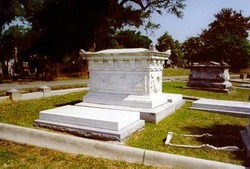
       In the first battle for Atlanta at Peachtree Creek, Stevens was leading his brigade on horseback in a charge against Federal breastworks. Sources conflict each other about whether he was hit by a bullet or artillery fire. Either way, he was struck in the head by a projectile that fractured his skull behind his jaw. While being carried from the field by two officers, they were also shot. Stevens was carried to Macon, Georgia where surgeons removed what they called a bullet and bits of bone. General Stevens died on July 25, 1864. He rests today in St. Paul's Episcopal Cemetery in Pendleton, South Carolina along with his brother-in-law General Barnard E. Bee. General Stevens was 42 years old. His wife Ann had died two years earlier and he left behind two sons. 
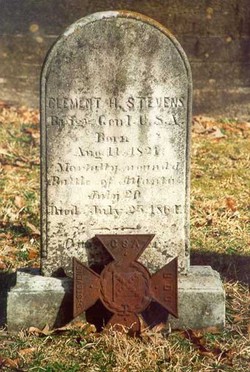
Picture of

Grave of General Stevens
Thursday, March 26, 2015

James Conner: The General and His Unlucky Leg


Brigadier General James Conner

       James Conner was born in Charleston, South Carolina in 1829. He became a lawyer and began his practice in 1852. He soon became a United States Attorney and tried a case involving the illegal slave trade. Like most in South Carolina, James was a secessionist. When the war began, he became a captain under Wade Hampton in the Hampton Legion. Sent to Virginia, he soon had a minor dispute with fellow officer and future Confederate general Matthew Butler. The two seemed to be advancing together against Union forces, when Butler attempted to get all the credit for a victory and moved too quickly allowing the Federals to escape. 
       At the Battle of Manassas, when Hampton and other commanders were wounded, Conner took over the Legion and following the battle was promoted to major. In the spring of 1862, he was made colonel of the 22nd North Carolina Infantry that needed an experienced commander. At the Battle of Mechanicsville, a bullet struck him in the leg and broke a bone. He was out of action for two years because of the ugliness of the wound. During that time he served on various military courts. 
       On June 1, 1864, Conner was promoted to brigadier general and given command of Samuel McGowan's South Carolina brigade. He was still not fit for extreme field service, so Lee assigned him to Chaffin's Bluff. He then proceeded as part of Kershaw's Division to participate in Jubal Early's Shenandoah Valley Campaign. Just a few days before the Battle of Cedar Creek, a shell fragment struck him in his "unlucky leg." The shrapnel passed through Conner's knee and shattered the bone. This time the limb would be amputated close to his hip. Thus ended the war for Brigadier General James Conner. 


The only other known wartime photograph of James Conner

       Conner would return to his law practice following the war. Had injury not kept him from so much of the war, he may have become one of the great generals we read of today. James Conner was a friend of both Robert E. Lee and Pierre Beauregard. He would die in Richmond, Virginia in 1883 at the age of 53. He died of bronchitis. His wife Sallie would outlive him by 44 years, dying in 1928. James Conner rests today in Magnolia Cemetery in Charleston, South Carolina, the city of his birth.


Sallie <i>Enders</i> Conner

Sallie Enders the wife of James Conner


A photograph of Sallie sometime before her death

James Conner

Graves of both James and Sallie Conner


Thursday, March 19, 2015

Stephen Elliott, Jr: The Artillery Officer Turned General of Infantry


Brigadier General Stephen Elliott, Jr.

       Stephen Elliott, Jr. was born in Beaufort, South Carolina in 1830. He attended Harvard, but withdrew before completing his studies. Prior to the war, he was a planter, politician, and captain of an artillery militia battery. His battery helped in the taking of Fort Sumter at the beginning of the war. He then began his service protecting Charleston Harbor. He was wounded in the leg while in command of Fort Beauregard while defending Port Royal, South Carolina. The wound was a result of a rifled cannon exploding upon the thirty-second shot of the battle. A fragment from the barrel struck him in the leg. Luckily for Elliott it was a slight wound. Elliott also led his command to victory at the Battle of Pocataligo near Yemassee, South Carolina. 
       Elliott was soon recommended for promotion by both William S. Walker and Robert E. Lee. Lee described Elliott as "one of the best officers in the Department...he exhibited intelligence, boldness, and sagacity." As a result he was promoted to major of artillery. Elliott led his command in several raids and even captured Federal boats. 
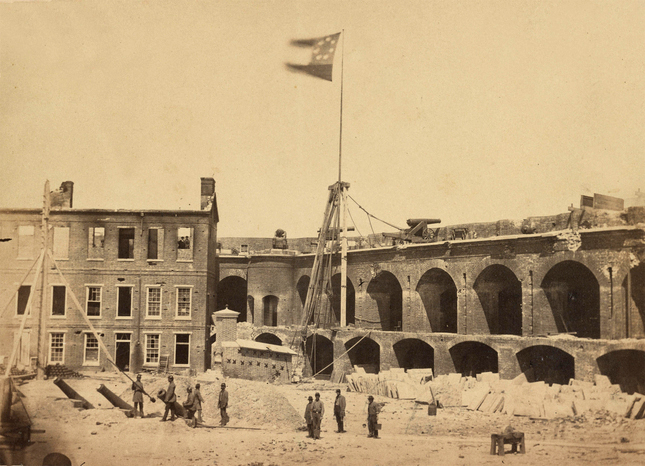
       He returned to Charleston in 1863 and served under General Beauregard there. Beauregard was thoroughly impressed with Elliott and placed him in command of Fort Sumter. Elliott strengthened the fort and as a result, the structure withstood 19,000 Federal artillery rounds being hurled against it. Elliott would be forced to take a leave of seventeen days when a powder magazine exploded in the fort wounding him in both the head and ankle. His head wound healed rather quickly, but his ankle gave him trouble for some time. Elliott soon became a Confederate hero for his actions at Fort Sumter. Beauregard immediately recommended him for promotion. 
       

Fort Sumter under Confederate control

       Elliott was soon sent to guard the Weldon Railroad just below Petersburg, Virginia. The regiment he commanded was a part of William S. Walker's brigade. Walker had been Elliott's commander back in South Carolina early in the war when they fought around Port Royal. When Walker accidentally rode into Federal lines, was wounded, and captured, Elliott was promoted to brigadier general on the recommendation of General Beauregard again. He would see action at Bermuda Hundred and Petersburg. 
       The most difficult day of the war for Elliott would occur on June 30, 1864 having been a general officer just over a month. Burnside's IX Corps occupied the trenches across from Elliott's brigade and had some Pennsylvania coal miners in his command. They dug a tunnel beneath a position known as Elliott's Salient. Inside the small earthen fort was the 18th, 20th South Carolina Infantry, and a four gun battery commanded by Captain Richard Pegram. Most of these commands would be destroyed when the powder filled mine exploded. 


Me and my buddy Jerry standing at the entrance to the mine


Me standing across the crater for scale

       Stephen Elliott reacted quickly by leading a counterattack against the Federal troops who charged into the huge hole left in the ground. He was wounded by a bullet striking him in the chest and passing through his left lung. He was carried to the rear, the wound believed to be mortal. Elliott's father and wife came to see him in Petersburg before his death. Soon, doctors realized that Elliott was going to survive and although his left arm was partially paralyzed, he obtained a furlough. He was unable to return to command for several months. 
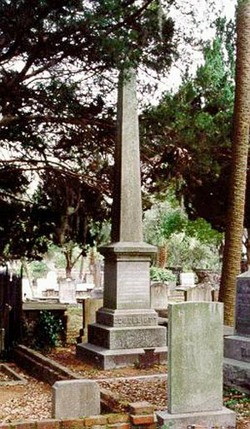
       Elliott would recover in time to participate in the last battle under Joseph E. Johnston at Bentonville, North Carolina. During this battle, he was wounded in the arm and his old Petersburg wound was reopened. Elliott was home on furlough when the army surrendered. With the finally over, Elliott planned to return to politics. Unfortunately, the doctors had been correct when they had called his Petersburg wound fatal. His health shattered, he died on February 21, 1866 in Aiken, South Carolina. He rests today in Saint Helena's Episcopal Churchyard in Beaufort, South Carolina. He was 35 years old. Most historians agree that Elliott would have made a name for himself to rival Wade Hampton and others had he spent the entire war in Lee's Army of Northern Virginia. Lee himself appreciated Elliott's leadership. 

Stephen Elliott, Jr

Resting place of Stephen Elliott, Jr.


Another view of Stephen Elliott, Jr.

Wednesday, December 17, 2014

Samuel McGowan: The Fifth Avenue Ghost


Brigadier General Samuel McGowan

       Samuel McGowan was born on October 9, 1819 in Laurens District, South Carolina. He graduated from South Carolina College and read law before being admitted to the bar. He was known for his speaking skills. Soon he was elected to the state legislature. He served in the Mexican War as a captain and was commended for his actions at the Battle of Chapultepec. Following the war, he returned to his law practice and rose to the rank of major general in the South Carolina militia.
       His first action occurred as he commanded a brigade at the bombardment of Fort Sumter. He served on Brigadier General Milledge Luke Bonham’s staff at the Battle of First Manassas. Following the fighting there, he was assigned to the 14th South Carolina Infantry where he rose to the rank of colonel. This regiment became a part of Maxcy Gregg’s South Carolina brigade in the Army of Northern Virginia. They saw heavy fighting during the Seven Days battle’s and McGowan was slightly wounded at Gaines’ Mill, though he never left the field.
       He would be severely wounded at Second Manassas. This would mean he missed the Battle of Antietam (Sharpsburg). He would be back in command of his regiment at the Battle of Fredericksburg. Maxcy Gregg was mortally wounded during this battle and McGowan was promoted over two senior colonels to command the brigade. His commission to brigadier general would rank from January 17, 1863. He wasn’t a strict disciplinarian, but was a confident commander.
 His first action as a brigadier general occurred at the Battle of Chancellorsville. Attacking a line of breastworks, his brigade was repulsed, but not before McGowan was struck below the knee by a bullet. He would be out of action until February of 1864, meaning he would miss Gettysburg. When he returned, he was forced to use a cane.
McGowan’s South Carolina brigade was broken at the Battle of the Wilderness. He reformed his men in the rear and led them back to the fight. At Spotsylvania, his brigade helped save the Confederate Army when the “Mule Shoe” was over ran. He was struck in the right arm by a bullet during this attack and would not return to duty until the brigade was in the trenches of Petersburg. He would surrender with his men at Appomattox.
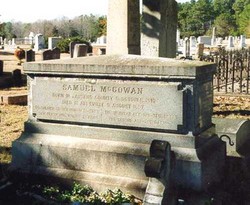
       Following the war, he would eventually return to the state legislature and then serve as a judge on the state supreme court. He died in 1897 at the age of 77 and rests today in Long Cane Cemetery, Abbeville, South Carolina. 

Samuel McGowan

Grave of General McGowan

       Perhaps his time on earth didn’t exist there. I’m not a big believer in ghosts, but my buddy Jerry Smith is a strong believer. (He claims he saw one in a clothes basket once. I think it was trying on his dirty underwear.) In 1953, a series of séances were conducted on Fifth Street in New York City. The people conducting the séance were given some pretty accurate details about General McGowan (supposedly by his ghost) and his life after the war when he lived sometime in New York. These people wrote a book called The Fifth Avenue Ghost about these events. The problem I had with the book is the fact that McGowan claimed he was choked to death by the boyfriend of his mistress. Everything I have ever found on the death of McGowan states that he died in South Carolina. Nevertheless, it was interesting and a good read.


Thursday, January 6, 2011

A Vision Across The Miles


Confederate Brigadier General States Rights Gist

       Confederate Brigadier General States Rights Gist was standing on Winstead Hill just south of the town of Franklin on November 30, 1864. He was busy trying to convince his servant Wiley to saddle his horse “Joe Johnston” for the coming charge because his other horse “Kitty“ was broken down. Wiley tried his best to persuade Gist not to ride this particular horse, saying, “Marse States, you ain’t got no business riding Joe. Joe ain’t got no sense when the bullets come around.”
       Gist had no choice because “Kitty” was stumbling as she walked. He replied, “He’ll just have to get used to the bullets.”
       Gist also realized the danger the frontal assault would present. He told his servant, “Wiley, you take charge of my money, my watch and ring. I might get tripped up this evening. Use what money you need, and if anything happens, take the watch and ring to my wife.”
       

Photo of Gist in the South Carolina Militia

       At that same moment almost four hundred miles away, General Gist’s brother Nathaniel lay of his deathbed with a fever. Their sister Sarah sat next to the bed attempting to make him as comfortable as possible. Nathaniel Gist had gotten typhoid fever while bringing the body of a dead relative from the front lines home for burial. 
       Nathaniel appeared to be getting delirious from his high fever. He stared at the ceiling as if he were seeing something happening far away. Suddenly, he announced, “Sarah, States has been killed in battle this afternoon.”
       Everyone present in the room became unnerved by the announcement. There was no reason to believe States Gist had even been in a battle, much less killed. He’d made it through three years of war with only a few minor wounds. Sarah attempted to calm Nathaniel. She was sure it was only the fever. 
       She said, “No, States is all right, your only dreaming.”
       Nathaniel refused to be comforted. He continued in his delirium, determined that his younger brother was dead. Finally, he announced, “I know that States is dead.”
       Back in Tennessee, States Rights Gist was leading his brigade of South  Carolina troops forward in one of the bloodiest assaults in the history of this country. Gist’s horse “Joe” was shot through the neck and began to plunge so wildly that the general was forced to dismount. 
       States then charged forward on foot leading his men. As they approached the Federal line, Gist was hit in the thigh by rifle fire. He refused to leave the field and was determined to share the fate of his men. As they reached the Federal breastworks, Gist was hit in the chest, a bullet passing through his left lung. He was in intense pain and as he was carried from the field, his last words were to one of his staff officers, “Lieutenant Trenholm, take me home to my wife.” 
       

Janie Gist

       He died at a field hospital at 8:30 p.m. His servant Wiley heard that Gist had been wounded and went in search of him. He asked a local lady if he could bury Gist in her yard and she was only too happy to provide a place for the great man. His wife, Janie Gist had his body brought back to South Carolina in 1866 and he rests there today in Trinity Episcopal Church Cemetery, Columbia, South Carolina. 
       Nathaniel survived his brother by only nine days. He rests in Fair Forest Presbyterian Church Cemetery, Jonesville, South Carolina. How he could possibly know his brother was dying in battle is a mystery. Perhaps when one is that close to death, he can sense things about those he loves so much.


Grave of States Rights Gist