Showing posts with label franklin. Show all posts

Saturday, December 13, 2014

Matthew Duncan Ector: Being in the front of the battle


Confederate Brigadier General Matthew Duncan Ector

       Matthew (sometimes spelled Mathew) Duncan Ector was born in Putnam County, Georgia on February 28, 1822. He was educated in La Grange, Georgia and Danville, Kentucky and became a lawyer in Georgia in 1844. He was a lawyer and a state legislature. He served during the Mexican War and while stationed in Texas, he fell in love with that state. In 1849, he moved to Henderson, Texas where he practiced law and became a Texas state legislator. 
       He enlisted as a private in the Confederate Army at the outbreak of the Civil War and was soon elected a lieutenant in a Texas cavalry regiment. He fought in the Battle of Wilson's Creek where he was cited for gallantry throughout the fight. He was again cited for gallant bearing during the Battle of Elkhorn Tavern (or Pea Ridge) in March of 1862. By April he was serving as Brigadier General Joseph Hogg's adjutant and sent to Corinth, Mississippi. Brigadier General Hogg died in Corinth of disease in May of 1862 and the 14th Texas Dismounted Cavalry elected Ector as their colonel. His regiment was sent to join Edmund Kirby Smith in his invasion of Kentucky in the fall of 1862. They were engaged in the attack on Richmond, Kentucky where serving under Patrick Cleburne (overall under Kirby Smith), he "particularly distinguished himself, being in the front of the battle and cheering on his men." 


General Braxton Bragg who always found a scapegoat for his failures

       Following the Kentucky Campaign, Ector was promoted to brigadier general to rank from August 23, 1862. He served in McCown's Division at the Battle of Murfreesboro (Stones's River for you Yankee's), where he was praised in the report of General McCown. He actually pursued the fleeing enemy for 4 miles before being recalled. McCown's Division seems to have gotten lost in its pursuit of the enemy and McCown received all the blame for Bragg's failure at Murfreesboro. Following all of Bragg's battles, he immediately found a subordinate to blame for his failures. 
       In Central Mississippi, Ector's brigade participated in Joseph E. Johnston's fruitless campaign against Grant's besieging army at Vicksburg. His brigade was sent back to Bragg's Army in time to participate in the Battle of Chickamauga. Following that bloody battle, his brigade was ordered back to Mississippi, yet somehow they remained attached to the Army of Tennessee throughout the Atlanta Campaign. 
        He was directing artillery fire in a redoubt on the edge of Atlanta when he received a wound to the left knee by Federal artillery fire. At the time, he was serving with but a single staff officer. He had attempted to lead his men with undaunted bravery and his lead his brigade with great honor. He lost his leg to amputation and managed to return to Texas to recuperate. He luckily missed the battles of Franklin and Nashville and returned to his brigade during the Carolina's campaigns against Sherman. 
       Following the war, he resumed his law practice in Texas and eventually became a judge there. He rests today in Greenwood Cemetery, Marshall, Texas. He died at the age of 57. His brigade probably earned more distinction than he did during the war, because they fought on while he was wounded, and they saw action in the bloodiest battle of the war at Franklin, Tennessee, while he was still recuperating. 
Matthew Duncan Ector

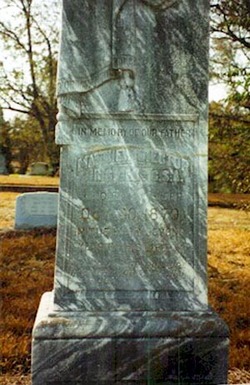
Grave of Ector in Marshall, Texas


Thursday, January 24, 2013

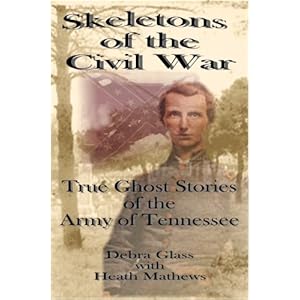
Skeletons of the Civil War by Debra Glass and Heath Mathews

Skeletons Of The Civil War - True Ghost Stories of the Army of Tennessee

A Great Book

       Last month, I had the opportunity to sit beside Debra Glass and Heath Mathews and sell books at the worlds largest Civil War show in Nashville, Tennessee. It was the first time I had met Heath in person. I'd talked to him on the phone a few times. Heath turned out to be a great guy. It didn't take me long to learn that Heath is the type person who is committed to saving as much of our historic battle grounds as possible. Sometimes, he feels like he's fighting a losing battle. 
       After the show on Sunday, we took the grand tour of Franklin and had a blast. I finally visited the graves of the Carter family and witnessed the spot where Hardin Figures, the fifteen year old boy, climbed a tree and watched the battle. He also showed where the house stood where Brigadier General States Rights Gist had died. Debra doesn't like General Gist very much because he came out so violently against Cleburne's proclamation to free the slaves and make soldiers out of them. While that is true of the man, he was fine commander and probably deserved a shot at division command. Besides, you have to love his name. 
       Heath and I then walked the ground where my ancestor Private Mack Keenum charged the osage orange abatis on the far right under General Thomas Moore Scott. We located what we think is the approximate position of General Adams death. Walked behind the Franklin Chamber of Commerce and found the position where a sign once stood marking the death site of General Strahl. 
       We passed through Franklin again a couple of weeks ago and again looked Heath up. Again, we did some more touring of the field of Franklin. I may be working with my publisher soon to do a documentary on the affair at Spring Hill and plan on asking Heath for help. If you haven't read the book Skeletons of the Civil War, you need to buy a copy soon. Even if your not into ghost stories, there is a lot of history in the book. 


Thursday, January 6, 2011

A Vision Across The Miles


Confederate Brigadier General States Rights Gist

       Confederate Brigadier General States Rights Gist was standing on Winstead Hill just south of the town of Franklin on November 30, 1864. He was busy trying to convince his servant Wiley to saddle his horse “Joe Johnston” for the coming charge because his other horse “Kitty“ was broken down. Wiley tried his best to persuade Gist not to ride this particular horse, saying, “Marse States, you ain’t got no business riding Joe. Joe ain’t got no sense when the bullets come around.”
       Gist had no choice because “Kitty” was stumbling as she walked. He replied, “He’ll just have to get used to the bullets.”
       Gist also realized the danger the frontal assault would present. He told his servant, “Wiley, you take charge of my money, my watch and ring. I might get tripped up this evening. Use what money you need, and if anything happens, take the watch and ring to my wife.”
       

Photo of Gist in the South Carolina Militia

       At that same moment almost four hundred miles away, General Gist’s brother Nathaniel lay of his deathbed with a fever. Their sister Sarah sat next to the bed attempting to make him as comfortable as possible. Nathaniel Gist had gotten typhoid fever while bringing the body of a dead relative from the front lines home for burial. 
       Nathaniel appeared to be getting delirious from his high fever. He stared at the ceiling as if he were seeing something happening far away. Suddenly, he announced, “Sarah, States has been killed in battle this afternoon.”
       Everyone present in the room became unnerved by the announcement. There was no reason to believe States Gist had even been in a battle, much less killed. He’d made it through three years of war with only a few minor wounds. Sarah attempted to calm Nathaniel. She was sure it was only the fever. 
       She said, “No, States is all right, your only dreaming.”
       Nathaniel refused to be comforted. He continued in his delirium, determined that his younger brother was dead. Finally, he announced, “I know that States is dead.”
       Back in Tennessee, States Rights Gist was leading his brigade of South  Carolina troops forward in one of the bloodiest assaults in the history of this country. Gist’s horse “Joe” was shot through the neck and began to plunge so wildly that the general was forced to dismount. 
       States then charged forward on foot leading his men. As they approached the Federal line, Gist was hit in the thigh by rifle fire. He refused to leave the field and was determined to share the fate of his men. As they reached the Federal breastworks, Gist was hit in the chest, a bullet passing through his left lung. He was in intense pain and as he was carried from the field, his last words were to one of his staff officers, “Lieutenant Trenholm, take me home to my wife.” 
       

Janie Gist

       He died at a field hospital at 8:30 p.m. His servant Wiley heard that Gist had been wounded and went in search of him. He asked a local lady if he could bury Gist in her yard and she was only too happy to provide a place for the great man. His wife, Janie Gist had his body brought back to South Carolina in 1866 and he rests there today in Trinity Episcopal Church Cemetery, Columbia, South Carolina. 
       Nathaniel survived his brother by only nine days. He rests in Fair Forest Presbyterian Church Cemetery, Jonesville, South Carolina. How he could possibly know his brother was dying in battle is a mystery. Perhaps when one is that close to death, he can sense things about those he loves so much.


Grave of States Rights Gist

Wednesday, December 8, 2010

The gallant charge of Brigadier General John Adams


Confederate Brigadier General John Adams

       John Adams was born in Nashville, Tennessee on July 1, 1825. Adams entered West Point and graduated in 25th in the class of 1846. He fought in the Mexican War and was cited for gallantry at the Battle of Santa Cruz de Rosalea. He would spend the remainder of his career in the United States army fighting Indians out west. 
       When the Civil War began, Adams would receive a commission of colonel in the cavalry and remain at that rank for the first two years of the war. One embarrassing incident occurred at Sweeden's Cove, Tennessee, where his command was surprised by Federal forces and he would lose over a hundred men. Despite the mishap, General Joseph E. Johnston would recommend Adams for promotion to brigadier general. He would receive that promotion by May, 1863 and took command of Lloyd Tilghman's Mississippi brigade after that officer's death at the Battle of Champions Hill. 
       He would spend the remainder of his life in command of this brigade. He saw action at Jackson, Mississippi during the Vicksburg Campaign. After the surrender of Vicksburg, his brigade would be transferred to Georgia, where they fought throughout the Atlanta Campaign. 


John Adams early in the war

        Adams would be in lead the brigade when Hood's army invaded Tennessee in the fall of 1864. At the Battle of Franklin, Adams was wounded in the arm early in the fight. His staff insisted he leave the field for medical attention. Adams refused, saying, "I am going to see my men through."
       Once his brigade neared the breastworks, they came upon and impenetrable abatis of Osage Orange trees the Federal soldiers had chopped down in front of their works. Adams brigade came to a sudden halt and he understood for them to stay in this position meant certain death. He rode his horse west until he came to a gap in the abatis and directed his men to charge through. Leading by example, he turned his horse through the gap and charged the Federal breastworks alone. The Federal troops could hardly believe their eyes. 


John Adams gallant charge at Franklin

       Colonel Scott Stewart of the 65th Illinois Infantry yelled for his men to hold their fire because he thought John Adams was too brave an officer to die this way. At that moment, Adams rode his horse upon the breastworks and attempted to snatch the regimental battle flag from the flag bearers hands. The color guard opened fire at once. Adams and his horse both collapsed in a heap, the horse landing on the leg of the general. 
       When the firing had died down, the Federal soldiers climbed onto the works and pulled the general from beneath the horse. He had been hit by nine bullets, but was still alive. They made him a pillow of the cotton from the old gin house and gave him water. At this point, the Federal soldiers apologized for shooting such a brave man. Adams replied, "It is the fate of a soldier to die for his country." He died a few minutes later and after dark, the Federal soldiers placed his body back among his men on the other side of the works. 
       The next morning, his body was placed in a wagon beside the body of Major General Patrick Cleburne and carried back to the rear porch of the Carnton Plantation. His body was then carried to Pulaski, Tennessee where it rests today beside his wife in Maplewood Cemetery.


The grave of John Adams in Pulaski, Tennessee

       Like a lot of incidents that occur during the fog of war, Adams death would become controversial after the war. One soldier in the 65th Illinois reported that Federal troops found Adams in front of the earthworks, but the man was already dead. He stated the body was brought inside the Federal lines and placed near the cotton gin which caused many to believe the general had actually penetrated the Union lines. 
       Federal General Jacob Cox stated that Adams and his horse were shot outside the breastworks. He claimed Adams horse charged ahead after being hit and died on top of the works. Adams, he reported, was shot through the legs and attempted to crawl away when he was shot to pieces. He originally stated that Adams was never brought inside the works, but later changed his story. Cox was in the vicinity, but in all likelihood he never witnessed the death of Adams personally and was only repeating a story he had heard.
       Colonel Casement, commander of the brigade that Adams charged, claimed in 1891 that he was the man who spoke with Adams. He said that Adams was conscious and uncomplaining and only desired to be placed back among friends. 
       Tom Gore, a soldier in the 15th Mississippi Infantry said he saw Adams horse staggering after being hit by nine bullets. This account was soon accepted as false due to the fact that Adams cousin and adjutant, Captain Thomas Gibson stated that Adams horse named "Old Charlie" tended to squat close to the ground when under fire. With all the heavy firing at Franklin, it is almost certain that Adams horse did the same here, causing Gore and others to think the animal had been hit.
       Most historians today believe that Adams was hit on the enemy parapet and taken prisoner only to die within Federal lines. Most believe he was then returned to the Confederate side of the works after dark before the Federals retreated to Nashville. Whichever story is true, one thing is certain, Adams was one of the bravest officers in the Confederate army and few have led such a gallant charge in any war.

Tuesday, November 23, 2010

Sam Stewart and the tragic Company B, 35th Alabama Infantry at Franklin

Lagrange Military College
       Lagrange College in Franklin County, Alabama (now Colbert, County, Alabama), was known as the West Point of the South. Young men from all over the country came here for a military education. In March, 1862, the 35th Alabama Infantry Regiment was formed at the school. The majority of the officer corps and a good deal of the enlisted men came from the student body. A lot of local farmers also enlisted with the regiment. 
       The regiment would go on to see action at the battles of Baton Rouge, Port Hudson, Corinth, Champions Hill, Jackson and throughout the Atlanta Campaign. Company B would march into Tennessee with General Hood with only twenty-one men. 
At Franklin, the 35th Alabama Regiment served under General Scott, William Loring’s Division and Alexander Peter Stewart’s Corps. They would advance on the far right near the Carnton Plantation and charged the Osage Orange abates in front of the Federal breastworks. 
Captain Samuel D. Stewart led these men. The boy was from near Mobile, Alabama and was only 21 years old. Stewart was elated  at the thought of charging across two miles of open fields and hitting the Federal lines. He may have just been trying to keep his men’s spirits up. Most men knew that few of them would come out of this battle unscathed. 

Captain Samuel D. Stewart
       Stewart said, “With this open field, we’ll be able to see who gets the farthest. I know Company B will not be behind and will continue to hold their high standing in the regiment.”
The regiment marched to within seventy-five yards of the Federal line before the enemy infantry opened fire. The men charged forward and reaching the Osage Orange found that they couldn’t fight their way through the man made barrier. 
Captain Stewart was right there with his men, hacking at the tree limbs with his sword. A bullet soon struck him in the abdomen, he crashed forward into the abatis and rolled out on the ground. His men thought he was dead, but he soon rose again only to have his left ear shot off. He was carried back to the McGavock House where he suffered tremendously. Some reports state he had four bullet wounds. He would die sometime during the night. 
        Of the twenty-one men who went into action at Franklin, four would be killed, thirteen wounded and out of action, two would be slightly wounded and only two came out unscathed. Besides Captain Stewart,  Fourth Sergeant Tom Peebles, Private William Bradley and Color Bearer Robert Wheeler would die. 
Joseph Thompson and Richard D. Beaumont would both be wounded by the same cannonball. Joe Thompson would have his leg amputated at the field hospital near the McGavock House. Second Sergeant Daniel Downs and Private’s William Woodford, James O. Murphy, A. Waddy Mosely, and J.P. Cooper would all be wounded. Steve Harmon would make it on to Nashville where he would be captured. The rest of the company present at Franklin haven’t been identified yet. 
       Joe Thompson wrote following the war how the entire town of Franklin within four miles of the battlefield had opened their doors and taken in the wounded. He had nothing but the highest compliments for the people of Franklin, Tennessee. 
Today, Lagrange College no longer exists. On April 28, 1863, the Federal Army under Colonel Florence M. Cornyn burned the college down. The brave color bearer Robert Wheeler would be brought home to Tuscumbia, Alabama where he rests in Oakwood Cemetery, not far from the grave of Brigadier General James Deshler. Captain Samuel Stewart still rests today in the McGavock Confederate Cemetery in Franklin, Tennessee.
Grave of Captain Samuel D. Stewart