Showing posts with label john bell hood. Show all posts

Sunday, July 14, 2013

Major General G.W. Smith: Was the strain more than he could bear?

Major General G.W. Smith: Was the strain more than he could bear?


Gustavus Woodson Smith

     One of the lesser known Confederate generals who could have played a larger role was Major General Gustavus Woodson Smith. He was born in Kentucky in 1821 and was a cousin of Confederate General John Bell Hood. Ten years older than his cousin, Smith graduated from West Point in 1842 and opposite his famous cousin, Smith graduated high in his class. Finishing high in his class meant he was able to enter the engineer corps.
     He saw action in the Mexican War and was breveted for gallantry three times. Smith then returned to West Point where he taught. In 1854 a year after his cousin John Bell Hood's graduation, Smith resigned and began a career in civil engineering. He was working in New York City as street commissioner when the Civil War began. He was delayed in coming South and joining the Confederacy until September, 1861 because of having suffered from a stroke that caused temporary paralysis.
  Upon enlisting in the Confederate Army, Jefferson Davis immediately commissioned him a major general. He was sent straight to the army in Virginia as a division commander under Joseph E. Johnston. Smith soon thereafter became an ardent follower of Beauregard and helped him in his attempt to gain control of the army over Johnston.

G.W. Smith in Confederate uniform

     When Davis tired of Beauregard and sent him to the western army, G.W. Smith became second in command of the Virginia army. His responsibility also began to grow. Johnston placed him in command of one wing of the army. When the army moved to the Peninsula to face McClellan's advancing army, Smith began to have strange medical conditions. His field performance was also poor.
    An aide of President Davis actually called Smith's condition one of moral cowardice. Not a fear for safety, but a fear of failure. This may be partially true, but was there more to the situation than just fear of failure. Was the mental strain of commanding large bodies of troops to much for him. Perhaps there was just too much responsibility for him to handle, especially for a man who has suffered from a stroke at such a young age. He was only forty when the war began.
     The great reputation that Smith had obtained when the war began was about to go spiraling downward. Davis had thought so much of the man, that he'd promoted him to third in rank in the Army of Northern Virginia the day he'd joined the Confederacy.
   That fall from glory occurred on May 31, 1862 when General Joseph E. Johnston was wounded at the Battle of Seven Pines. Command of the army passed to Smith. Davis arrived at his headquarters the next morning to learn of his plans and found his general partially paralyzed again and unable to “endure the mental excitement.” By the next day, he would be forced to leave the army entirely because of his condition. Davis placed Robert E. Lee in charge of the Virginia army and we all know how well that worked out.
    Smith was taken to Richmond where his condition seemed to worsen. In July he said, “I do not get straight in brains and nerves as fast as I hoped.” Smith would serve at various posts in the army throughout the war, but never again would he be given an important assignment.
    Following the war, he would return to civil engineering and begin a long bitter feud with Davis and Johnston. He would die in 1896 of a heart condition and rests today in Cedar Grove Cemetery, New London, Connecticut.

    Historian William C. Davis believes Smith's failure came from too much pride and ego. He believes that Smith had earned too high a reputation without earning it and when forced to perform had become sick. This of course is possible. It is also possible Smith suffered from a nervous breakdown from the strain. Especially one who has suffered from a stroke the previous year, working under constant responsibility, it may just be that simple. We may never know for sure. 

Wednesday, May 1, 2013

What Was Hood's Plan For Spring Hill?


Confederate General John Bell Hood

       Historians have argued over what John bell Hood attempted to accomplish when he advanced into the flank of John Schofield's army at Spring Hill. I've argued for years now that Hood was emulating his hero's Robert E. Lee and Stonewall Jackson and trust me I've had my share of being laughed at by Civil War buffs who are convinced Hood was an idiot. Bare with a few moments as I attempt to show through the maps my 11 year old son Chase drew for me Hood's true intentions as I see them.


Flanking movement

       General Hood left two divisions and all the artillery under Lieutenant General S.D. Lee at Columbia to hold Schofield's army in place while he took Cheatham's Corps, A.P. Stewart's Corps and one division of S.D. Lee around Schofield's flank and headed for his rear at Spring Hill. Many historians think Hood planned to race north and take Nashville with these troops leaving Schofield free in his rear. I've always felt this was preposterous. It would almost be insane to march north leaving an army almost as large as your own free in your rear. 

Hood's plan at Spring Hill

       It is well known that Hood ordered Patrick Cleburne and William Bate after crossing Rutherford Creek to move west and form their division across the pike and sweep toward Columbia. As you can see from the map above, Cheatham's corps is facing south across the Columbia Pike, Schofield's escape route to Nashville. A.P. Stewart reported his orders from Hood upon reaching Rutherford Creek, "I reached Rutherford's Creek as Cheatham's division was crossing. I received orders to halt and form on the south side of the creek, my right to rest on or near the creek, so as to move down the creek if necessary." It doesn't take a rocket scientist to realize what Hood had in mind by looking at the map above. A man doesn't deploy an entire division (plus the extra division on loan from S.D. Lee) unless you intend on using them. Why else would Hood have Stewart move his men from march formation into attack formation facing west unless he had plans to move them against Schofield's flank the way Lee would have had Jackson do back in Virginia? Hood called the move the greatest of his career.


The first domino falls

       As Cleburne moves toward the pike as ordered by General Hood, he is attacked on his right flank by a single brigade of Federal infantry. He immediately turns to face this threat and begins to drive the Federal's back toward Spring Hill. Bate is ordered to join Cleburne's division on the pike by General Hood and moves that way despite the fighting occurring off to his right. Somewhere in the midst of all these movements, Cheatham (who was not present when Hood ordered Bate to the pike) makes the mistake of believing that Spring Hill is the goal. He will say Spring Hill was Hood's objective for the rest of his life. Upon finding Cleburne facing northwest in the direction of Spring Hill, he threatens to arrest Bate if he doesn't give up the pike and join Cleburne. 


Two divisions versus three brigades

       Once Brown places his division on Cleburne's right flank and Bate is being ordered away from the pike to Cleburne's left. At the moment above there are two Confederate divisions facing only two brigades of Federal infantry. Hood who is exhausted is at his headquarters at the Thompson House and doesn't realize that Cheatham is not following Hood's orders. He still has Stewart's entire corps south of Rutherford Creek waiting to crash into Schofield's flank once he retreats and engages Cheatham. Soon Cheatham will arrive and report that his division is not in command of the pike because they have unexpectedly ran into Federal infantry. Hood thinking that Cheatham has attempted to get his division across the pike facing south asks Cheatham if he brings Stewart's corps across the creek and forms them on his right will they be across the pike. Cheatham answers in the affirmative. Many speculate that Cheatham has a dinner date with Mrs. Jessie Peters and wants the fight called off for the night. Some believe the normally aggressive Brown refuses to advance because he has become intoxicated and lost his nerve.


The situation in Hood's mind

       Hood then orders Stewart to cross the creek and form on Cheatham's right believing this will place his corps across the pike. Sadly, Stewart isn't across the pike and reports this to Hood.


The last domino falls

       Once Stewart forms on Cheatham's right, his line is still running perpendicular to the pike. The last straw falls when Hood tells Stewart the situation is fine because he has ordered Forrest to cover the pike with what men he has available. The map above shows the great mix up at Spring Hill and results in Schofield's escape. 

Thursday, January 24, 2013

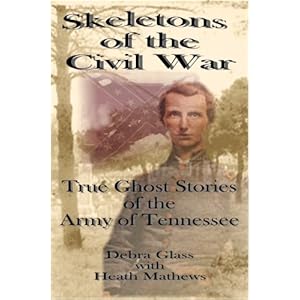
Skeletons of the Civil War by Debra Glass and Heath Mathews

Skeletons Of The Civil War - True Ghost Stories of the Army of Tennessee

A Great Book

       Last month, I had the opportunity to sit beside Debra Glass and Heath Mathews and sell books at the worlds largest Civil War show in Nashville, Tennessee. It was the first time I had met Heath in person. I'd talked to him on the phone a few times. Heath turned out to be a great guy. It didn't take me long to learn that Heath is the type person who is committed to saving as much of our historic battle grounds as possible. Sometimes, he feels like he's fighting a losing battle. 
       After the show on Sunday, we took the grand tour of Franklin and had a blast. I finally visited the graves of the Carter family and witnessed the spot where Hardin Figures, the fifteen year old boy, climbed a tree and watched the battle. He also showed where the house stood where Brigadier General States Rights Gist had died. Debra doesn't like General Gist very much because he came out so violently against Cleburne's proclamation to free the slaves and make soldiers out of them. While that is true of the man, he was fine commander and probably deserved a shot at division command. Besides, you have to love his name. 
       Heath and I then walked the ground where my ancestor Private Mack Keenum charged the osage orange abatis on the far right under General Thomas Moore Scott. We located what we think is the approximate position of General Adams death. Walked behind the Franklin Chamber of Commerce and found the position where a sign once stood marking the death site of General Strahl. 
       We passed through Franklin again a couple of weeks ago and again looked Heath up. Again, we did some more touring of the field of Franklin. I may be working with my publisher soon to do a documentary on the affair at Spring Hill and plan on asking Heath for help. If you haven't read the book Skeletons of the Civil War, you need to buy a copy soon. Even if your not into ghost stories, there is a lot of history in the book. 


Monday, May 16, 2011

Grant vs. Hood: Who was the better commander?


John Bell Hood and Ulysses Grant

       The title of this blog may be a bit deceiving. General Grant has long been considered a military genius by some and a butcher by others. General Hood has been declared one of the worst army commanders of the Civil War. I would like to take this opportunity to look at the various strategies employed by each man and let us see if one general is truly a better commander than the other. 
       Why, you might ask would I compare two generals who never faced each other in battle. Historians have compared Grant and Lee to the extent that nothing further needs to be written on the subject. I’m interested in comparing Grant with Hood because both men seem to be vastly misunderstood as military commanders. 
       First, we’ll look at how Grant got the reputation of being a butcher. At Forts Donelson and Shiloh, he allowed his army to be surprised by the Confederate Army because he under-estimated his enemies will to fight. At Vicksburg, he was forced to settle the affair by siege only after having failed with frontal assaults. Then he made a frontal assault at Chattanooga that succeeded, mostly due to the ineptness of Braxton Bragg. 
       

Grant's Overland Campaign

       He then was promoted to lieutenant general and went to oversee the Army of the Potomac for the rest of the war. There he was attacked by Lee in the Wilderness. He then attempted to turn Lee and having failed, he assaulted Lee’s entrenchments at Spotsylvania. He again attempted to turn Lee and because of over-aggressiveness, he almost placed his men in a trap at the North Anna River. He then tried to turn Lee again and failing again, attacked entrenchments at Cold Harbor. The question remains, why could men like Lee and Jackson turn their enemy’s flank while Grant failed each time. 
       Many historians claim it was because Lee understood his enemy so well. There is some truth in this analysis, but I believe there is a little more to it than just that. More on that later.
       John Bell Hood didn’t begin his career as an army commander until the summer of 1864. He inherited an army that had been mismanaged the entire war. Hood faced an army almost twice as large as his own and attempted to do what Lee had done early in the war and that was to offset the enemy’s numerical advantage by maneuver. 
       The Battle of Atlanta was a near perfect copy of Lee’s flank movement at Chancellorsville, a little over a year earlier. Because of his subordinates failures and some good luck within the Federal army, he didn’t obtain the same results.


Atlanta


Chancellorsville

       The move he made at Columbia, Tennessee was a near copy of Lee’s move against Pope during the Second Manassas Campaign. He used two divisions to hold Schofield in place and marched around his left flank with the rest of his army. He arrived in Spring Hill, Tennessee in Schofield’s rear to only allow him to escape because of confusion within his ranks. He then made the greatest mistake of his career by attacking an entrenched Federal Army at Franklin. The result was the same as Grant’s assault at Cold Harbor, the only difference was at that point of the war, the South could ill afford to lose men. 


Hood's plan to destroy Schofield at Spring Hill

       In one sense, you can say that Hood’s move at Columbia worked. He arrived in Schfofield’s rear in time to trap his army. Grant was never able to accomplish this. How did Hood’s turning movement at Atlanta and Columbia almost succeed while Grant’s weren’t nearly as close?
       The answer lies in several factors. From the beginning of the war the Confederate’s (especially Lee) utilized their cavalry. The only time Lee was caught off guard was at Gettysburg when he allowed his cavalry to get away from him. At Chancellorsville, it was Lee’s cavalry that discovered Hooker’s right flank in the air. Hooker had sent his cavalry on a raid which accomplished nothing at a time when Hooker needed valuable information. 
       Meade and Sheridan had a serious disagreement about the use of cavalry in Virginia. Meade wanted to use his cavalry as Lee did, gathering information about the enemy. Sheridan wanted to attack Lee’s cavalry by raiding. Meade had been with the Army of the Potomac from the beginning. He had seen how a lack of cavalry impaired an army. Grant naturally sided with his friend Sheridan. While Grant was facing Lee during most of the spring Campaign of 1864, Sheridan was off making raids. 
       At Atlanta, Hood had Joseph Wheeler’s cavalry cover the advance of the flanking movement of Hardee’s Corps and then instructed him to take the Army of the Tennessee’s supply train. Wheeler bungled the latter job, claiming there was an infantry force too large for him to break when in fact he could have easily accomplished the job. (Wheeler was one of the most overrated cavalrymen of the war, but that’s for another blog.)
       There is another factor that most historians overlook when understanding why Grant’s turning movements always failed. While Lee and Hood left a portion of their armies facing the enemy to hold them in place, Grant would take his entire army out of line and march away. It didn’t take a genius to realize he was making some sort of movement when the entrenchments are empty. If Grant would have took a lesson from Lee or Hood and left men in the trenches and took a portion of his army around the flank, he may have ended the war far earlier and with a lot less losses. 
       When Grant removed his entire army from the front of Lee’s Army and moved away without cavalry, he had no idea where his enemy was. Lee with the help of cavalry could pretty much keep up with where Grant was headed. 
       The one time he did make this kind of move was in front of Richmond after Cold Harbor. He left men in the trenches facing Lee and marched a large part of his army across the James River to attack Petersburg. This movement, much like Hood’s would have succeeded if his subordinates hadn’t been so cautious. There was hardly a force available to stop the Federal Army from taking Petersburg, but because of their caution, Lee was able to move reinforcements up in time to save the town.
       If you look at the two commanders by how they used strategy, you would have to say that Hood better understood battlefield strategy than Grant. Hood was very poor at logistics, but as far as strategy, his plans looked just like his hero Robert E. Lee. By 1864, Hood was in the same shape as Lee, he had no Stonewall Jackson to help him carry out his plans. 
       Grant had a staff that was superb at logistics. He also had the will to continue hammering away at his enemy. He proved that at Vicksburg when he hammered away at Pemberton almost a year. Although the man grew frustrated, he never threw in the towel and gave  up.