Showing posts with label Confederate. Show all posts

Sunday, October 1, 2023

The Man Responsible For Racism in America


Edward V. Valentine

       I've been doing quite a bit of research to learn who is most responsible for the trouble that has been caused in this country in the past few years. The man responsible was one I knew very little about. All it takes is serious research to uncover the truth and I have accomplished that.
       I learned that the man most responsible was a man born in Richmond, Virginia in 1838. His name was Edward Virginius Valentine. He was old enough to fight in the war, but missed the entire conflict because he spent the war years studying sculpting in Europe. There isn't a lot of information out there on Edward Valentine, but trust me, the man is to blame for all American racism. If you don't believe me, just ask Washington Post Reporter Gregory Schneider. 
       According to Schneider, Valentine's monuments brought "racist mythology to life." Basically, Schneider goes on to explain how those monuments were the main reason that George Floyd was killed by white Minnesota police officers. I'm not sure those cops had ever seen a Confederate monument in their life, but it's easier for the extreme leftists to blame inanimate objects for their problems than real life people. 


One of the dangerous monuments that caused George Floyd's death

       I've been to several of Edward Valentine's monuments myself and yet to have killed anyone or felt any reason to be racist, but I have an IQ above my shoe size unlike most people today. I can see why anyone without much intelligence could feel threatened by a statue today. I also love the way those with a low IQ attempt to teach the rest of us that we are the ones that are wrong. 
       One of my favorite arguments is where they tell me these monuments didn't appear until Jim Crow laws started coming into affect. Do these people do any real research before making such statements? Why were there no monuments to Confederate heroes erected right after the war? Could it have been because it was illegal to raise such monuments? It was even illegal to wear a Confederate uniform in public after the war. It wasn't because Confederate's felt guilty or like they had done anything wrong I can assure you. After all, they were just doing what we celebrate every July 4th and that was the right to secede from an overbearing government. 
       I have a few questions these genius people need to answer for me. Since they are so set on the war being over slavery, surely they have the answers I need. When the slave trade was open and the Northern states were making quite a bit of money off selling slaves to the South, why were there no large groups of abolitionists? When it no longer made them money, then they became concerned about the morality of the institution. This also goes for England. Great Britain made tons of money off the slave trade, yet by the time of the war, they had become concerned with the morality of slavery (they weren't making money off it anymore). Do you see how things have always worked in the world? Just follow the money and the answer will lie there. 
       I pray to God that he will forgive Edward Valentine for creating such monstrous statues that caused so many innocent deaths. If only he had known how dumb we would become. 


Tuesday, May 12, 2020

PTSD Among General's of the War


Timmy and I visiting Brigadier General William F. Brantley

       My wife has been after me to get busy publishing blogs again and I've been struggling for subjects. If you know me, you probably think there must be something wrong. I have lots of blog subjects, but not the motivation. I guess if she "nags" me enough, I'll finally get busy. This blog was inspired a few minutes ago by my youngest son Timmy. He was watching youtube when out of the blue, he asked me if General Robert E. Lee (his personal hero) had PTSD. I immediately replied without giving it much thought. I told him I didn't think General Lee had PTSD, but that was a particularly bloody war and I'm sure some had it. Like today, I'm not sure it was as prevalent among officers as the true combat soldier himself. 
       That statement isn't exactly accurate either. If you look at the Confederate officer, he went into combat with his men. The Civil War (especially in the South) wasn't like the military today. Redd Foxx once said that he backed up so far once that he backed into a general. That wouldn't happen in the Civil War, especially in the Confederate army. Marine Lieutenant General Chesty Puller summed up Confederate leadership in one quote, "In the Confederate Army, an officer was judged by stark courage alone, and this made it possible for the Confederacy to last four years." Truer words were never spoken. Let's take a look at what is known about these incredibly brave men.
       There were 426 Confederate general's commissioned by President Davis (not all were confirmed). Out of those 426, 77 were killed in combat, not to mention how many were wounded. Some were wounded numerous times. Brigadier General Thomas Benton Smith was so severely wounded that he remained in a mental institution for the remainder of his life. Nineteen Confederate generals died during the war, Archer, Jones, and Winder had heart attacks, Bowen, Grayson, Hogg, Nelson, Smith, Villepigue, Wilson, and Bowen all died of fever, Wharton, Van Dorn, and Walker were murdered, Donelson, Floyd, and Twiggs died of old age, Cocke committed suicide in 1861 and Baldwin broke his neck in the fall from his horse. Another named Frost deserted to Canada during the war.
       One Confederate general resigned following the Nashville Campaign from effects that could be construed as PTSD. Major General Henry D. Clayton of Alabama asked to be relieved because of "chronic stress." He'd seen a lot of suffering and death by this point of the war. As a division commander at Franklin, he lost a lot of good men. He never regained his health to the point of returning to the army before the surrender occurred just four months later.
       I made a quick attempt at answering Timmy's question by looking at the post-war careers of these commanders. If you subtract 77 killed, 1 mentally unfit, 19 who died during the war, that leaves 338 commissioned Confederate generals. Here is what I was able to reveal. Three of those surviving generals committed suicide, but it's impossible to tell if it was because of their war experiences. Buford killed himself over personal and financial problems, Cosby committed suicide because of constant pain from an old war wound (he was 89 years old), and the other was Scott of Louisiana who drank himself to death (this one technically isn't a suicide, but he died in a New Orleans coffee shop). 
       Out of the remaining generals, eight were murdered, the only one that may have had something to do with the war is General Hindman (we will never know the true reason of his murder). Brantley, Liddell and Grimes were murdered in what appear to be family feuds. Parsons was murdered by Jauristas in Mexico. The rest were murdered in lawyer related issues. 
       That leaves the generals who turned to religion. This category is also difficult to establish because some became religious while others were religious before the war. Lowrey and Pendleton were pre-war ministers. General Leonidas Polk who was killed at Pine Mountain was a pre-war Episcopal bishop. Others became religious leaders following the war. Capers (Methodist), Colquitt (Methodist), Evans (Methodist), Hawthorne (Baptist), and Gano (Church of Christ). Many more became religious following the war, but whether it was because of what they'd been through is difficult to determine. 
       In answer to Timmy's question about PTSD, I can't prove they had it, but I can't prove they didn't. It was a different time period and people acted differently back then. Death became an everyday part of life in that war. It's as one old veteran once told me, you've made up your mind your not going to survive and every day that you do has been a blessing. Maybe that was their mindset. 
       By the way, the one general that did exhibit signs of PTSD, Alabama Major General Henry D. Clayton, following the war he resumed his law practice, became a circuit judge, became the president of the University of Alabama, and raised a son who became a prominent Alabama congressman, Henry DeLamar Clayton, Jr. 

Friday, May 8, 2020

The Frustration of Studying the Civil War

Nathan Bedford Forrest - Wikipedia

Lieutenant General Nathan Bedford Forrest

       Someone recently called my attention to a Civil War talk board online that mentioned a youtube video I posted several years ago. You would be surprised at some of the names I was called because some of these people didn't agree with my ranking of the Confederate lieutenant generals. If they had bothered to read the introduction they would have learned that I made the video just for fun and to spark some discussion, but now I've learned that I'm an idiot. The computer reminds me of the same people who drive automobiles. Behind a keyboard or a steering wheel it seems many of us become something we wouldn't be in person. If someone doesn't agree with your opinion, then you must be an idiot. It can't possibly be that they are the idiot, that would destroy the perfect world they've created in their own minds. 
       Is there no such of thing as friendly discussion with rational arguments anymore? After further study of my subject, I can honestly say I don't agree any longer with the way I have some of them ranked. One person called me an idiot because I didn't include General Beauregard in the list. It doesn't matter that Beauregard was never ranked as a lieutenant general, but was promoted from brigadier general to full general skipping the ranks of major general and lieutenant general, but of course, I'm the idiot. 
       In my "for fun" video, I ranked Stonewall Jackson as the best lieutenant general. Most people agreed with that choice, but after that I really rankled some feathers. I was attacked because I ranked Bedford Forrest second. The reason given was because Forrest wasn't promoted to lieutenant general until March 2, 1865 and this person called me an idiot for ranking him second when he only served as lieutenant general for a month and that isn't enough time to see how well he commanded at the corps level. What this genius fails to realize is the fact that Forrest had been commanding a cavalry corps since 1863 without having been promoted. Just because he wasn't ranked a lieutenant general, didn't mean he wasn't an excellent corps commander for two years. When he was promoted, his position as corps commander never changed, so why can we not judge him on his corps leadership ability for those two years. 
       The one that always gets peoples feathers ruffled is James Longstreet. Ever since the movie Gettysburg came out, he has been claimed by many people to be the greatest commander of the war. In this country today, all it takes is a fictional movie based on a fictional novel to change peoples perception of someone. Longstreet obviously fits this category. If I had a nickel for every time someone watched that movie and told me that Lee would have won at Gettysburg if he'd just listened to Longstreet. The move Longstreet proposed was expected by Meade and he was just itching to retreat to a better position on Pipe Creek. Without cavalry present (Jeb Stuart was off on a useless raid) it would have been almost impossible to perform the flanking move without Stuart's cavalry screen. Another question I have about Longstreet is why he made the move he made in Knoxville, Tennessee later the same year. On November 9, 1863, Longstreet assaulted Fort Sanders with around 3000 men. The fort only held a little over 400 Federal troops, yet the attack was a disaster. Longstreet lost over 800 men compared to just 13 Federal casualties he inflicted. Instead of responding as General Lee would have done and took the blame, he immediately began to emulate Braxton Bragg by arresting his subordinates. The mark of a true leader is when he takes the blame for his mistakes.
       If I had the video to make over, I'm sure there are several I would reorder. I ranked Jubal Early high because of his advance to the outskirts of Washington and Wade Hampton because of I felt he was an excellent cavalry corps commander especially his Beefsteak Raid. S.D. Lee I feel like I may have ranked too high. He made a severe mistake at Ezra Chruch and failed Hood at Columbia, Tennessee, however he helped save the army during the Battle of Nashville. I perhaps ranked Richard Heron Anderson low because of how he allowed his staff to run his forces. There were times when he acted like he had little interest in the war. Hardee is perhaps ranked too low because he was called "Ole Reliable," however he was the biggest back biter in the army. He undermined all of his superiors including Sidney Johnston, Braxton Bragg, Joseph Johnston, and John Bell Hood. However, when offered command of the army, he refused the responsibility. 
       Don't get me wrong, I'm a big fan of A.P. Hill, but he was often rash, just look at his actions at Bristoe Station. He was impulsive and got a lot of good men killed by his aggressiveness. He can be compared to the way General Hood is often perceived. The lieutenant general in my personal opinion that I believe should be ranked in the top five is D.H. Hill. He only saw action as a corps commander at Chickamauga was the reason I ranked him low, but he was a dependable commander and if he didn't suffer from chronic back pain which left him extremely sarcastic to subordinates and superiors alike he may have reached his true potential. He became so rude to others that General Lee was happy to see his dependable subordinate transferred to Bragg's army.
       I won't go into all the lieutenant generals that I listed. The full generals were listed in another video and I didn't rank them with the officers that only reached the rank of lieutenant general. If people would slow down long enough to read the descriptions of the videos before they decide to attack someone, they may find there is little reason to become so upset and insult others. 

Sunday, July 28, 2019

Twitter and the Idiocracy...


Kevin Levin (A "historian" in denial)

       I've written a couple of blogs about Mr. Levin (the expert on the American Civil War) if you count re-writing history as being an expertise these days. My publisher has insisted that I become more active on social media and my wife has forced me to learn new things. One new thing she has introduced me to is something called twitter. My wife went and subscribed me to everyone that tweets on the Civil War and other history. That's how I came to hear the garbage that Mr. Levin is posting on social media. 
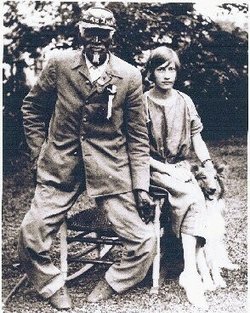
       He has written a book about the myth of the black Confederate soldier and I'm sure it's as accurate as the garbage he put out in his book on the Battle of the Crater. Mr. Levin doesn't allow the truth to get in the way of his version of history. I recently received a tweet from Mr. Levin with a picture of a black Confederate soldier sitting next to a young white lady at a Confederate reunion. Mr. Levin immediately tells his followers that "this individual showed up at a Confederate reunion in Tampa, Florida." Well, Mr. "Lying" Levin, you are wrong again. This individual happened to show up at a Confederate reunion in Memphis, Tennessee. He had his photograph taken with the granddaughter of the colonel of the regiment which happens to be the 5th Alabama Cavalry. This man is Reuben Patterson of Florence, Alabama.
       
 Reuben Patterson

As he was known in North Alabama "Uncle" Reuben Patterson

       This is probably over Kevin Levin's head, but in the South, if one is respected he is called "Uncle." This is what "Uncle" Reuben was called following the war. Once the war ended, Reuben ran a bootblack stand. His chairs, boot polish, and boot stands were purchased for him by the Daughters of the Confederacy. Uncle Reuben loved to tell tales of his war service. He often foraged for the colonel, and the colonel actually stated that he never worried about having a horse or food as long as Reuben was well. He also served as bugler of the regiment or as Reuben called it "the horn blower." 
       Uncle Reuben didn't just attend his regimental reunion, but was known to attend state and national reunions. His wife once stated that Reuben was the most unreconstructed Rebel around. Fortunately, Uncle Reuben's bugle, hat, and bootblack stand are preserved in Pope's Tavern Museum in Florence, Alabama. Also preserved in the museum is a photograph of a Confederate reunion held in Florence with several black Confederate's posing beside the white Confederate veterans. 
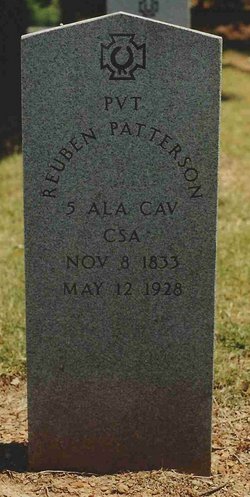
       About a mile from Pope's Tavern is the Florence City Cemetery where Uncle Reuben rests today. As per his request, he is buried beneath a marker designated for only Confederate soldiers. Beside him rests another black Confederate and the Sons of Confederate Veterans camp in Florence keeps a Confederate battle flag on these graves in their honor.

Picture of

Grave of Uncle Reuben in Florence City Cemetery

       Now I've had numerous discussions with these New England "historians" about there being black Confederate soldiers. They always bring the subject around to these men are not listed on a muster role of the regiment so therefore they are not soldiers. If you go into battle (in cavalry regiments the bugler had to go into battle to sound the various orders to the troopers), do you think a bullet cares if you have your name on a piece of paper? The next thing they tell me is that these men were body servants and cooks. Well, I used to work with a guy that served in Vietnam a year as a cook. Although the United States Army calls him a veteran, by the New England "historians" perspective, he wasn't even a soldier. I mean you can't have it both ways. 
       Another question I would like answered is this: If these men weren't soldiers, why were they given Confederate pensions? In order for a white Confederate to receive a pension, he had to prove he served faithfully, and never deserted. Do you think the states in the financial shape they were in following the war would give these men money without proof of service? 
       There is the story of captured Federal prisoners at Murfreesboro being whacked over the head with a saber by a black man named Jake. These men were terrified to be captured thinking the Confederate soldiers might kill them. Jake advancing with the 8th Arkansas Infantry whacked these prisoners on the head and shouted, "You ought to get home, then!" I'm sure Jake wasn't a soldier, he probably just picked up a saber to beat his liberators over the head with (makes New England sense I guess). 
       Allow me to tell you another story of a black servant that also lived in Florence, Alabama when the war began. When William "Billy" Patton entered Confederate service, his best friend as a boy was a servant the same age and owned by Billy's father. This servant was named Sam. Sam promised Billy's mother that he would go to war with Billy and if anything should happen to his best friend he would bring the body home. William A. Patton was elected a lieutenant in Company C, 16th Alabama Infantry. At the Battle of Shiloh, the regiment was part of General Wood's Brigade. Wood was also from Florence, Alabama. Advancing past Shiloh Church the unit overran Waterhouse's artillery battery near Water Oaks Pond. During this assault, Lieutenant Billy Patton was killed. Sam brought the body back to the church and remained with it during the night. The next morning Sam found a mule and began the long road back to Corinth where he could place Billy's body on a train back to Alabama. 
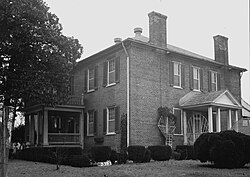
       During the day, the Confederate army began its retreat to Corinth and coming upon Sam and his best friend's body, they confiscated his mule because they needed all they could get to pull off the wagons, captured artillery, etc. Sam would not let that stop him from keeping his promise, but placed William's body over his shoulder and continued to Corinth. He delivered the body to his home which is called the "Sweetwater Mansion." Thanks to Sam, Billy's funeral was held in the parlor of the home. The house still stands there today.

Sweetwater Mansion Florence.jpg

Sweetwater Mansion

       Now New England "historians" have a hard time understanding the South. Most know very little about how life was here, yet they can sit and proclaim how evil the South was and how holy the north was without daring to research their subject. They rely on presentism. Using modern standards to judge history. This is extremely unfair. One more question they can never seem to answer for me is this: If slavery were so bad and harsh, why didn't the slaves rise up in rebellion when Lincoln issued his emancipation proclamation? With all the white men gone to war, this would have helped the Union win the war, yet it never happened. This was one of Lincoln's hopes when he issued his proclamation. He was losing a war that was quickly becoming unpopular in the north. People were growing tired of the long casualty lists. Newspaper reporters were jailed for speaking the truth. Members of state legislatures (Maryland) were arrested in the dead of night. The largest mass execution of 38 Native Americans by the U.S. Government in 1862. Yet the New England "historian" ignores all the things that portray his side of the fight as evil. Thus Kevin Levin. 


Sunday, June 17, 2018

Year of Glory by Monte Akers: An Excellent Book


Major General J.E.B. Stuart

       I just finished reading the book Year of Glory by Monte Akers. The book deals with Jeb Stuart's military career from June 1862 to June 1863. I'll be the first to admit that I've never been a very big Jeb Stuart fan, but Monte's book has since changed my mind. I couldn't put the book down. I even read several parts of the book to my wife and she said, "He was your clone."
       Working on the railroad I earned the nickname "Instigator" because of pulling pranks and jokes on people and enjoying a good laugh. Jeb was much the same way. This book is full of funny stories about some of Jeb's funnier moments. I'd always read how Jeb was seeking personal attention when he left Lee's Army blind in Pennsylvania during the Gettysburg Campaign. Monte Akers helps explain how and why things occurred the way they did. He doesn't do like most biographers and attempt to make his subject sinless, but points out that Stuart was human and prone to make mistakes. The book is a great read and I highly recommend it. I could hardly put it down and there is a part two to this book that I'm already in the process of purchasing. Book two covers from Gettysburg until Stuart's death and if it's half as good as this book, it will be a great book. 
       There are several interesting stories and many are commical, especially the story of a Prussian staff officer sitting on a wet painting, but there was one story that particularly interested me. In the chapter on Chancellorsville, Stuart and his staff camped beside a barn that served as a field hospital for Federal soldiers. The Prussian volunteer staff officer named Scheibert made a note of the difference in wounded Confederate soldiers and wounded Federal soldiers. According to Scheibert, Confederate soldiers considered it a disgrace to groan aloud when they were wounded, but suffered stoically in silence. He said a person could tell if the hospital was Federal or Confederate by the sounds. Scheibert mentioned meeting a captain walking to the rear during a battle with his hat covering one hand. Scheibert asked the captain if he was severely wounded, there being a great deal of blood on the officer's uniform. The captain replied, "No, only the hand is gone." Scheibert went on to mention other instances to back his claims that Southern soldiers took wounds with little complaint while the Federal soldiers groaned and cried aloud. 
       I'm not trying to say Southerner's are tougher or stronger than Federal soldiers. It was the Southern ideal of honor and bravery that made them act in such a manner even when they understood their wound was mortal. According to the book Attack and Die by Grady McWhiney and Perry Jamieson all of this was a direct result of Southerner's ancestry. The descendants of the Celtic people mostly settled in the South. The Celt's were a warring people. Take that and have part of the population intermarrying Native American's and you have yourself a perfect fighting machine. 
       Again, I highly recommend Year of Glory by Monte Akers. I have come away with a completely different view of Major General Jeb Stuart and now I must have the next book.
       

Sunday, February 26, 2017

Alabama Brigadier General Alpheus Baker


Alpheus Baker

           Alpheus Baker was born on 28 May, 1828 in Clover Hill, South Carolina. He became a school teacher at age sixteen and taught in South Carolina, Georgia, and eventually settled in Eufaula, Alabama.  At the age of twenty, he began reading law and soon became an attorney.
      When the war began, Baker enlisted as a private and was quickly elected captain. Ordered to Fort Pillow, Tennessee on the Mississippi River, Baker was elected colonel of the 1st Alabama, Tennessee, and Mississippi Infantry. He was in the process of moving artillery from New Madrid, Missouri to Island No. 10 when the fort was surrendered. He was held prisoner from April, 1862 until September.
       Upon his exchange, Baker’s regiment was reorganized as an all Alabama regiment and became the 54th Alabama Infantry. He saw action at Fort Pemberton during the Vicksburg Campaign and was severely wounded in the foot at Champions’ Hill. General Loring, his superior there, praised him for his bravery.


A post war photograph of Alpheus Baker

       After his recovery, Baker was promoted to brigadier general on March 7, 1864. His brigade of four regiments, the 37th, 40th, 42nd, and 54th Alabama infantry were ordered to the Army of Tennessee in Georgia. He saw heavy action at Resaca and New Hope Church. At the Battle of Ezra Church, he was again praised by his immediate commander Major General Henry D. Clayton. His brigade had charged and lost almost half their men.
    Although praised by his division commanders, it appears his corps commander Lieutenant General S.D. Lee was somewhat disappointed in Baker. He called the general “indecisive” and “lacking in energy.” Baker’s brigade was soon transferred to Mobile, Alabama saving them from the blood bath at Franklin. His last battle was at Bentonville, North Carolina where his brigade numbered only 350 men, yet they captured 204 Federal troops.
       Following the war, Baker returned to his law practice. He was well known for his use of humor in the courtroom. Thirteen years after the war, he moved to Louisville, Kentucky and practiced law there. He died there in 1891 at the age of 63 and rests today in Cave Hill Cemetery. A space was left vacant at his request amid the Confederate POW’s buried there and he rests with those men today. 

Alpheus Baker

Alpheus Baker late in life

Image result for alpheus baker grave

Baker's tombstone

Monday, February 20, 2017

Braxton Bragg: Exactly what was that guy's problem?


General Braxton Bragg

       My old military history professor in college was a guy named Doctor Ikerman. He was the first to explain the difference in an art and a science when it comes to warfare. In science, you can repeat an experiment and it always has the same result. In art, you can get a different result each time. I still use some of his analogies when I give talks today. Historians have spent decades trying to understand the problem with Braxton Bragg's generalship. I think they too often become overly focused on his argumentative personality. While that is a big part of him becoming such a failure, that's not his greatest downfall. The man didn't understand that war was an art. 
       When he planned a battle, he planned it from A to Z. In other words, he figured he would make the first move, his enemy would react a certain way and Bragg would react to that in a sequence. He planned his battle all the way through. When his opponent didn't react as expected, it threw General Bragg into a quandary. An example is the quote Major General Breckinridge made in regard to Bragg's battle planning. He claimed that when Bragg was planning a battle, he would take no advice from his top subordinates, but when things went awry, he would accept the advice of a drummer boy. 
       Historians look at the Battle of Chickamauga and attempt to understand what Bragg was thinking. He'd won the battle, and was informed of the victory by several of his subordinates, yet he refused to believe he'd won. The main question here is why? Bragg had spent days attempting to cut Federal General Rosecrans off from Chattanooga and his base of supplies. On the night of September 18th, he went to bed thinking he'd finally gotten his army beyond Rosecrans's right flank. Rosecrans expected Bragg to do this very thing and during the night extended his left flank beyond the Confederate right. Bragg was surprised in the morning when his flank attack turned into a very costly frontal assault. 


Bragg's frontal assault on the morning of September 19, 1863

       When Rosecrans began to shift more troops from his right to the heavily engaged left, Bragg had an opportunity to strike these forces in the flank, but it went against how he had planned the battle and three of his divisions sat idly by as the opportunity was lost. Once the day was finished, he made another blunder. He changed the order of battle. To completely change the order of battle in the midst of a battle is just asking for mass confusion and that's exactly what he got. In most Confederate armies, a general was in command, lieutenant generals commanding corps' answered directly to the general. Bragg decided to mix matters up by having Lieutenant General D.H. Hill report to Lieutenant General Leonidas Polk who he made the right wing commander. He had Lieutenant General James Longstreet command the left wing and placed Major General John Bell Hood in command of Longstreet's Corps. Are you confused yet, because D.H. Hill and Leonidas Polk certainly were. 
       The blunders didn't end there. The next day, the frontal assault continued, Polk's right wing lost heavily. Luckily for Bragg's army, Rosecrans committed a blunder by creating a gap in front of Longstreet's left wing. Hood managed to attack at the right moment and break the Federal army. Once the Federal army began to retreat, Longstreet begged Bragg for reinforcements from the right wing to help him finish the enemy forces off. Bragg, far to the rear at his headquarters at Reed's Bridge refused to believe he'd won the battle. Without riding forward and observing for himself, he simply refused to send Longstreet any troops. 
       There is a comical story told about a Confederate private who'd been captured by the Federals and then escaped when their army retreated. He made his way to Bragg's headquarters and insisted on seeing the general in person. When he was brought into the presence of General Bragg, he told his commander that he'd won a great victory and that the Federal army was in full retreat. "How would you know what a retreat looks like?" snapped Bragg. "I should know," the ragged private replied, "I've been in your army almost two years."
       Even Bedford Forrest was frustrated with Bragg asking what the man fought battles for anyway. Mary Chesnut said of Bragg when he laid siege to Chattanooga: "Bragg, thanks to Longstreet and Hood, won at Chickamauga. So we looked for results that would pay for our losses in battle, at least. Certainly, they would capture Rosecrans. No! There sits Bragg--a good dog howling on his hind legs before Chattanooga, a fortified town--and some Yankee Holdfast grinning at him from his impregnable heights. Waste of time. How? He always stops to quarrel with his generals."
       That brings us to the second problem General Bragg had. He could never take the blame. At each failure or setback, his first reaction was to find someone to blame. When the repulse of Pickett's Charge occurred at Gettysburg, the first words out of General Lee's mouth was, "It's all my fault." As one historian once wrote, "Bragg would have choked on those words." I give two examples of great leaders. One is Robert E. Lee and the other is former Alabama football coach Paul "Bear" Bryant. Coach Bryant always took the blame for the losses and gave the players credit for the wins. Robert E. Lee praised his soldiers in victory and took the blame in defeat. Braxton Bragg wasn't capable of this at all. It was always someone else's fault. 
       At Shiloh, he blamed Randal Gibson and the Confederate soldiers. At Murfreesboro, it was General McCown and Cheatham. At Chickamauga, he blamed Polk, D.H. Hill, and Hindman. It was always someone else's fault. A leader like Lee had no problem motivating his men to fight. They knew he was there to accept fault for failures even when they weren't his fault. Bragg never!

Thursday, January 19, 2017

James Byron Gordon: A Brave, Intelligent Commander

James Byron Gordon.jpg

James Byron Gordon

       One of the little known brigadier general's that gave his life for the Confederacy was James Byron Gordon of North Carolina. He was born in 1822 in Wilkes County, North Carolina. He was of Scottish descent. He was a distant cousin of Georgia Major General John Brown Gordon who attained a bit more fame. Prior to the war, Gordon was a business man and farmer.  He also served in the North Carolina State Legislature. 
       Gordon began the war as a lieutenant in the 1st North Carolina Cavalry. During the summer of 1861, he was promoted to major of the regiment. They were assigned to Jeb Stuart's brigade in Virginia. He saw a couple of engagements in late 1861. In the spring of 1862, he was promoted to lieutenant colonel when Laurence Baker was promoted to colonel. Baker had an alcohol problem and took an oath to abstain from drinking until the war concluded. Stuart noted that Baker wasn't near as dashing once he stopped drinking. 
       Gordon saw action during the Peninsula and Seven Days campaigns. During the summer of 1862, the 1st North Carolina Cavalry was placed in Wade Hampton's cavalry brigade. Gordon was noted for bravery, intelligence, and leadership in the battles of late 1862. He saw action at 2nd Manassas, Sharpsburg, and Stuart's raids. He fought at Brandy Station and at Gettysburg. When Hampton was wounded at Gettysburg, Baker took command of the brigade and Gordon led the regiment. 
       Gordon led the regiment in an attack at Hagerstown, Maryland and routed Kilpatrick's Federal brigade. Because of this action, Stuart and General Lee both recommended Gordon be promoted to brigadier general. He received his promotion on September 28, 1863 and took command of the North Carolina Cavalry Brigade. Gordon was wounded a month later in a skirmish, yet refused to leave the field. He had his horse shot from beneath him a week later. 


Marker where Gordon was mortally wounded

       When Sheridan led a raid against Richmond, Stuart was mortally wounded at Yellow Tavern on May 11, 1864. Gordon took command of the cavalry and defended Richmond once Stuart was wounded. The next day, Gordon was fighting Sheridan at Meadow Bridge when he too was mortally wounded. Carried to Richmond, he survived for six days, dying on May 18, 1864. He was one of Stuart's better cavalry commanders always distinguishing himself. He managed to save Richmond from Sheridan. Hampton seemed to think that Gordon would have received a promotion to major general before the war ended had he survived. 
       
James Byron Gordon

Gordon's grave in St. Paul's Episcopal Churchyard, Wilkesboro, North Carolina

Tuesday, November 22, 2016

The Truth About Confederate Massacres


The Fort Pillow Massacre

       In my last blog I discussed the Northern myth of the white supremacist Southerners. Now, I'd like to discuss the misleading stories of Confederate massacres on black Federal troops. The most famous of all would be the Fort Pillow massacre. Saying there weren't atrocities committed at Fort Pillow would be an outright lie and I'm not going to lie. The truth is there were some pretty depraved acts committed there. 
       I've heard every excuse in the world given for why unarmed men were shot down. The most famous excuse was because the flag was never lowered. It is true the flag was never lowered. The fort being overran so suddenly, there probably wasn't enough time to lower the flag and raise a white banner of surrender. While we know there were atrocious acts committed by Confederate troops at Fort Pillow, we hardly ever hear the rest of the story. 
       Prior to the assault at the fort, Federal troops had captured seven of Forrest's subordinates and killed them. Lieutenant Willis Dodd had been captured by Colonel Fielding Hurst of the 6th Tennessee (U.S.) Cavalry and had been tortured to death. Dodd's face had been skinned, his nose cut off, his under jaw disjointed, his private parts cut off, among other depredations to his body. Forrest's men were furious at the conduct of the Tennessee (U.S.) troops who were using the war as an excuse to plunder the property of Confederate soldiers. 
       Also, never told in the story of Fort Pillow are the whiskey barrels. The Federal officers in charge of the fort believed black soldiers were inferior to white soldiers. They had barrels of whiskey placed around the fort believing the black soldiers would need liquid courage to fight. During the truce, there were many witnesses to the conduct of the intoxicated black soldiers toward the waiting Confederate cavalrymen outside the fort. By the time the truce ended and the assault began, the Confederate's were furious from the taunting. As Shelby Foote once mentioned, the Confederate's had to fight their way into the fort, losing good men in the process and as soon as they breached the walls, the black troops threw down their weapons to surrender. Someone in the Confederate ranks basically said, "The hell you surrender, you had your chance." 


The Crater Massacre

       The Battle of the Crater is the other instance of black troops being massacred after having surrendered. One historian named Bryce Suderow calls the Battle of the Crater the wars worst massacre. One must take a look at the numbers to see just how mad this massacre truly was. An entire division of black troops attacked the Crater at Petersburg and 219 were killed. That makes his statement almost laughable in itself. But, there were black troops killed there after having surrendered. 


Confederate Major General William Mahone

       As soon as the explosion blew a hole in Confederate Major General Bushrod Rust Johnson's lines, Lee called up Major General Mahone's division as reserves to fill the gap. General Mahone arrived to find General Johnson busy eating breakfast and seemingly uninterested in repairing the breach in his line. Mahone turned away disgusted and led his men toward the crater. He received word from numerous retreating troops saying they had witnessed unarmed Confederate soldiers shot down after having surrendered. The United State Colored Troops had shouted "No Quarter!" upon entering Confederate lines. Mahone halted his division and informed his troops that Union black soldiers were not giving quarter and he didn't expect his men to give quarter. Thus, led forward by their general, the arrived on the scene to give the black troops the same treatment they were dishing out. Today, over a century later, we only hear about the black troops who were gunned down by the evil Southerners for no reason at the Battle of the Crater. 


Lieutenant Joshua Lazaras Moses

       In the last blog about minorities serving in the Confederate Army, I mentioned Jewish Lieutenant Joshua Lazaras Moses. He commanded an artillery battery from South Carolina. At the end of the war he was sent to Fort Blakely on the east side of Mobile Bay. 
       After the Federal troops overran the small Confederate force at Blakely, Lieutenant Moses and his men were quickly surrounded. The Confederate troops surrendered, but the United States Colored Troops refused to give quarter. They opened fire on Joshua Moses's men. Lieutenant Moses shouted, "For God's sake, spare my men, they have surrendered!"
       As white Federal officers commanding the black troops attempted to stop the slaughter, Lieutenant Moses and two white Federal officers were gunned down by the Union Colored Troops. Confederate officers complained of the actions of the Federal troops at Blakely and argued that some of the white commanding officers had encouraged the black troops to show no quarter. The date was April 9, 1865, the war basically over, there being no Confederate government to demand a response from the U.S. government. The incident is one of the fewest talked about massacres of the war. 
       I haven't written this blog to make the North appear evil and the South innocent. I know there were massacres by both sides. I wrote this blog to show how only one side is portrayed on television and by Northern historians. I don't mind the telling of history as it was, but if someone considers themselves a true historian, they will tell both sides without bias. This is all the people of the South have ever asked for. 
       

Friday, February 13, 2015

Robert Frederick Hoke: Underrated General


Robert Frederick Hoke (in his colonel's uniform)

       Robert Frederick Hoke was born in 1837 in Lincolnton, North Carolina. The city and county (Lincoln) was named for Major General Benjamin Lincoln who commanded American troops in the Revolutionary War. The name has nothing to do with northern President Abraham Lincoln. Hoke's father was a successful business man there, but an unsuccessful politician losing his bid for governor of the state in 1844. Robert Hoke graduated from the Kentucky Military Institute and began to manage his family's business ventures, including the iron works, cotton mill, and other's. 
       Robert began his service in the Confederate Army as a lieutenant in the 1st North Carolina Infantry. His first action occurred at the Battle of Big Bethel where he was commended by his commander, Confederate Colonel Daniel Harvey Hill. Hill praised Hoke for his coolness and judgement under fire. He was quickly promoted to major and then made lieutenant colonel of the 33rd North Carolina Infantry. By 1862, the 33rd was assigned to Lawrence O'Bryan Branch's Brigade. 
       The regiment saw action at the Battle of New Bern where the colonel was captured, forcing Hoke to assume command of the regiment. Branch praised Hoke for his conduct in the action there. The brigade was then sent to Virginia where they saw action under Lee during the Seven Days' (where he was wounded), Second Manassas, and Sharpsburg (Antietam Campaign). Hoke's regiment performed admiringly at Second Manassas and was praised for his actions there. Following Sharpsburg, Hoke was promoted to colonel and placed in command of the 21st North Carolina Infantry. 
       

Hoke in his brigadier general's uniform (note the wreath around the stars and the double buttons on the coat)

       Hoke took command of Isaac Trimble's brigade during the Fredericksburg Campaign and led the unit in a counterattack when Meade's Federal Division broke through Confederate A.P. Hill's lines on the right flank. His horse was struck in the head, throwing Hoke off, and his foot caught in the stirrup dragged him, making him senseless for a short time. Because of his action at Fredericksburg, he earned a promotion to brigadier general to rank from January 17, 1863. 
       He commanded his brigade during the Battle of Marye's Heights (Second Federicksburg) during the Chancellorsville Campaign on May 4, 1863. A bullet struck Robert in the shoulder area, passed through the head of the humerus (upper arm bone), the shoulder joint, and exited his scapula (shoulder blade). Surgery was performed that day and Hoke was out of action for seven months, returning in December of 1863. He would miss the Gettysburg Campaign because of the severe wound. 
       

Headquarters Flag of Major General Robert Hoke

       General Hoke would return to duty commanding troops in North Carolina along the Roanoke River. He saw action near New Bern, although he wasn't completely healed from his wound yet. Hoke commanded his division during the Siege of Plymouth, North Carolina from April 17 until April 20, 1864. There he lost 800 men, but captured 2,000 Federal troops under the command of Brigadier General Henry Wessells. When the Federal troops surrendered, General Wessells told Hoke, "This is the saddest day of my life." Hoke replied, "This is the proudest day of my life."
       Robert Hoke's division was next sent to Bermuda Hundred just south of Richmond, Virginia. When first stationed there, he was warned of an approaching Federal force. He replied, "I shall fight them if met from all sides." 
       His division next saw action under General Robert E. Lee at the Battle of Cold Harbor where Grant's forces suffered devastating losses. He was sent back to North Carolina where he saw action in the fight at Fort Fisher near Wilmington. In January of 1865, he was again absent from his command because of a boil on his face. Upon his return to duty, he fought under Joseph Johnston at the Battle of Bentonville to wrap up his military career. When the army surrendered, Hoke addressed his troops, "The proudest days in all your proud careers was that on which you enlisted as Southern soldiers."
       Following the war, he again became a successful business man, becoming director of the North Carolina Railroad Company. He eventually was diagnosed with diabetes. The last few weeks of his life, he was in a diabetic coma and succumbed to the disease on July 3, 1912 in Raleigh, North Carolina. He rests there today in Oakwood Cemetery. Robert Hoke was 75 years old. 

Robert Frederick Hoke

Grave of Robert Hoke