Showing posts with label corinth. Show all posts

Tuesday, March 28, 2017

Edward Dorr Tracy: The Confusion surrounding the Alabama General


Brigadier General Edward Dorr Tracy

       It wouldn't be a good story without a little bit of controversy. The same is true of Edward Dorr Tracy. He was born on November 5, 1833 in Macon, Georgia. He graduated from the University of Georgia and became a lawyer at just 17 years of age. He taught school for three years and then moved to Huntsville, Alabama in 1855. He practiced law there until the war began.
       He raised a company that became a part of the 4th Alabama Infantry in early 1861. He had risen from Captain to major by the summer of 1861 and held that position at the Battle of Manassas, the first major battle of the war. Following the battle, he was appointed lieutenant colonel of the 19th Alabama Infantry which was commanded by Colonel Joseph Wheeler. He served in this position, becoming one of the few Confederate officers to have fought at First Manassas and the Battle of Shiloh. At the battle along the west bank of the Tennessee River, Tracy attacked the eastern flank of the Hornet's Nest and had a horse killed beneath him. During the action at Shiloh, he was noted for his bravery and coolness under fire. 


Another image of Edward Dorr Tracy

      Soon after the Battle of Shiloh, Wheeler was promoted which resulted in Tracy becoming colonel of the 19th Alabama. He saw action around Corinth and was again praised for his gallantry. His brigade marched into Kentucky under the command of Edmund Kirby Smith who recommended Tracy for promotion to brigadier general. Although, Tracy saw limited action in Kentucky, Smith praised him for being "upright, intelligent, and accomplished." When the army returned to Tennessee, Tracy was promoted to brigadier general effective on August 16, 1862. 
       His brigade was soon sent to the defense of Vicksburg, Mississippi. There, his brigade was placed in a position to guard the southern part of town. Tracy was ordered to reinforce General Bowen's division south of town when Grant was found crossing the river below Vicksburg. He marched his 1500 men south, but was forced to stop and allow stragglers to catch up. 
       On the morning of May 1, 1863, Tracy was ordered south to intercept Grant. He was reduced to only three regiments which cost him a quarter of his fighting force. His position was attacked at 7 a.m. About an hour after the engagement began, General Tracy was shot through the chest and killed instantly. He was called a "brave and skillful officer, who fell where it is the soldier's pride to fall-at the post of duty and of danger." Bowen said that Tracy had shown his "signal proof of his ability as an officer and bravery as a man."
       He rests today in Rose Hill Cemetery, Macon, Georgia. He was 29 years of age. So where does the controversy come from? 


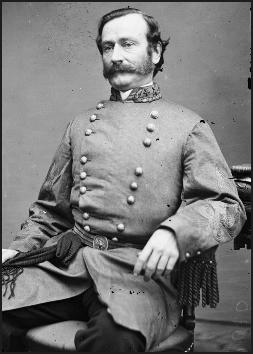
The above image is listed as three different Confederate officers

       The above image has been credited as being that of Edward Dorr Tracy sometime before 1863 while he was still a colonel. There is a slight resemblance to the above photographs of Tracy, however the match is not perfect. The above photograph has been listed as that of Confederate Brigadier General James Green Martin of North Carolina. A Quick look at General Martin will quickly show you the above photo looks nothing like him.


An image of Brigadier General James Green Martin who lacks the amount of hair to match the photo above his

       In the book More Generals In Gray by Bruce Allardice is photograph of a Confederate Colonel named John Donelson Martin. The photo is provided by a descendant of Colonel Martin. Colonel John D. Martin was born in Tennessee in 1830 and his father was a wealthy business man of Nashville, Tennessee. Colonel Martin fought in the Mexican War at the age of 16. Following that war, he became a doctor. He entered the war as a captain in the 154th Tennessee Infantry. He became colonel of the regiment by January of 1862. He fought at Belmont, Shiloh, Iuka, and was mortally wounded on the first day of the fighting at the Battle of Corinth. Colonel John Donelson Martin rests today in Elmwood Cemetery, Memphis, Tennessee. If the photograph below is that of John D. Martin as his descendants insist, then the photograph was taken between January of 1862 and October of 1862, between the time he served as a captain and the time he was killed in combat at the age of 32. Below is the photograph of John Donelson Martin.


Colonel John Donelson Martin


Monday, July 20, 2015

Mansfield Lovell: Awaiting Further Orders


An Early War Photograph of Major General Mansfield Lovell

       Most of my blogs are about great Confederate General's that happen to be my hero's. This is not one of those blogs. Mansfield Lovell may have tried his best, but just wasn't a great commander. He was known for his ability with artillery and perhaps in engineering, but he just wasn't a leader of combat troops. 
       Lovell was born in Washington, D.C. in 1822. His father was the first surgeon general of the United States Army. He grew up in Washington, and after 1836, moved to New York. His grandfather was a prominent politician in Boston, Massachusetts. His ancestry hailed from the north. Lovell received an appointment to West Point and graduated ninth out of 56 cadets in the Class of 1842. His high class ranking ensured he wouldn't be assigned to the infantry and he received an appointment as lieutenant in the artillery. He would see action in the Mexican War, where he was wounded twice and cited for gallantry. Lovell's star was on the rise. For the latter part of the Mexican conflict, Lovell served on the staff of Brigadier General John Quitman. 
       

Brigadier General John Quitman

       Quitman, like Lovell was born in the north, studied law, and eventually moved to Natchez, Mississippi. He would become governor of Mississippi from 1850-1851. The relationship between the two men became like a father and son. It is believed that Quitman is the man that swayed Lovell to consider himself a southerner. 
       In 1854, Lovell resigned his commission from the U.S. Army and moved to New Jersey. He eventually became the deputy street commissioner for New York City under another southerner named Gustavus W. Smith (see my blog http://trrcobb.blogspot.com/2013/07/major-general-gw-smith-was-strain-more.html). 
       When the Civil War began, both Gustavus Smith and Mansfield Lovell left New York City for the south. They arrived and reported to Joseph Johnston, who in turn recommended them to Jefferson Davis as the two "best officers whose services we can command." Lovell would be sent to New Orleans, Louisiana where he would be promoted to major general and begin service in command of the coastal defenses there. 
       The Confederate government believed that New Orleans was safe from the south because of Fort's Jackson and St. Phillip. They soon began to strip Lovell of guns and men believing the real threat came from the upper Mississippi River. Six months later, a Federal fleet under David  Farragut would run past the forts and capture New Orleans. Lovell received an unfair share of the blame for the loss, but in truth, the government was at fault. Lovell reacted quickly and sent men, guns, and supplies to Vicksburg to hold that important city. Although criticized, Lovell was beginning the war doing the best that could be expected of anyone. 


Mansfield Lovell has grown his whiskers out for this photograph

       To appease the people of Mississippi and the state government, President Davis placed Major General Earl Van Dorn over Lovell. Van Dorn himself had become something of a failure as a general of troops having almost lost his army at the Battle of Elkhorn Tavern in Arkansas. He assigned Lovell to a division of his new command in Mississippi and marched northward intending to retake Corinth, Mississippi. The Federal commander waiting there was William Rosecrans and ironically, his army was occupying the same breastworks built by the Confederate Army in the spring of 1862. 
       Lovell began the campaign as a division commander under Van Dorn, but Lovell was an arrogant man. He believed himself superior to Van Dorn and equal to the best general in the Confederate Army. This would be the recipe for a disaster. It was said he had a swagger that reminded his subordinates of a conquering Caesar. To make matters worse, while advancing toward Corinth, he spotted what appeared to be the wheels of a single artillery piece on the horizon. He ordered skirmishers thrown out and an entire brigade to advance across the field toward the enemy threat. The distance was covered quickly, every man expecting to receive enemy fire in an instant. Once the skirmishers reached the position, they found to their amazement, a single pair of abandoned wagon wheels from an old sawmill. 
       During the first day of the battle, Lovell's division advanced on the far right and after serious fighting took possession of Oliver's Hill. (One of his regiments that my grandfather fought in, was the 35th Alabama Infantry. They captured a cannon there named "The Lady Richardson.") At this point in the battle, Lovell seems to have lost his nerve. With the Federal troops in full retreat, he halted his advance. His three brigade commanders were just itching to finish the fight. Lovell allowed the two divisions on his left to do the remainder of the days work. Brigadier General John Stevens Bowen (see my blog http://trrcobb.blogspot.com/2011/03/death-of-another-stonewall.html) was extremely irritated that the battle had been won when Lovell inexplicably called a halt. He went to Lovell and asked for permission to attack. It was only 3 p.m. For the remainder of the day, Lovell's division cared for their wounded and collected their dead for burial as they listened to the fury of the battle. Lovell's actions are inexcusable. 


Another uniformed photograph of Mansfield Lovell

       He continued to do little on the second day of the battle. Ordered to attack by Van Dorn, he simply ignored the order and did nothing. Van Dorn must have been out of touch with what was occurring that day because he praised Lovell's actions in his official report. That praise would not save Lovell. President Davis still blamed Lovell for the fall of New Orleans. Jefferson Davis was famous for holding grudges. There were positions where Lovell could have possibly excelled, but Davis refused to give him the chance. 
       A court of inquiry was held on Lovell's responsibility for losing New Orleans and the court cleared him of any blame. Once this occurred, Joseph Johnston asked Davis to assign Lovell to his army to command a corps. Davis refused. (Likely a good thing considering Lovell's failure commanding troops at Corinth). Again, Braxton Bragg suggested Davis make Lovell chief of artillery of the Army of Tennessee, a position Lovell had excelled in before. Again, Davis refused. The only message from Richmond to Lovell was "Await further orders." 
       Lovell finally gave up on receiving a new assignment and served Joseph Johnston as a volunteer aide during the Atlanta Campaign. When A.P. Stewart took command of Leonidas Polk's old corps following that officers death, Johnston asked that Lovell be assigned to command Stewart's division. Not surprisingly, Davis refused this request also. Once Hood took command of the army, he asked Davis to assign Lovell to command his old corps. Despite the close relationship between Hood and Davis, the president still would not relent. 
       Not until Robert E. Lee was made commander in chief of all Confederate troops would Lovell receive another assignment. Johnston was given command of the Army of Tennessee during the Carolina's Campaign in 1865 and asked Lee for Lovell's services. Lee assigned Lovell to command Confederate forces in South Carolina. He held the assignment from April 7 until his surrender one month later. 


Lovell's frock coat in the Louisiana State Museum

       Following the war, Lovell attempted to run a rice plantation in Savannah, Georgia, but high water wiped out his first crop. He then moved to New York City where he became a civil engineer and surveyor. He helped with the removal of river obstructions in Hell's Gate, Queens, New York. Lovell would die in New York City on June 1, 1884 before the completion of the job. He was 61 years old. He rests today in Woodlawn Cemetery, Bronx, New York. 

Mansfield Lovell

Lovell's grave


U.S. Army Corps of Engineers completing the work at Hell's Gate one year after the death of Mansfield Lovell.


Monday, September 30, 2013

On With The Assault


Colonel John N. Daly is lying to the right of Colonel Rogers

       The most famous commander killed at the Battle of Corinth on October 4, 1862 was William Peleg Rogers who commanded a brigade of Texas Infantry. Killed in the attack on Battery Robinette alongside of Colonel Rogers was Colonel John Daly, commander of the 18th Arkansas Infantry.

       I’ve attempted to write a blog about Colonel Daly for some time now, but there is very little information to be found about him. After months of research, I decided to publish what is known about this brave Arkansas colonel.
 
       John Daly was born in Tennessee and eventually became a lawyer in Ouachita County, Arkansas. He was 29 years old in the 1860 census and had married a lady named Mary Ann McCollum. Together they had one son named Richard Hugh Daly. Mary Ann was born in 1838 making her seven years younger than John.

       When the war began, John was elected lieutenant of Company I, 18th Arkansas Infantry which was organized Camden, Arkansas. He was soon elected lieutenant colonel and eventually colonel of the regiment.
 
       The regiment having been 1000 strong when organized was down to 425 men by September, 1862 because of sickness. They fought in the Battle of Iuka on September 19, 1862. They then marched to Corinth where they formed for battle on October 4, 1862 with just over 300 infantrymen. They advanced against Battery Robinette and received enfilading fire from Battery Williams to the south. Colonel Daly led the regiment forward over felled trees and up to the enemy breastworks.
 
       He was wounded as he led the assault with his sword in hand. He yelled, “On with the assault!” before collapsing on the ground mortally wounded. The fire at the works was so severe, that only 43 men returned from the charge.
 
       One soldier in the 18th Arkansas wrote, “On Saturday, our gallant colonel John Daly, leading his men, was mortally wounded in that sheet of fire and lead which no troops could withstand. On Monday, after the charge on Saturday, I found our Colonel John Daly, who commanded the 18th Arkansas, and a number of others of the regiment. A detail of Federals were burying the Confederate dead. It was horrible to contemplate the scene and look upon the blackened and bloated corpses.”

       Studying the photograph of Colonel Daly beside Colonel Rogers, I had assumed he was shot in the head. There appears to be blood on his forehead, but eyewitness accounts say he didn’t die until sometime the next day. He possibly was struck in the head and survived until the following day. I also wanted to find where he was buried and the best I can figure is that he rests where he fell near Battery Robinette. There is a marker there dedicated to Colonel Rogers and one to Brigadier General Joseph Lewis Hogg who died in Corinth of dysentery on May 16, 1862. I asked one of the Park Rangers there at the Battery Robinette Civil War Museum if Colonel John Daly was buried there alongside of Colonel William Peleg Rogers and she replied, “I’ve never heard of the man.”

       If you study the above picture, you'll notice what appears to be blood above Colonel Daly's right eye. 

Monday, January 2, 2012

A Mississippi Civil War Gasm


Me at the grave of Brigadier General Joseph L. Hogg

       Well, I finally had a day off without kids to baby sit and went on a mini-Civil War Gasm with my buddy Jerry in Mississippi. If you know Jerry, you know we had a blast. We have begun a hobby of visiting as many Confederate generals graves as possible and having our pictures taken with them. Our first stop was in Corinth, Mississippi at the museum located on the site of Battery Robinette where Confederate Brigadier General Joseph Lewis Hogg is buried. He didn't die in battle here, but from dysentery about three months after his promotion to brigadier general and without seeing any action whatsoever. Colonel William Peleg Rogers is also buried there, killed in the charge that overran the small earthen fort. He commanded a brigade in the action there and by all rights should have been a general officer. Despite the fact that a petition was signed begging President Davis to promote the man, he remained a colonel. The reason being that he and Davis had an argument during the Mexican War and Davis being the type person who held grudges would never forgive Rogers. 
       This brings us to the funny part of the story. Jerry and I wore our shell jackets on this trip. We were in a hurry because after all it was a Civil War Gasm. (Civil War Gasm definition is where you hit as many places as quickly as possible and we had places to go before dark.) We entered the museum to find the park ranger talking to a group of people. The entire group paused to watch us pass right by and out the back door of the museum at a high rate of speed. We exited the museum and walked around to the gate to find it locked. We then re-entered the museum by a side door and exited through another door out of sight of the ranger and group. We made each others picture beside General Hogg and Colonel Rogers graves, walked back around the building to Jerry's truck and left. It was only later that we decided that this is how ghost stories begin. We can just imagine someday reading about ourselves as the park ranger writes a book about the first sergeant and private that passed right through the museum and beyond a locked gate to be seen no more. 


Me at the grave of Colonel William Rogers one of my personal hero's.

       We left Corinth and headed southwest toward Ripley, Mississippi. About six miles beyond Ripley is a small town called Blue Mountain. Here in Blue Mountain Cemetery is the resting place of Brigadier General Mark Perrin Lowrey. His grave was easy enough to find, the cemetery not much more than an acre and his being the only one with an obelisk. General Lowrey was one of Patrick Cleburne's brigade commanders. He had fought in the Mexican War and returned home determined to become a preacher. Despite the fact that he couldn't read or write, he proceeded to accomplish his goal. His wife taught him reading and writing and he became a Baptist minister. He rose to the rank of general during the Civil War and following the war returned to the ministry and also founded a female college in Blue Mountain which later became Blue Mountain College. He died in the railroad depot in Middleton, Tennessee while awaiting a passenger train. 


Grave of Mark Perrin Lowrey

       Leaving Blue Mountain, Mississippi, Jerry called my attention to something I had never realized before. It seems the laws of mathematics cease to exist in this old southern state. We arrived at a sign that declared the intersection a four way stop. The problem was, we only counted three roads. One might think this was a simple accident, but we'll come back to this later. 
       We then drove west to Holly Springs, Mississippi where there are four generals buried in one cemetery. We arrived and entered the first cemetery entrance we came to. There on the right within twenty feet of the entrance we found the grave of Major General Edward Cary Walthall. If you know my luck, you'll know this was a complete accident. Walthall was the little known Confederate general that Forrest chose to help him fight the rear-guard for Hood during the retreat from Nashville. It would prove to be Walthall's best performance of the war. 


Major General Edward Cary Walthall

       We then got lucky and found the graves of Samuel Benton and Winfield Scott Featherston. Benton was only a colonel leading a brigade at the Battle of Atlanta when artillery shrapnel nearly tore his foot off and a piece lodged just inches from his heart. His foot would be amputated and his promotion to brigadier general would arrive from Richmond just two days before his death. The authorities in Richmond had not known he'd been wounded. 


Brigadier General Samuel Benton

       Brigadier General Winfield Scott Featherston began the war in the Virginia army and made a name for himself at the Battle of Ball's Bluff. From that point on he would serve as a capable officer but made no special name for himself. He would be shipped to the west where he would finish the war with the Army of Tennessee. His grave was as easy to find as Walthall's which was a good thing because it was about a ten degree windchill factor and I told Jerry that if a limb was to hit my ear, it would shatter like glass. 


Brigadier General Winfield Scott Featherston

       This brought us to the most difficult part of finding Brigadier General Daniel Chevilette Govan's grave. His marker is relatively flat without the enormous obelisks to mark the position. Jerry has a sixth sense or so he claims, sometimes it gets a bit off on him. He told me to check some markers about forty yards from the truck. I almost left my camera in the car because I don't trust Jerry's sixth sense, but I carried it along just in case. Lucky for me because, it did indeed turn out to be General Govan. This was truly our lucky day, my ears having lost all feeling along with my fingers, toes, and nose. Govan is the Arkansas brigadier who stood next to his close friend Patrick Cleburne at Franklin and said, "General, there won't be many of us to return home to Arkansas after this battle." Cleburne simply replied, "Well, Govan, if we are to die, let us die like men."


Brigadier General Daniel Govan

       It was at this point that Jerry's sixth sense began to get goofy or at least I think it did. He still claims he was right, but on that point I still remain dubious. He claimed he had an intuition that there was someone buried beneath a cedar tree he could see across the cemetery. He refused to leave the cemetery without investigating this mystery person. We drove across the cemetery to the cedar tree in question and sure enough, there was someone buried beneath the tree. I simply shook my head. Of course there was someone buried beneath the tree, it is a cemetery. He argues that he never said it was anyone buried there that had anything to do with the Civil War, he simply said there was someone buried there. 
       Leaving Holly Springs headed back home we again encountered a four way stop sign with only three roads. Jerry wanted to stop and take a picture of the intersection, but luckily he chose to pass on by this time. It was a typical Civil War Gasm for me. Out prowling the country with a fellow Civil War nut and we got photographs of us by six Confederate generals graves. I only wish I could do this everyday. 


Wednesday, July 13, 2011

The Bravest Man: Colonel William P. Rogers


Colonel William Peleg Rogers

       William P. Rogers was born in 1819 in Georgia, but grew up in Alabama and later Mississippi. His father wanted him to become a doctor. Rogers graduated medical school and practiced medicine for a short time before becoming an attorney. He joined the army during the Mexican War and was made a captain in the 1st Mississippi Infantry. That regiment was commanded by Jefferson Davis, the future president of the Confederacy. 
       Rogers proved to be an excellent leader, but he had trouble with Davis as his commander. Davis had to control every part of his regiment down to the smallest detail. Although Rogers had performed admirably during two battles, Davis slighted the man in his reports. The war ended with both men having a strong dislike of each other and ironically both would return home a war hero. 
       Rogers moved to Texas and worked as an attorney and dabbled in politics until the Civil War began. He was commissioned lieutenant colonel of the Second Texas Infantry and saw his first action at the Battle of Shiloh. There the regiment lost over one-third of its men. General Hardee called the regiment a "bunch of cowards". Rogers took offense to the statement and vowed to prove Hardee wrong. 
       Rogers would be promoted to colonel and over the next few months the commanders of over twenty regiments petitioned President Davis to make Rogers a general. Rogers was pleased with the recommendation, but deep down he knew Davis would never make him a general. 


Battery Robinette

       William Rogers most glorious moment would occur at the Battle of Corinth on October 4, 1862. He was given the task of leading the assault on Battery Robinette. Riding in front of his regiment, he shouted, "Forward, Texans!"
       He led the regiment from the tree line and across the field at a slow steady march. The Federals described the sight of the Confederates slowly moving toward them as nerve grating. Colonel Rogers rode in front of his line as cool as if he were leading his men to dress parade. Within a hundred yards of the earthen fort the Federals opened fire. Men went down by scores. Rogers ordered his regiment to charge. They were forced to fight through abatis and over the dirt walls. 
       Four of his color-bearers had been killed, so Rogers dismounted and picked up the flag. With his pistol in one hand and the flag in the other, he climbed the wall and planted his regiments colors on the parapet. Over half of his men were shot down within minutes. William Rogers realized there was no way he could hold the position. He shouted, "Men, save yourselves or sell your lives as dearly as possible!"


Scene at Battery Robinette

       Those would be his last words. Despite wearing a bullet proof vest, Rogers would be killed. One of the bullets penetrated his body near the arm where the vest didn't cover. He was killed instantly. 
       Following the battle, General Rosecrans, the Federal commander would come to Battery Robinette to see the brave colonel. Rosecrans would become known for denying Confederates a burial with military honors, but not Colonel Rogers. Rosecrans said, "He was one of the bravest men that ever led a charge. Bury him with military honors and mark his grave, so his friends can claim him. The time will come when there will be a monument here to commemorate his bravery.”


Rogers Grave at Battery Robinette

       Rosecrans would be correct in that prediction. Today there stands a large obelisk just a few yards from Battery Robinette marking the grave of the brave Texas colonel. Colonel John Daly of the Eighteenth Arkansas would also be killed assaulting the fort. No one would ever accuse the Second Texas of cowardice again. 


William Rogers (L) and John Daly photographed after the battle


Monday, December 13, 2010

Only Indiana General Killed During The Civil War


Brigadier General Hackleman

       Pleasant Adam Hackleman was a lawyer and politician before the Civil War. Because of his hard work helping Lincoln get elected, he was commissioned a brigadier general in the Federal army. He saw action early in the war at the fiasco at Ball's Bluff. Hackleman would then be sent to the western army where he would not see action again until the Battle of Corinth under General Rosecrans.
       On the first day of the battle there, the Confederate army under Van Dorn hit Rosecrans hard. Part of the Federal line began to fall apart. Hackleman was attempting to rally his men  when he was struck in the neck by a bullet. 
       Being carried to the rear, Hackleman stated, "I am dying, but I die for my country. If we are victorious send my remains home; if not, bury me on the field."
       They would be the last words the forty-seven year old general would ever utter. He was carried to the Tishomingo Hotel and laid on the floor of the ladies' parlor. Surviving until nightfall, his division commander Thomas Davies would be by his side as he took his last breath.


Tishomingo Hotel

       The battle went from an apparent defeat to a victory the next day and Pleasant Hackleman would get his wish of being buried at home. Today, he rests in East Hill Cemetery, Rushville, Indiana.


Site of Pleasant Hackleman's death today


Pleasant Hackleman's grave


Tuesday, November 30, 2010

The “Bloody” Sixth Mississippi at Shiloh

          The 6th Mississippi Infantry Regiment was made up of men from Rankin, Quitman, Leake, Scott, Copiah, and Simpson counties. From Corinth they were ordered to carry five days rations and 100 rounds per man. The regiment arrived at Shiloh with only 425 men. There, they would fight in Patrick Cleburne’s brigade. 
They were in the front line attacking the Federal army near Shiloh Church in a small field known as Rhea Field. Camped there was the 53rd Ohio Infantry under Colonel Jesse Appler. The Federal soldiers were in a good position on the high ground behind their tents. The 23rd Tennessee Infantry was advancing alongside of the 6th Mississippi. All together they numbered about a thousand men. 
As the two regiments advanced from the tree line into the open, Appler’s Ohio infantry opened a devastating fire. Both Confederate regiments quickly withdrew into the cover of the forest. The 23rd Tennessee broke completely and the officers were unable to reform them. This left the 6th Mississippi to face twice their numbers alone. Colonel Thornton would pick up the colors when the color bearer went down and in turn fall severely wounded. Seven color bearer’s would be wounded in the attack at Rhea Field. 


Major Robert Lowry

Major Robert Lowry would take command and lead the 6th on another charge. He would fall with two wounds at the head of the regiment. As this charge soon died away, Colonel Appler of the 53rd Ohio panicked. He yelled, “Every man for himself!” He quickly showed them the way by turning and racing toward Pittsburg Landing. Most of the 53rd Ohio followed his example. 
Of the 425 men that went into Rhea Field, only sixty would be present to answer roll call following the fight. After the battle, when they returned to Corinth, they would only muster 100 men. The rest were either killed, wounded or missing. 
Colonel Thornton would be forced to resign his commission because of his wounds. Major Robert Lowry would survive his two wounds and later be promoted to brigadier general. He would fight through the rest of the war and surrender in Greensboro, North Carolina in 1865. But, from April 6, 1862 forward, the 6th Mississippi would become known as the “Bloody Sixth”.


The burial trench above contains the remains of many of the men of the 6th Mississippi Infantry listed below.

Burkholder, Abraham, Private; killed at Shiloh
Chandler, Wade, Private; killed at Shiloh
Miller, W. D., Private; killed at Shiloh
Myers, Isaac, Private; killed at Shiloh
Ennis, J., Private; killed at Shiloh
Strong, Claiborne F., Private; killed at Shiloh
Hall, W. A., Private; 4th Corporal; killed at Shiloh
Henry, D. F., Private; killed at Shiloh
West, H., Private, 3rd Corporal; killed at Shiloh
Childers, J. W., Private; killed at Shiloh
Cook, J. W., Private; killed at Shiloh
Derrick, Silas H., Private; wounded mortally in lungs at Shiloh
Reeves, W., Private; killed at Shiloh
Hix, Josiah, Private; killed at Shiloh
Whitehead, J., Private; killed at Shiloh
Owen, Gus Roland, Private; killed at Shiloh
James, James M., Private; killed at Shiloh
Willis, Thomas H., Lieutenant; killed at Shiloh
McLendon, Elias, Private; killed at Shiloh
Gordon, Stephen, Private; killed at Shiloh
Webb, J. M., Private; wounded mortally both legs and arms at Shiloh