Showing posts with label knight. Show all posts

Wednesday, January 19, 2011

The Black Knight


      Turner Ashby

       Turner Ashby was born in Virginia in 1828. His father, Turner Ashby, Sr., served as a colonel in the War of 1812 and died while he was very young. His grandfather was a captain in the Revolutionary War. Turner Ashby was privately tutored and after finishing, he purchased a farm near his mother's home. He named the home Wolf's Crag.


Wolf's Crag

       Turner Ashby was known for his chivalry, horseman ship, and as an avid outdoorsman. He was a natural leader and when the war began, he took command of a cavalry unit. The man was described as about five feet, eight inches, weighing about one hundred-sixty pounds and had a dark complexion from all the time he'd spent outdoors. He earned the nickname 'Black Knight of the Confederacy' because of his jet black hair and dark eyes. Always riding either a solid black horse or a solid white horse, he was a fearless leader. His command would follow him anywhere, but he was without formal military training and had lots of trouble because of his lack of discipline.
       Ashby was soon assigned to Stonewall Jackson's command in the Shenandoah Valley. Jackson gave him the job of patrolling the Potomac River north of the valley. In an engagement there, his brother Richard Ashby would be killed. Turner was told that Richard was bayoneted to death while attempting to surrender. No one for certain exactly what happened there, but regardless, Turner believed the story. From that point forward, he hated Northern troops and fought with a vengeance. 


Ashby in the militia uniform of Virginia before the war

       Ashby was soon promoted to colonel and given command of the 7th Virginia Cavalry Regiment. Many were pushing for Ashby to be promoted to brigadier general, but Jackson was against the idea. Jackson didn't think Ashby was capable of higher command because of the lack of discipline in his command and no proper military training. A brave fighter, Ashby never learned how to properly drill his men. Despite what Jackson suggested, Ashby was promoted to brigadier general in May of 1862. He would hold that rank for just ten days.
       Although Ashby was brave to a fault, there were times when he failed Jackson. Cavalry being the eyes of an army, it was Ashby's job to give Federal positions and troop strengths. At Kernstown, he greatly underestimated the size of the Union army. Jackson attacked the position and was defeated. Near Winchester, Virginia, after Jackson's infantry had defeated Nathaniel Banks force, Ashby's soldiers were too busy plundering captured wagons and allowed the retreating enemy to escape. Had Ashby's men been trained properly and disciplined, most of Banks force would have been captured.
       On June 6, 1862, General Ashby was fighting a rearguard action near Harrisonburg, Virginia. His force was being attacked by both Federal cavalry and infantry. His men easily repulsed the first attack. When the second attack began, Ashby's horse was killed. Rising from the ground, Ashby charged the enemy force, yelling, "Forward, my brave men!"
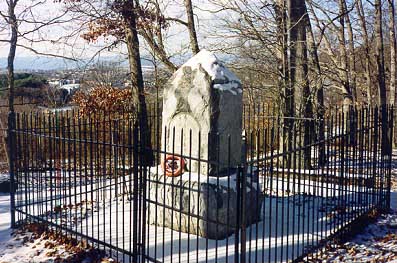

Monument marking the place where Ashby was killed

       Those were his last words. A bullet had hit him in the heart. He was killed instantly. It has been suggested that he could have been hit by friendly fire leading his men forward, but this seems highly unlikely. Turner Ashby's body was carried to the Kemper Home in Port Republic, photographed and then laid out in one of the rooms. Jackson soon arrived to view his remains.


Frank Kemper Home

       Despite the differences between Jackson and his cavalryman, the Confederate commander retired to his tent when he learned of his Ashby’s death. He later wrote, “As a partisan officer I never knew his superior; his daring was proverbial; his powers of endurance almost incredible; his tone of character heroic, and his sagacity almost intuitive in divining the purposes and movements of the enemy.”


Room where Jackson viewed Ashby's body

       Ashby rests today in the Stonewall Cemetery, Winchester, Virginia next to the body of his brother Richard. Turner Ashby was thirty-three years old. 


Ashby photographed in death


Grave of both Turner and Richard Ashby


Monday, January 17, 2011

A Knight Without Fear


James Holt Clanton

       James Holt Clanton was born in 1827 in Georgia, but his family moved to Alabama in 1835. After finishing school, Clanton went to the University of Alabama. He served as a private in the Mexican War and returned to become an attorney in Montgomery, Alabama. Though he opposed secession, he raised a company of cavalry at the outbreak of the war and quickly was made colonel of the 1st Alabama Cavalry. He would prove to be a man without fear, always leading his charges, pistol in hand. 
       Clanton would see his first action at the Battle of Shiloh. According to General James Chalmers, Clanton was “constantly exposed to the most dangerous fire, exhibited the most fearless and exemplary courage, cheering on those who seemed inclined to falter or grow weary.”
       He saw action at Farmington and at Booneville drove the enemy from the field. Like most officers in the army, he had a disagreement with General Bragg and resigned his commission as colonel of the 1st Alabama Cavalry. General Bragg had little use for officers without  proper military training and this probably was what caused them to have the disagreement. 
       Clanton returned to Montgomery and raised one infantry regiment and three cavalry regiments. He would receive a commission to brigadier general in late 1863. General Leonidas Polk called Clanton “an experienced cavalry officer, very efficient and enterprising.” 


Another wartime picture of Clanton

       For some reason, General Joseph Johnston, who was always begging for troops refused to accept Clanton’s brigade into his army. He stated that Clanton was incompetent. Why he believed this is still unknown, but probably stems from a mutiny in one of his regiments at one point earlier in the war. Clanton had been cleared of any wrong doing in the affair. 
       At Greensport, Alabama, he was outnumbered six to one by Federal troops, but the brave man decided to attack at dawn. He charged around the bend, personally leading his 200 troops. Pistol in hand and charging on foot. He was only twenty paces away when the Federal opened fire, armed with Spencer repeating rifles. His clothes were riddled with bullets, his entire staff killed or wounded. 
       During the fighting, a large black soldier named Griffin a member of his command approached General Clanton and asked, “General, where is Marse Batt?”
       Clanton was as calm as could be, pointed toward the Federal line and said, “There he is, dead.”
       Griffin charged forward, amid cries to stay back, through the smoke and bullets and picked up the young soldier and returned with him in his arms. 
       “Is he dead?” Clanton asked.
       “I don’t know, sir,” he replied, “My Mammy was his nurse and I’m older than he is. I promised to take care of him and bring him to her. I’m carrying him home now.”
       The Confederate troops were compelled to retreat before the terrific Federal fire. 
       In March, 1865, he was wounded in a fight at Bluff Spring, Florida. He fired his pistol at a Federal officer and spun his horse to ride away when a bullet slammed into his lower back. The bullet passed through his intestines and then exited the body. Doctors informed him the wound was mortal, so he called his chief of staff and had him write out Clanton’s will. Captured by the Federals, they paroled him, believing he would die. He was told if he survived the wound, he was to report to a prison camp. 
       After the war, Clanton returned to his law practice. Representing Alabama in a case against the Chattanooga and Alabama Railroad, he was forced to travel to Knoxville, Tennessee. He understood that Knoxville had sided with the Union during the war and believed the railroad had the case moved to Knoxville in an attempt to have him murdered. 


Another surviving photograph of General Clanton

       On September 27, 1871, after leaving the courtroom, Clanton was walking back to his hotel room with a Colonel Prosser. Tomlinson Fort later testified that he was walking down the sidewalk across the street with David Nelson who had served as a colonel in the Federal army during the war. 
       Tomlinson Fort walked across the street and shook Clanton’s hand because they were also friends. He then introduced Clanton to Nelson, saying, “Nelson fought against us, but had been very kind to his late enemies.”
       Nelson was already intoxicated. He asked Clanton to come have a drink with him. Clanton agreed to enter a saloon with the two men. On the way to the establishment, Nelson asked Clanton, “I’ll show you something if your not a coward.” 
       Clanton, known to as a knight without fear, answered, “Do you think I’m a coward?”
       “I’m not sure,” Nelson repeated. He then began to insult Clanton, becoming very excited. Clanton as was his nature during the war remained extremely cool. This seemed to make Nelson even more excited because he couldn’t intimidate the man.
       Tomlinson Fort placed his hand on Nelson’s shoulder and said, “Keep cool, Dave. You are in the wrong and there is no use in fighting.”
       Nelson ignored him. He said to Clanton, “I don’t know whether you’re a coward or not.”
       “You can try me anytime or place,” Clanton replied.
       Nelson said, “This is as good a place as any.”
       Fort stood talking to Clanton, telling him they were both his friends and there was no use in fighting. Nelson disappeared inside the saloon and returned a few moments later carrying a double-barreled shotgun.
       Nelson fired without taking careful aim, trying to kill Clanton before he could arm himself, but missed. Clanton drew his pistol and fired back, but missed also. Nelson then fired again, hitting Clanton in the shoulder and chest with over fifteen pellets of buckshot. Clanton immediately went to the ground, landing on his hands and face.
       The buckshot had gone into his lungs, torn his shoulder from the socket and shredded several arteries in his chest. They carried him to the Lamar Hotel where he would die a few moments later. Clanton left a widow and six children, some very young. 


Lamar House Hotel

       The case went to trial in 1873 and was highly publicized. A Judge Trigg also witnessed the incident and testified that Nelson fired the first shot at Clanton, who was not prepared or armed. 
       Nelson’s defense attorneys claimed the murder was in self-defense. The jury took five minutes to acquit Nelson of the murder charge. The entire state of Alabama became furious over the trial. Newspapers called the trial a big sham. 
       Interestingly, David Nelson’s father Thomas Nelson was a prominent politician and judge in Knoxville, Tennessee. He resigned his seat as judge to help defend his son’s murder charge. After his son was found not guilty, Thomas Nelson would spend the remainder of his life teaching Sunday school. Today, Thomas Nelson rests in an unmarked grave. David Nelson has long since been forgotten about, unlike the brave man he unjustly murdered.


Thomas Nelson, father of the murderer

       James Holt Clanton rests today in Greenwood Cemetery, Montgomery, Alabama. 


Me standing beside the grave of General Clanton