Showing posts with label s.a.m. wood. Show all posts

Monday, May 14, 2012

S.A.M. Wood: Alabama General


Sterling Alexander Martin Wood

       S.A.M. Wood as he came to be called was born in Florence, Alabama on 17 March, 1823. There is a street in Florence today that is called Wood Avenue which is actually named for Wood's brother, a prominent Florence lawyer. S.A.M. Wood would soon return to Florence and become his brother's law partner. In 1857, Wood was elected to the Alabama state legislature and later become editor of the Florence Gazette
       When the war began, Wood organized Company K, 7th Alabama Infantry which was known as the Florence Guards. He would only remain a captain for a very short time. The unit was sent to Pensacola, Florida and Wood was there elected Colonel of the regiment. 


Flag of Company K, 7th Alabama Infantry

       On 7 January, 1862, Wood was promoted to brigadier general by Jefferson Davis. Braxton Bragg, Wood's commanding officer fired off an angry letter to Richmond about Wood being promoted ahead of James Patton Anderson, one of Bragg's favorite officers. 
       Just before the Battle of Shiloh, Wood's brigade (which consisted of the 16th Alabama, 8th and 9th Arkansas, 27th, 47th, and 55th Tennessee, and the 3rd Mississippi Battalion, all infantry regiments, including an artillery battery) was placed into Hindman's Division, William Hardee's Corps. This brigade was credited with the opening shots of the Battle of Shiloh. Wood was wounded when he fell from his horse there and momentarily gave up command of his brigade, but soon returned to lead them through the rest of the battle. 
       General Hindman had nothing good to say about Wood's leadership. There was a formal inquiry to Wood's actions as brigade commander, but no wrong doing could be found. He then led his brigade in action at the Battle of Perryville, Kentucky and while his brigade helped to capture an artillery battery there, Wood was wounded by a artillery shrapnel. 


S.A.M. Wood (seated in dark uniform) with members of his staff

       Following the Kentucky Campaign, Wood's brigade was placed into the elite division of Patrick Cleburne. Cleburne commended Wood for his performance at the Battle of Murfreesboro. It seemed Wood's star was on the rise. 
       On the second day of the Battle of Chickamauga, General Wood lost control of his brigade which became separated and only one regiment got in the action. Wood then got the rest of his brigade into a field where they attacked alone and were repulsed with heavy losses. Cleburne was furious with Wood and ordered him to take the remainder of his brigade to the rear. 
       Cleburne failed to mention Wood in his report following the battle, which was considered an insult or a sign of failure in that time period. S.A.M. Wood saw the writing on the wall and resigned his commission on 17 October 1863. It would be the last time he would see action during the war. He moved his family to Tuscaloosa and continued his law practice. He later reentered politics and became a member of the faculty at the University of Alabama. He died there on 26 January 1891.


Timmy and I at the grave of S.A.M. Wood in Evergreen Cemetery less than a hundred yards from Bryant Denny Stadium


Sunday, January 8, 2012

Another Civil War Gasm

       I was very lucky to go on two Civil War Gasms in one week, this time while babysitting.  Jerry and I planned a trip that would add another ten Generals graves to our collection.  The only problem with this trip was the fact that it was pouring down rain here at home.  Jerry swore up and down that his intuition (women's intuition is what I think it is)  told him that it wasn't raining south of us.  We'll come back to this part later.  


Me and Timmy at the grave of William F. Tucker

       
       Our first stop was in Okolona, Mississippi at a cemetery called Odd Fellows.  I told Jerry that he should be buried in a cemetery by this name.  Luckily for us General Tuckers grave was easy to find.  We had just gotten our pictures made at the grave site when the bottom fell out.  We were forced to run to the car and while running Timmy announced "that old man got us wet!"  Brigadier General William Feimster Tucker lead Mississippi infantry in the  Army of Tennessee.  He was severely wounded at Resaca only two months after his promotion, disabling him from service for the rest of the war.  This resulted in him not being one of the well known Confederate Generals.  


More Mississippi road signs

       Again Jerry found road signs that made no sense in the state of Mississippi.  He insisted I stand out in the rain to take a picture of this phenomenon.  We are driving down the road and approach a 'do not enter' sign and just 50 yards beyond is a stop sign.  Jerry's question is, "if you're not supposed to enter, why do you need a stop sign?"  Jerry is always on the lookout for such things.  Between Okolona and Aberdeen he found  a county road that went into a cotton field and ended.  I talked him out of stopping and forcing me to take a picture of this, thank goodness because we were running behind.  


Timmy and I at the grave of Samuel Gholson

       We left Okolona and the dark cloud that follows Jerry everywhere he goes and went south to Aberdeen.  At another cemetery where Jerry should be buried, also called Odd Fellows, we found the grave of Brigadier General Samuel A. Gholson.  General Gholson lost an arm in a cavalry skirmish in Egypt, Mississippi.  We passed through Egypt on the way to Aberdeen and I had to talk Jerry out of stopping and asking where the pyramids were.  


Jerry and I at the grave of John Gregg

       About 20 yards from Gholson we found the grave of one of my favorite generals.  Brigadier General John Gregg was born in Lawrence County, Al and attended college at LaGrange which was considered the West Point of the South.  LaGrange is less than 10 miles from my house.  He fought in the Vicksburg campaign, was wounded in the neck at Chickamauga, and transferred to Lee's army in Virginia where he was shot in the neck again just outside of Richmond and killed. For more on General Gregg please see my John Gregg blog April 2011.   I never thought I would get a four year old to take a good picture, but the picture of Jerry and I was taken by Timmy.  As soon as he took the picture he announced,  "I got you and that old man with the white mustache."  


Confederate New Jersey Cavalry?

       In the confederate section of the Aberdeen cemetery we found a private John Wallace company B 2nd regiment, CSA.  Jerry was amazed to find that New Jersey provided regiments for the confederate army.  I told him that I thought the J should have been a C and it had to be North Carolina cavalry, but I learned Jerry was right this time.  There was a sign at the cemetery entrance that told the story of John Wallace.  Apparently John Wallace was a deserter from the 2nd New Jersey Cavalry, U.S. He burned the house of an elderly southern gentleman which resulted in the mans death.  The mans son then killed John Wallace.  There was still no explanation why this criminal was buried beneath a confederate marker.  


Me and Timmy at William Baldwin's grave

       We then traveled on southward to Columbus, Mississippi and to Friendship Cemetery where three confederate generals rest.  The first grave we found was of another one of my favorite generals, Brigadier General William Edwin Baldwin.  The first words out of Jerry's mouth was, "There is no drain hole in the bowl on top of the stone.  I wonder what keeps the water from freezing and bursting this bowl?"  

       I replied sarcastically, "Jerry, that is just the question I was about to ask after I finished paying tribute to one of my Confederate heroes."  You can read more about William Baldwin in my blog, 'Confederate General Killed by DUI?'  August 2011.


Photo taken by Timmy of Tim and the Old Man with General SD Lee

       The next general was one of Jerry's heroes, General SD Lee.  Jerry's ancestor served under Forrest who in turn served under Lieutenant General SD Lee at times.  Following the war, Lee was the first president of Mississippi State University.  


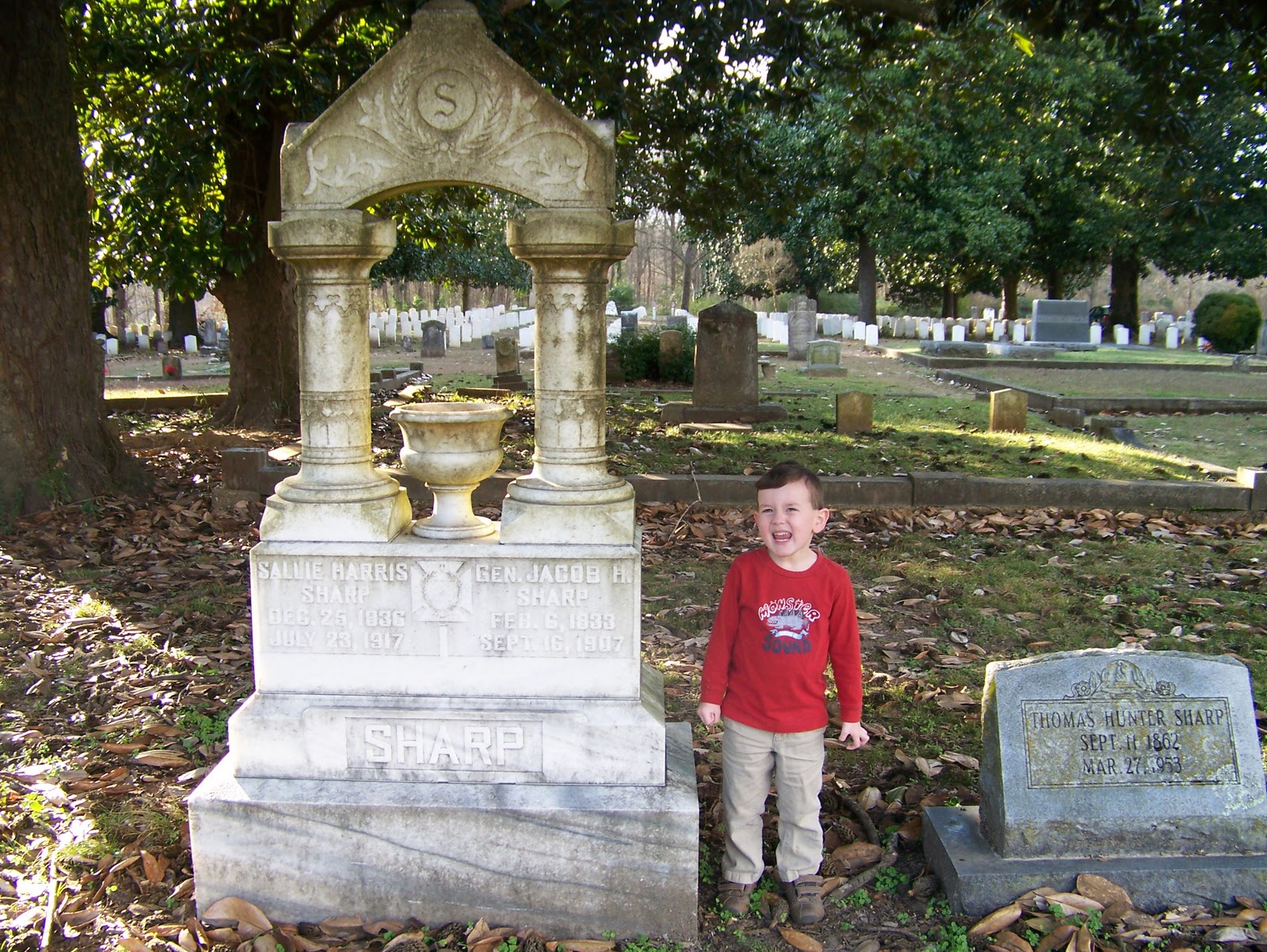
Timmy with General Sharp

       Brigadier General Jacob Hunter Sharp is also buried in this cemetery.  General Sharp led a brigade in the Army of Tennessee from Chickamauga to Bentonville.  


Me and Timmy with Phillip Roddey

       We arrived in Tuscaloosa only 30 minutes before sunset.  While I was frantically hunting the graves of Brigadier Generals George D. Johnston and Phillip D. Roddey Jerry was being entertained by two police officers attempting to arrest a man in a house next to the cemetery.  General Roddey was called 'the defender of the Tennessee Valley'.  


Timmy and I with Josiah Gorgas

       It was almost dark when we found the graves of Josiah Gorgas and S.A.M. Wood.  Wood was a native of Florence, Alabama.  He saw action from Shiloh to Chickamauga where he lost control of his brigade during a night fight and resigned.  One could throw a stone from these two officers graves and hit Bryant Denny Stadium.  It had been a great trip. We had gotten ten generals grave photos.  Any trip with Jerry that doesn't end with an arrest is a good trip.


Timmy in the cemetery with Bryant Denny Stadium in the back