
The New Nathan Bedford Forrest Bust in Selma's Live Oak Cemetery
Stacie and I had been planning to spend the weekend with my good buddy Pat and his wife Ruthie for several months now. We went down on Friday afternoon on May 22nd and spent two nights there. If you know anything about the way our year began, we you understand how badly we needed the time away. Pat, Ruthie, and another couple of their friends were there the first night. When we planned this visit, we had no idea that the new Nathan B. Forrest bust was to be unveiled on this weekend. When Pat told me we were going the next morning, I was excited because it would add another three pictures of me with Confederate generals graves.
Pat cooked us all the biggest steaks I've ever attempted to eat in my life. I couldn't do it. Pat's buddy Larry not only ate all of his steak, but half of his wife Nita's. I couldn't believe it. Larry was a door gunner during the Vietnam War. Larry went to bed before Pat and I, so we sat on the front porch and discussed our favorite subject of course, the Civil War.
The next morning we arose early and headed to Selma which is about an hour south of Pat's house. The trip was relatively uneventful if you don't take into account the lady texting while meeting us in our lane. Pat has a brand new pickup that I thought was gonna need a lot of work, along with its three occupants. The wives were following us down in another vehicle.

Pat and I at the grave of Catesby Ap Jones
We arrived in Live Oak Cemetery at 9:30 a.m. just in time for the cemetery tour. The first grave we got our picture taken was at Confederate Naval Captain Catesby Ap Jones. Captain Jones was the man who took charge of the CSS Virginia during its engagement with the USS Monitor. We then were led to the grave of Brigadier General Edmund Winston Pettus. Pettus had the distinction of being captured three times during the war. We learned that Pettus was buried under a flat concrete marker because he was a very humble person.

Pat and I with Brigadier General Edmund W. Pettus
We were then taken to the grave of "Old Reliable" himself. Confederate Lieutenant General William J. Hardee. Hardee fought with the Army of Tennessee from Shiloh until Atlanta when he finally left that army following an argument with General John Bell Hood. He would return to that army to finish the war in the Carolina's during the spring of 1865. General Hardee was my favorite general's best friend, Patrick R. Cleburne. Hardee was also known as the Army of Tennessee's biggest back biter, which says a lot when you look at all the turmoil that occurred in that army.

Me and Pat with General William J. Hardee
We then finished up the Civil War tour with little known Confederate Brigadier General John Tyler Morgan. Morgan was more famous as a post-war senator than as a Confederate general. Ironically, his monument is much larger than the others as you can see by the photo.

Us with General John T. Morgan
We remained in the cemetery for most of the rest of the afternoon listening to the unveiling ceremony. It was not in our original plans, but I'm extremely glad we did. There were four wonderful speakers that kept our attention. (Even with my narcolepsy I only nodded once or twice). During the cemetery tour, I'd learned there was an extremely interesting cannon at City Hall that I wanted to visit. Pat promised me we'd go there before calling it a day. My wife became extremely interested in a couple of strange looking grasshoppers on Catesby Ap Jones grave that we don't have in Northern Alabama. (She kept calling them crickets for some reason which caused Pat to laugh and say "Those are grasshoppers.")
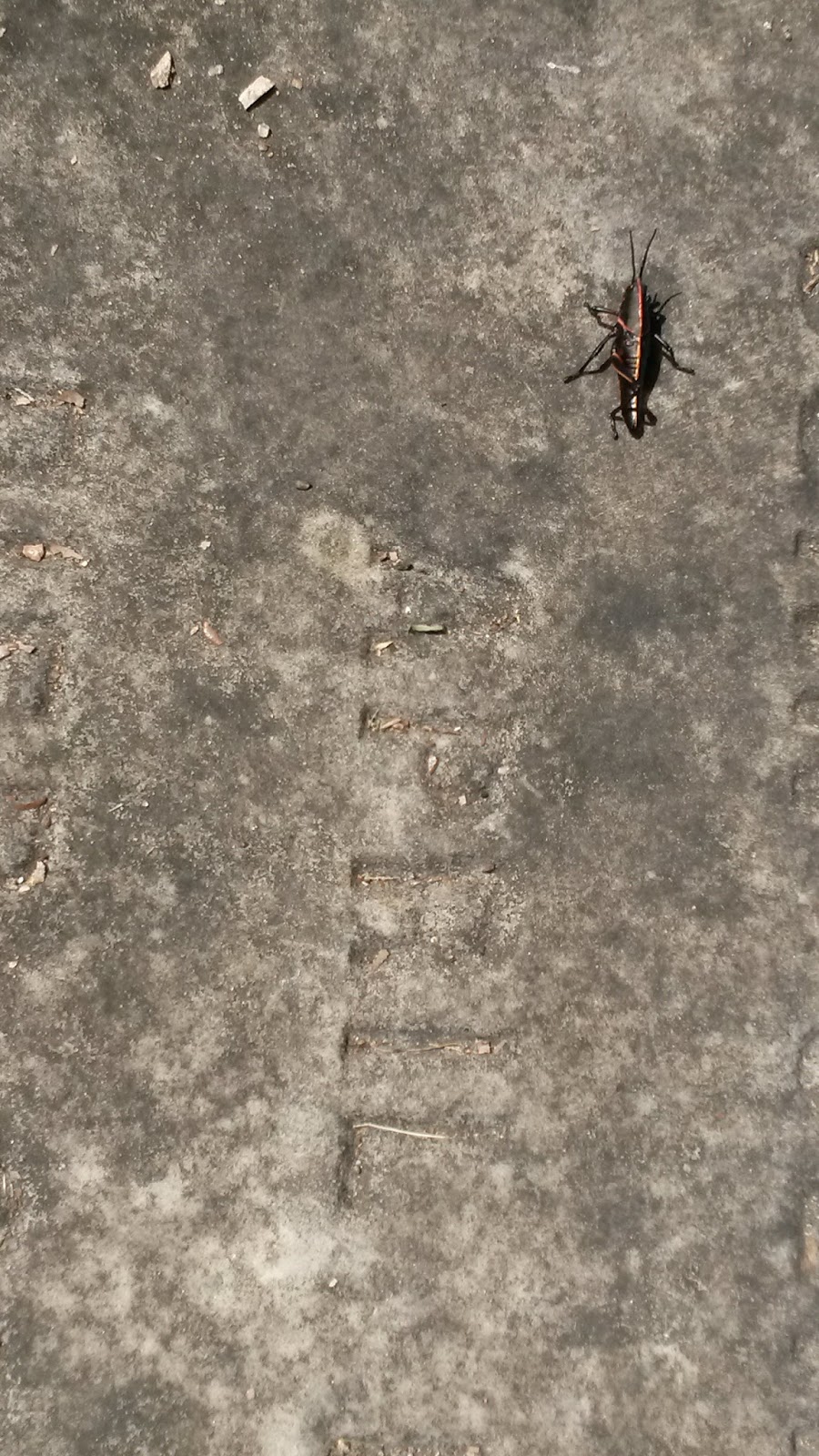

The Eastern Lubber Grasshopper on Captain Jones's Grave
The city historian was one of the speakers at the event and as soon as it was finished, I approached him and asked where the Confederate ironclads were built during the war. He told me where to go (it just happened to be very near where we ate dinner). Sadly, there is nothing left on the location but just some trees. After we ate, we headed to City Hall where one of the Seven Inch Brooke rifles that was on board the CSS Tennessee during the Battle of Mobile Bay sits today. Two Confederate sailors were killed serving this very gun during that engagement. The rifle is marked S-5, which means it was the fifth Brooke Rifle cast at Selma.

Left to Right: Me, Pat, and Larry with the sweetest piece of history in Selma
I thought this was a pretty neat little Civil War trip, but Pat had a surprise in store for me the next day. He took me to a Confederate ironwork's and cemetery. I'll write that blog tomorrow, stay tuned.


