Showing posts with label thomas. Show all posts

Wednesday, June 29, 2011

The Ghost of Thomas Cobb


Thomas Reade Rootes Cobb

       The very first blog I wrote was on Thomas R.R. Cobb. I wrote about the conspiracy theory surrounding his death. Some said he was killed by artillery shrapnel, others say a bullet, and yet another claimed it was friendly fire. Recently, I have learned of another Cobb story.
       Thomas Cobb built his house in 1830. In 1850 he added octagonal wings. It was still on its original site in 1984, when the city decided it needed to be torn down. The house was in a state of disrepair. The home was then moved to Stone Mountain Park where it was to be restored. The restoration never occurred. In 2004, a non-profit organization had it brought back to Athens and restored to its original condition. It opened for tours in 2007. 


Cobb House today in Athens, Georgia

       The present staff have some very strange stories to tell about the place. According to them, two priests have visited the home and asked who the ghost is. Both priests said they saw a man dressed in gray descend the stairs and walk into General Cobb's library where he stood by the fireplace. They also tell a story of some newspapers catching fire in the house while no one was there. The papers were found the next morning completely burned, but none of the house was touched. One of the priests said that the house was being protected by Cobb. 
       The staff also claims to hear footsteps and a little girl laughing when there are no visitors in the home. The Cobb's had three children die inside the home. The staff believes the girl laughing is one of Cobb's deceased children. There is also an armoire that belonged to General Cobb. The doors on the cabinet are very difficult to open. Often times the staff will arrive in the morning to find the doors wide open. The staff believes Cobb's spirit is there looking for something.
       There is a part of this story I find a bit difficult to believe. According to the priests and the staff, General Cobb's ghost is benevolent and appreciates what is occurring at his old home. I've studied Confederate Generals all my life and there is one thing that is certain. In life, General Cobb was not a benevolent person. The man had a violent temper and often seemed paranoid. During the war he constantly complained about his superiors. He didn't agree with Davis's policy and even labelled Robert E. Lee as being haughty and crude. 
       Maybe Cobb haunts his old home place. If I'm ever in Athens, Georgia, I would like to tour the house. Regardless, if ghosts are real, it would be a man like Thomas Cobb who would have a restless spirit. 


Saturday, January 29, 2011

Master Of War


General George Henry Thomas

       I strongly recommend the book 'Master Of War' by Benson Bobrick. The book is a biography on the life of Federal General George Henry Thomas. Mr. Bobrick makes a strong case that General Thomas was the best Union commander of the Civil War. I have always believed this myself. 
       Mr. Bobrick points out the reasons that he thinks General Thomas is often overlooked as a brilliant commander. Thomas was born in Virginia and unlike Ulysses Grant, he didn't have a congressman pushing him for promotion. Every laurel that Thomas won, he won on what he accomplished during the war. 
       George Thomas died in 1870 and after his death, both Grant and Sherman attempted to smear his reputation. Grant accused Thomas of being too slow in action. Thomas was known as a general who relied on maneuver, unlike Grant who fed his troops into a meat grinder with little thought. Thomas had the most complete victory of the war at the Battle of Nashville. At the same time Grant was calling Thomas too slow, he had been bogged down in front of Petersburg for six months without accomplishing anything of merit. 


Ulysses Grant

       Grant and Sherman became best friends during the war. At the Battle of Chattanooga, Grant formulated a plan to make Sherman the hero. While Thomas held the center, Sherman was to attack the north flank of the Confederate battle line on Missionary Ridge. First, Sherman advanced and took the wrong hill. He then attacked Missionary Ridge, Cleburne's division to be exact and his troops stalled, unable to push Cleburne from his position. 


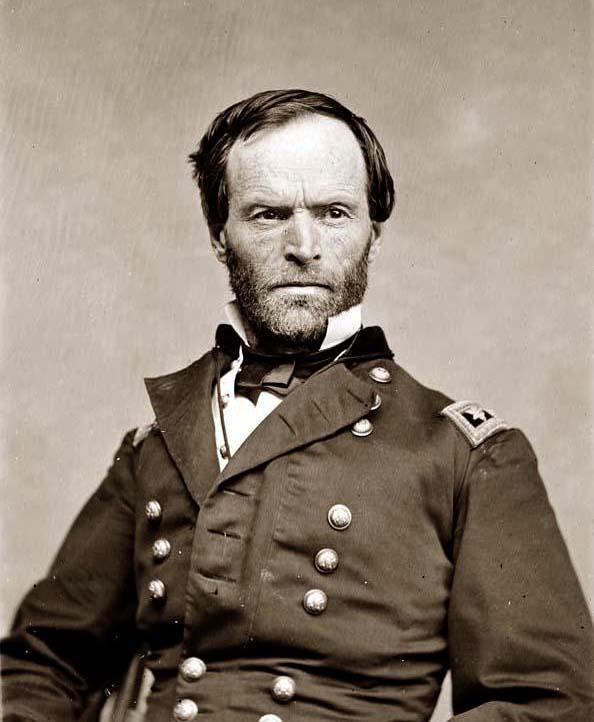
William Tecumseh Sherman

       Grant ordered Thomas to make a demonstration in the center. Thomas sent his troops forward and without orders they charged up Missionary Ridge and broke the Confederate center. Far from elated at the victory, Grant turned to Thomas and asked, "Who gave that order?"
       Thomas replied that he didn't know of anyone giving them the order to charge the heights. Grant then said to Thomas, "Well, it will be investigated."
       Try as he might during the war, Grant could hardly make Sherman the hero. It would be after the war and after Thomas' death that Sherman and Grant would change history by attacking his reputation and spreading false statements about the man. 
       During the Atlanta Campaign it was George Thomas who continued to insist on flanking the entrenched Confederate army. John A. Logan was at Sherman's headquarters when the army faced the Confederate army at Kennesaw Mountain. The position was the strongest faced during the campaign. Logan noted that Sherman was reading a newspaper about Grant's high casualties during the Overland Campaign. He complained that Grant's army was gaining all the attention while Sherman's army was being overlooked. He decided that the only way to get attention back on his army was by doing some fighting. Sherman then ordered a frontal assault on Johnston's strongly entrenched army. 
       Both Thomas and McPherson objected to the plan. Sherman said the assault must be made to prove to the country that his army would fight as well as Grant's. The result was over 3000 Federal casualties. After the war, Sherman attempted to shift the blame for the battle on George Thomas, saying he had been the one who suggested an assault there. 
       Sherman praised himself for his March to the Sea Campaign when in fact he had left Thomas to deal with the Confederate army while he faced nothing but old men and young boys. 


James B. Fry

       After the war, James B. Fry wrote an article in which he quoted Sherman as saying Grant was lucky and not quite the great general that most people believe him to be. Sherman denied that he had ever said this and attempted to ruin Fry's career. Fry then produced a letter signed by Sherman where he had said that exact thing. Sherman had embarrassed himself having to admit that he had indeed made the statement. His memoirs are full of untruths in his attempt to glorify himself, much as Grant's is also. 
       I strongly recommend this book. It is very interesting to read and you will learn a lot about the two famous Union hero's of the war. You'll also learn about George Henry Thomas, probably the best commander the north had during the war.