Sunday, January 8, 2012

Another Civil War Gasm

       I was very lucky to go on two Civil War Gasms in one week, this time while babysitting.  Jerry and I planned a trip that would add another ten Generals graves to our collection.  The only problem with this trip was the fact that it was pouring down rain here at home.  Jerry swore up and down that his intuition (women's intuition is what I think it is)  told him that it wasn't raining south of us.  We'll come back to this part later.  


Me and Timmy at the grave of William F. Tucker

       
       Our first stop was in Okolona, Mississippi at a cemetery called Odd Fellows.  I told Jerry that he should be buried in a cemetery by this name.  Luckily for us General Tuckers grave was easy to find.  We had just gotten our pictures made at the grave site when the bottom fell out.  We were forced to run to the car and while running Timmy announced "that old man got us wet!"  Brigadier General William Feimster Tucker lead Mississippi infantry in the  Army of Tennessee.  He was severely wounded at Resaca only two months after his promotion, disabling him from service for the rest of the war.  This resulted in him not being one of the well known Confederate Generals.  


More Mississippi road signs

       Again Jerry found road signs that made no sense in the state of Mississippi.  He insisted I stand out in the rain to take a picture of this phenomenon.  We are driving down the road and approach a 'do not enter' sign and just 50 yards beyond is a stop sign.  Jerry's question is, "if you're not supposed to enter, why do you need a stop sign?"  Jerry is always on the lookout for such things.  Between Okolona and Aberdeen he found  a county road that went into a cotton field and ended.  I talked him out of stopping and forcing me to take a picture of this, thank goodness because we were running behind.  


Timmy and I at the grave of Samuel Gholson

       We left Okolona and the dark cloud that follows Jerry everywhere he goes and went south to Aberdeen.  At another cemetery where Jerry should be buried, also called Odd Fellows, we found the grave of Brigadier General Samuel A. Gholson.  General Gholson lost an arm in a cavalry skirmish in Egypt, Mississippi.  We passed through Egypt on the way to Aberdeen and I had to talk Jerry out of stopping and asking where the pyramids were.  


Jerry and I at the grave of John Gregg

       About 20 yards from Gholson we found the grave of one of my favorite generals.  Brigadier General John Gregg was born in Lawrence County, Al and attended college at LaGrange which was considered the West Point of the South.  LaGrange is less than 10 miles from my house.  He fought in the Vicksburg campaign, was wounded in the neck at Chickamauga, and transferred to Lee's army in Virginia where he was shot in the neck again just outside of Richmond and killed. For more on General Gregg please see my John Gregg blog April 2011.   I never thought I would get a four year old to take a good picture, but the picture of Jerry and I was taken by Timmy.  As soon as he took the picture he announced,  "I got you and that old man with the white mustache."  


Confederate New Jersey Cavalry?

       In the confederate section of the Aberdeen cemetery we found a private John Wallace company B 2nd regiment, CSA.  Jerry was amazed to find that New Jersey provided regiments for the confederate army.  I told him that I thought the J should have been a C and it had to be North Carolina cavalry, but I learned Jerry was right this time.  There was a sign at the cemetery entrance that told the story of John Wallace.  Apparently John Wallace was a deserter from the 2nd New Jersey Cavalry, U.S. He burned the house of an elderly southern gentleman which resulted in the mans death.  The mans son then killed John Wallace.  There was still no explanation why this criminal was buried beneath a confederate marker.  


Me and Timmy at William Baldwin's grave

       We then traveled on southward to Columbus, Mississippi and to Friendship Cemetery where three confederate generals rest.  The first grave we found was of another one of my favorite generals, Brigadier General William Edwin Baldwin.  The first words out of Jerry's mouth was, "There is no drain hole in the bowl on top of the stone.  I wonder what keeps the water from freezing and bursting this bowl?"  

       I replied sarcastically, "Jerry, that is just the question I was about to ask after I finished paying tribute to one of my Confederate heroes."  You can read more about William Baldwin in my blog, 'Confederate General Killed by DUI?'  August 2011.


Photo taken by Timmy of Tim and the Old Man with General SD Lee

       The next general was one of Jerry's heroes, General SD Lee.  Jerry's ancestor served under Forrest who in turn served under Lieutenant General SD Lee at times.  Following the war, Lee was the first president of Mississippi State University.  
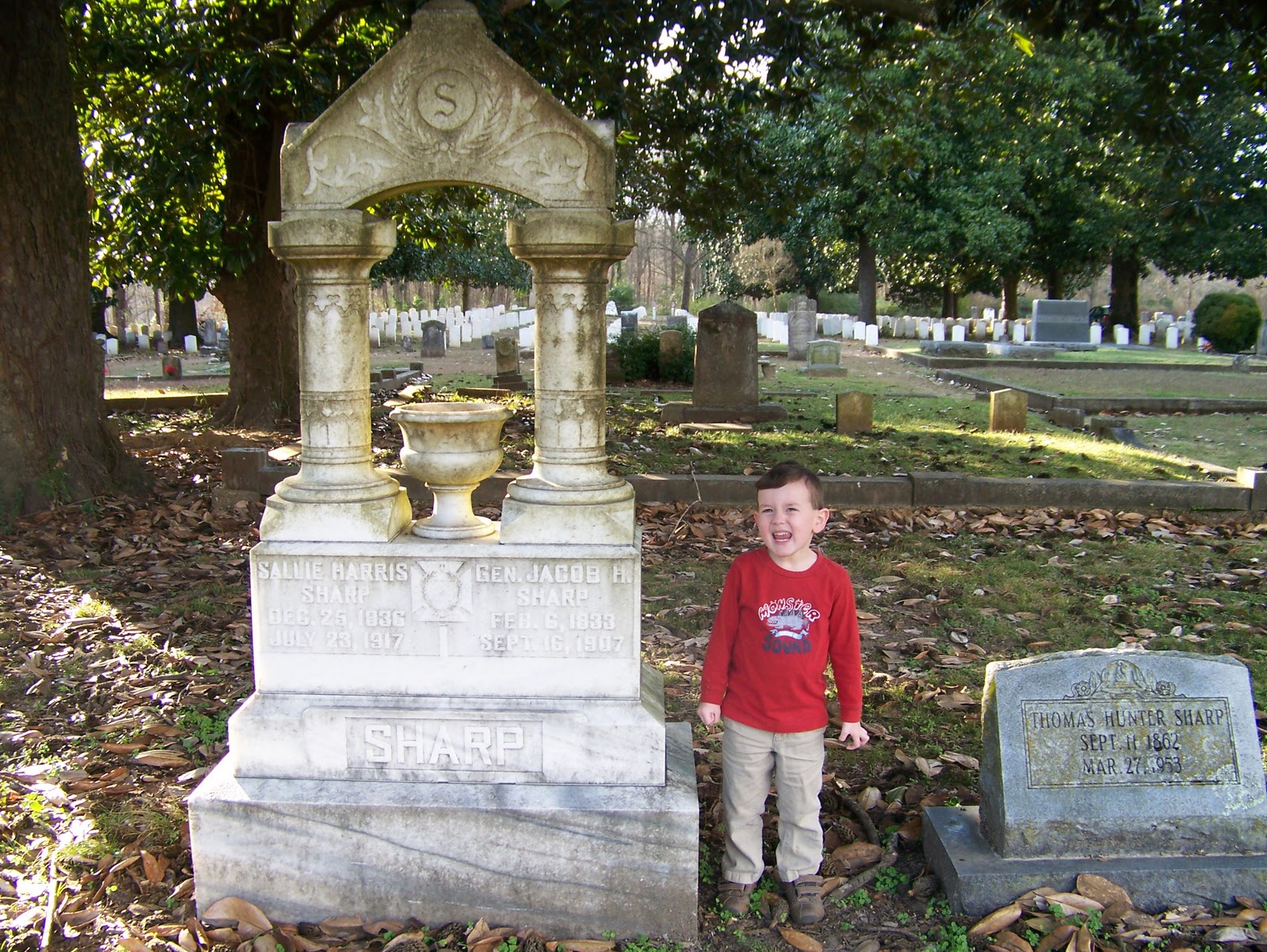

Timmy with General Sharp

       Brigadier General Jacob Hunter Sharp is also buried in this cemetery.  General Sharp led a brigade in the Army of Tennessee from Chickamauga to Bentonville.  


Me and Timmy with Phillip Roddey

       We arrived in Tuscaloosa only 30 minutes before sunset.  While I was frantically hunting the graves of Brigadier Generals George D. Johnston and Phillip D. Roddey Jerry was being entertained by two police officers attempting to arrest a man in a house next to the cemetery.  General Roddey was called 'the defender of the Tennessee Valley'.  


Timmy and I with Josiah Gorgas

       It was almost dark when we found the graves of Josiah Gorgas and S.A.M. Wood.  Wood was a native of Florence, Alabama.  He saw action from Shiloh to Chickamauga where he lost control of his brigade during a night fight and resigned.  One could throw a stone from these two officers graves and hit Bryant Denny Stadium.  It had been a great trip. We had gotten ten generals grave photos.  Any trip with Jerry that doesn't end with an arrest is a good trip.


Timmy in the cemetery with Bryant Denny Stadium in the back

Monday, January 2, 2012

A Mississippi Civil War Gasm


Me at the grave of Brigadier General Joseph L. Hogg

       Well, I finally had a day off without kids to baby sit and went on a mini-Civil War Gasm with my buddy Jerry in Mississippi. If you know Jerry, you know we had a blast. We have begun a hobby of visiting as many Confederate generals graves as possible and having our pictures taken with them. Our first stop was in Corinth, Mississippi at the museum located on the site of Battery Robinette where Confederate Brigadier General Joseph Lewis Hogg is buried. He didn't die in battle here, but from dysentery about three months after his promotion to brigadier general and without seeing any action whatsoever. Colonel William Peleg Rogers is also buried there, killed in the charge that overran the small earthen fort. He commanded a brigade in the action there and by all rights should have been a general officer. Despite the fact that a petition was signed begging President Davis to promote the man, he remained a colonel. The reason being that he and Davis had an argument during the Mexican War and Davis being the type person who held grudges would never forgive Rogers. 
       This brings us to the funny part of the story. Jerry and I wore our shell jackets on this trip. We were in a hurry because after all it was a Civil War Gasm. (Civil War Gasm definition is where you hit as many places as quickly as possible and we had places to go before dark.) We entered the museum to find the park ranger talking to a group of people. The entire group paused to watch us pass right by and out the back door of the museum at a high rate of speed. We exited the museum and walked around to the gate to find it locked. We then re-entered the museum by a side door and exited through another door out of sight of the ranger and group. We made each others picture beside General Hogg and Colonel Rogers graves, walked back around the building to Jerry's truck and left. It was only later that we decided that this is how ghost stories begin. We can just imagine someday reading about ourselves as the park ranger writes a book about the first sergeant and private that passed right through the museum and beyond a locked gate to be seen no more. 


Me at the grave of Colonel William Rogers one of my personal hero's.

       We left Corinth and headed southwest toward Ripley, Mississippi. About six miles beyond Ripley is a small town called Blue Mountain. Here in Blue Mountain Cemetery is the resting place of Brigadier General Mark Perrin Lowrey. His grave was easy enough to find, the cemetery not much more than an acre and his being the only one with an obelisk. General Lowrey was one of Patrick Cleburne's brigade commanders. He had fought in the Mexican War and returned home determined to become a preacher. Despite the fact that he couldn't read or write, he proceeded to accomplish his goal. His wife taught him reading and writing and he became a Baptist minister. He rose to the rank of general during the Civil War and following the war returned to the ministry and also founded a female college in Blue Mountain which later became Blue Mountain College. He died in the railroad depot in Middleton, Tennessee while awaiting a passenger train. 


Grave of Mark Perrin Lowrey

       Leaving Blue Mountain, Mississippi, Jerry called my attention to something I had never realized before. It seems the laws of mathematics cease to exist in this old southern state. We arrived at a sign that declared the intersection a four way stop. The problem was, we only counted three roads. One might think this was a simple accident, but we'll come back to this later. 
       We then drove west to Holly Springs, Mississippi where there are four generals buried in one cemetery. We arrived and entered the first cemetery entrance we came to. There on the right within twenty feet of the entrance we found the grave of Major General Edward Cary Walthall. If you know my luck, you'll know this was a complete accident. Walthall was the little known Confederate general that Forrest chose to help him fight the rear-guard for Hood during the retreat from Nashville. It would prove to be Walthall's best performance of the war. 


Major General Edward Cary Walthall

       We then got lucky and found the graves of Samuel Benton and Winfield Scott Featherston. Benton was only a colonel leading a brigade at the Battle of Atlanta when artillery shrapnel nearly tore his foot off and a piece lodged just inches from his heart. His foot would be amputated and his promotion to brigadier general would arrive from Richmond just two days before his death. The authorities in Richmond had not known he'd been wounded. 


Brigadier General Samuel Benton

       Brigadier General Winfield Scott Featherston began the war in the Virginia army and made a name for himself at the Battle of Ball's Bluff. From that point on he would serve as a capable officer but made no special name for himself. He would be shipped to the west where he would finish the war with the Army of Tennessee. His grave was as easy to find as Walthall's which was a good thing because it was about a ten degree windchill factor and I told Jerry that if a limb was to hit my ear, it would shatter like glass. 


Brigadier General Winfield Scott Featherston

       This brought us to the most difficult part of finding Brigadier General Daniel Chevilette Govan's grave. His marker is relatively flat without the enormous obelisks to mark the position. Jerry has a sixth sense or so he claims, sometimes it gets a bit off on him. He told me to check some markers about forty yards from the truck. I almost left my camera in the car because I don't trust Jerry's sixth sense, but I carried it along just in case. Lucky for me because, it did indeed turn out to be General Govan. This was truly our lucky day, my ears having lost all feeling along with my fingers, toes, and nose. Govan is the Arkansas brigadier who stood next to his close friend Patrick Cleburne at Franklin and said, "General, there won't be many of us to return home to Arkansas after this battle." Cleburne simply replied, "Well, Govan, if we are to die, let us die like men."


Brigadier General Daniel Govan

       It was at this point that Jerry's sixth sense began to get goofy or at least I think it did. He still claims he was right, but on that point I still remain dubious. He claimed he had an intuition that there was someone buried beneath a cedar tree he could see across the cemetery. He refused to leave the cemetery without investigating this mystery person. We drove across the cemetery to the cedar tree in question and sure enough, there was someone buried beneath the tree. I simply shook my head. Of course there was someone buried beneath the tree, it is a cemetery. He argues that he never said it was anyone buried there that had anything to do with the Civil War, he simply said there was someone buried there. 
       Leaving Holly Springs headed back home we again encountered a four way stop sign with only three roads. Jerry wanted to stop and take a picture of the intersection, but luckily he chose to pass on by this time. It was a typical Civil War Gasm for me. Out prowling the country with a fellow Civil War nut and we got photographs of us by six Confederate generals graves. I only wish I could do this everyday. 


Sunday, January 1, 2012

Vicksburg 1863 and Winston Groom


       I'm currently reading Vicksburg 1863 by Winston Groom and so far it has been an excellent read. I also have a copy of Shrouds of Glory by the same author. Shrouds of Glory deals with the Nashville Campaign and is also a descent read although I'm not in total agreement. Groom seems to agree with Hood's attack at Franklin. I can see Groom's point as well as Hood's reasoning behind the attack, but in hindsight one can't help but admit it was a horrible mistake. 
       At one point in Vicksburg 1863, Groom mentioned a rumor that a local potter had made chamber pots with pictures of notorious Federal General Benjamin Butler in the bottom. He goes on to admit that he hasn't found any evidence to support this. That is the reason I decided to post this blog. We'll get to that part later. 


Benjamin "Beast" or "Spoons" Butler

       Next to Abraham Lincoln, Benjamin Butler was possibly the most hated man in the Confederacy. When he arrived in New Orleans, a crippled veteran of the Mexican War named William Munford had torn the United States flag from the Federal mint. Butler charged Munford with treason and hanged him. Citizens who refused to sign the loyalty oath had their homes confiscated and used by his officers. His brother got rich off of steeling from the citizens of New Orleans which earned Butler the nickname "Spoons" for all the silverware he had stolen. 
       The most infamous thing Butler ever did was to issue an order that stated if any woman insulted or showed contempt toward a Union officer, she will be regarded as a woman of the town. Shock waves would be heard across the Atlantic from this proclamation. The way the order read, it sounded as if he was giving his men permission to rape southern women. Jefferson Davis branded Butler an outlaw and ordered if the man was captured to have him hanged on the spot. British prime minister Lord Palmerston declared that any Englishman should blush that Benjamin Butler was a member of the Anglo-Saxon race.


William Munford

       This brings us back to the statement Groom makes about the chamber pots. My wife noticed me smiling and asked me what I was reading. I told my wife I have actually seen these chamber pots. 


One of the chamber pots Mr. Groom can't find any evidence of.

Wednesday, December 28, 2011

Brother Against Brother, Part 2


Confederate Brigadier General James B. Terrill


Federal Brigadier General William R. Terrill

       Two more brothers who served as general's during the Civil War on opposite sides were James and William Terrill. Unlike the McIntosh brothers, both of the Terrill brothers would die fighting during the war. William was born in 1834 and obtained an appointment to the United States Military Academy. He would rise to the rank of brigadier general and be mortally wounded by artillery fire at the Battle of Perryville. His younger brother James was born in 1838 and attended the Virginia Military Institute. Unlike William, he didn't make the military his career, but instead became an attorney. When the war began, James and another brother named Phillip joined the Confederate army. Phillip was a private and was killed at the Battle of Cedar Creek. James who rose to the rank of brigadier general was killed at Bethesda Church by a Federal sharpshooter. He was buried by the Federals on the field and his grave has been lost to history.
        After the war, their father erected a monument to the memory of the Terrill brothers which read, 'This monument erected by their father. God alone knows which was right.'


Confederate Major General George B. Crittenden


Federal Major General Thomas L. Crittenden

       George Crittenden was born in 1812 and his younger brother Thomas was born in 1819. George graduated from the United States Military Academy and became a career soldier. He saw action in the Black Hawk War and Mexican War. The Crittenden family were close friends with the Davis family, both from Kentucky. George decided to join the Confederate army under his close friend Jefferson Davis. He commanded the troops at Mill Springs during the defeat there. Rumors soon circulated that he had been intoxicated while on duty. A courts-martial was convened and Crittenden was cashiered from the army. Thomas became a lawyer and joined the army to fight during the Mexican War. He rejoined the army when the Civil War began and rose to the rank of major general before resigning in 1864. 


Confederate Brigadier General John R. Cooke


Federal Brigadier General Phillip St. George Cooke

       In an even rarer incident, there were a pair of general's who fought on opposite sides who were father against son. Virginia born Federal cavalry commander Phillip Cooke remained loyal to the Union when the Civil War began. His Harvard educated son John Rogers Cooke would resign his commission and enter the Confederate army. John's sister Flora Cooke had married a Virginian named James Ewell Brown Stuart, otherwise known as Jeb. When the war began Stuart would see action on the Peninsula in Virginia against his father-in-law Phillip. Stuart once said that his father-in-law would regret his decision for fighting against his home state but once and that would be eternally. 
       Bother Cooke's would survive the war, but Stuart would be mortally wounded at Yellow Tavern in 1864. The senior Cooke would outlive his son by four years dying in 1895. These are just a few of the many close relatives in the officer ranks during the war. There were many cousins who fought against each other in that war also. Abraham Buford and John Buford, both served in the cavalry service. Robert E. Lee's second cousin was Samuel P. Lee who was a rear admiral in the United States Navy and in charge of the North Atlantic Blockading Squadron.  There were probably few families who weren't affected by relatives fighting relatives during the Civil War. 


Sunday, December 25, 2011

Brother Against Brother, Part 1


Confederate Brigadier General James M. McIntosh

       Most everyone has heard stories about the Civil War being a war where brothers often fought one another. Few realize that this also occurred among the generals who fought. James McQueen McIntosh was born in 1828 in Florida while his father was stationed there in the U.S. Army. A year later, while still at that post James little brother John Baillie McIntosh would be born. Their father would be killed during the Mexican War. 
       James would miss the Mexican War while attending West Point. There he proved to be a very poor student. He cared very little for the classroom and like fellow Confederate General George Pickett, he would finish dead last in his class. His brother John wouldn't attend West Point, but served in the Navy as a midshipman during the Mexican War. 


Union Brigadier General John B. McIntosh

       When the Civil War began, James resigned his commission and became colonel of the Second Arkansas Mounted Rifles. He saw action at Wilson's Creek where he proved to be a daring cavalry commander. He was famous for his fearlessness in battle and his colorful language. Leading his men in desperate charges would prove his undoing. 
       He would receive a promotion to brigadier general for his actions in routing a numerically superior force. His first major battle following that promotion would prove to be his last. At the Battle of Pea Ridge after seeing his friend and commander Benjamin McCulloch killed. He charged forward in an attempt to recover the mans body and be shot through the heart. They would carry the high-strung officer back to the National Cemetery in Fort Smith, Arkansas where he rests today. James McIntosh was either 33 or 34 years old. His exact birth date has been lost to history. 


McCulloch and McIntosh were both killed in the treeline across the field

       When the war began, James's brother John was working in business in New Jersey. Like James, John would spend the war serving in the cavalry. He was with McClellan's army during the Seven Days. He served well during the  Battle of Chancellorsville. He led an attack against J.E.B. Stuart's cavalry at Gettysburg. His next action would be over a year later at the Battle of Winchester where he would lose a leg. 
       Following the war, John would return to New Jersey and die there in 1888 at the age of 59. He is buried in Elmwood Cemetery, New Brunswick, New Jersey. It makes you wonder how two brothers so close in age could ever consider fighting a war on opposite sides. 


James grave in Arkansas


John's grave in New Jersey


Thursday, December 1, 2011

The Jennie Wade Story by Cindy L. Small


The Jennie Wade Story by Cindy L. Small claims to be a true account of the only civilian killed during the Battle of Gettysburg.  Although attempts were made to smear her reputation by the famous John Burns,Cindy Small manages to dig up all known evidence and set the record straight.  When you finish this book you will understand that Jennie Wade was indeed baking bread for Union soldiers when she was killed.  Contrary to the way John Burns described Jennie Wade as a lady of loose character.  In truth John Burns attempted to smear Jennie's reputation because he despised having to share his fame with anyone else.  


Although the book is only 71 pages long Mrs. Small does an excellent job covering everything that is known about Jennie's life.  She stops just short of a forensic investigation, describing where the bullet was thought to have come from and the path the bullet took as it struck her in the back after passing through two doors.  The bullet was ranging upwards, passed through her heart and spent its force stopping inside her corset.  All eyewitness accounts claim that Jennie died making bread for union soldiers.  Cindy Small says that Jennie was buried with the dough still on her hands.  


Actual dough tray Jennie was using

Cindy Small goes into the details of Jennie's fiance Jack Skelly, the message he gave to Wesley Culp when he was mortally wounded in Virginia.  Wesley Culp went to school with Jennie and Jack, born and raised in Gettysburg, he had moved to Virginia prior to the war and remained loyal to the South.  Wesley would be killed on his cousins farm before he could deliver any message.  The amazing part of this story is that none of the three childhood friends knew the fate of their classmates.  Cindy Small's book lists for less than six dollars but it is worth every penny.  

Monday, November 14, 2011

A Crisis In Confederate Command


General Edmund Kirby Smith
 On a recent Civil Wargasam my wife bought me the book, The Red River Campaign, edited by Savas, Woodbury, and Joiner.  Reading this small book of only 130 pages reminded me of another book I have read on the subject.  A few years ago I read, A Crisis In Confederate Command by Jeffery Prushankin.  This book went into the disagreement between Confederate General Edwin Kirby Smith and Major General Richard Taylor.  

 The disagreement between Smith and Taylor had more to do with strategy than anything.  Richard Taylor had commanded a Louisiana brigade during the early part of the war under Stonewall Jackson in Virginia.  He had studied closely what Stonewall had accomplished.  He was extremely aggressive like Stonewall and believed that once you had your enemy against the ropes you went in for the kill.  

Major General Richard Taylor

Edmond Kirby Smith was the total opposite of Richard Taylor.  Kirby Smith's generalship has been compared to that of Joseph E. Johnston.  Instead, Kirby Smith's idea on strategy closely resembled that of Confederate President Jefferson Davis.  Smith believed in spreading his forces out and defending every foot of his military district.  Richard Taylor believed in concentrating his forces and hitting a small part of the enemy at a time.  

When Federal Major General Nathaniel Banks began his campaign up the Red River, Richard Taylor only had 6,000 men present.  Banks army numbered 28,000 men.  Taylor was forced to retreat because he didn't have enough troops to stop Banks.  Taylor begged Smith to reinforce him with troops from Arkansas.  Smith was worried about Federal General Steele's forces in Arkansas and was afraid to commit too many men.  He finally reinforced Taylor with 1,800 men, bringing his total to 8,800 men.  In true Stonewall Jackson fashion, Richard Taylor caught Banks army strung out on the road and hit him at a place called Mansfield.  Although his attack was disjointed, he managed to defeat Banks.  At a high cost in officers, Taylor lost 1000 men while Banks lost 2,235 men.  For Banks, the Red River Campaign  was over.  He immediately began to retreat.  

They would fight again the next day  at Pleasant Hill in an indecisive battle.  Banks army then escaped unmolested.  Taylor blamed General Edmond Kirby Smith for not reinforcing him with enough troops to destroy Banks.  Taylor was awarded with a promotion to lieutenant general for his actions in the campaign.  Unfortunately, he had lost Brigadier General Alfred Mouton, Brigadier General Thomas Green, Brigadier General William R. Scurry, and Horace Randall.

Brigadier General Thomas Green

Brigadier General Alfred Mouton


Colonel Horace Randall

Brigadier General William R. Scurry

I have always wondered what these two men could have accomplished if they had worked together instead of bickering with each other more than they did the enemy.  For more on the subject I recommend reading Prushankins A Crisis in Confederate Command.